This post was created with help from AI tools and carefully reviewed by a human (Muntaseer Rahman) . For more on how we use AI on this site, check out our Editorial Policy.
Check Out These FREE Tools We Made JUST For You!
19 Types Of Pet Frogs You Can Keep At Home (2026 Guide)
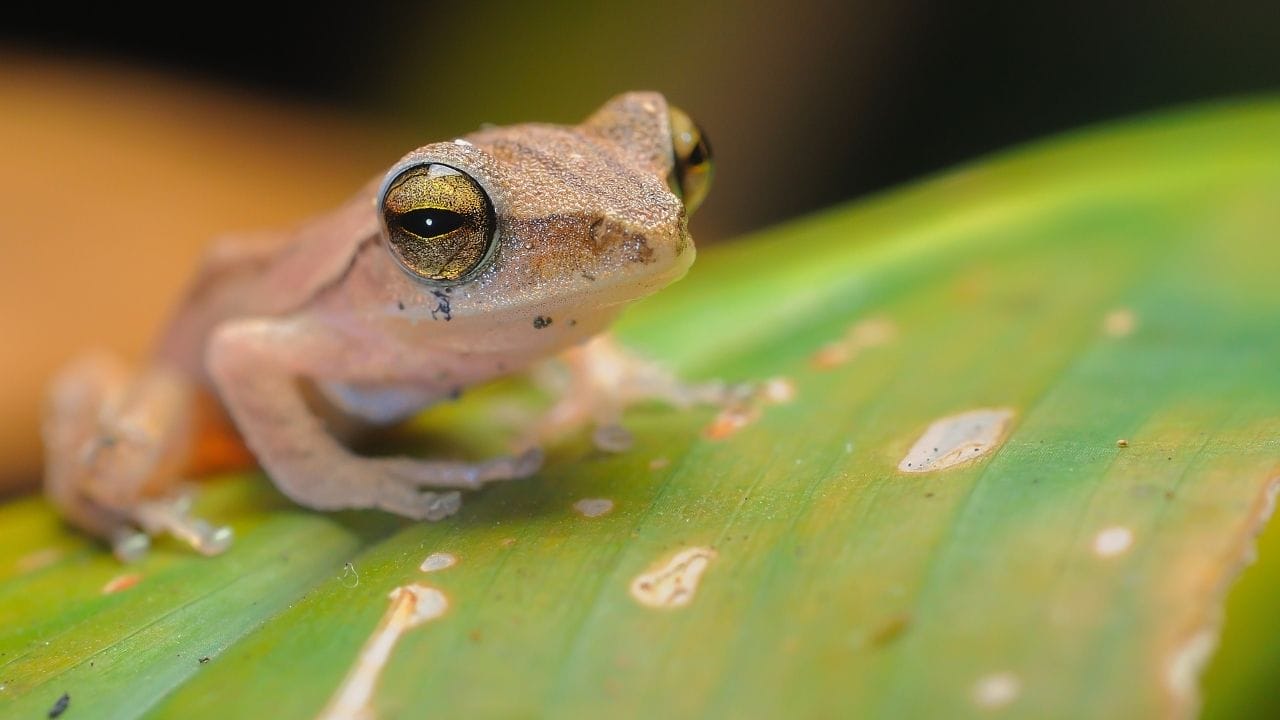
Most “types of pet frogs” lists are just 19 photos with a price tag under each one. Nobody tells you that one of these frogs is illegal in eleven states, that another one lives longer than your car loan, or that the cute little aquatic ones once caused a 42-state Salmonella outbreak.
So this is that list, but honest.
I’ve gone through the 19 frogs people actually buy, with the tank size each one really needs, what it costs in 2026, how long it will be alive in your living room, and whether a first-time keeper should touch it at all.
Fair warning up front: frogs are watching pets, not holding pets. If you want something that greets you at the door, get a dog. If you want a tiny weird animal that eats crickets in the dark and lives twenty years, keep reading.
The Quick Answer: Which Frog Should You Actually Get?
If you have never kept an amphibian, get a White’s tree frog or a Pacman frog. That’s it. That’s the whole answer.
Both are hardy, both forgive a bad week of humidity, both are captive bred everywhere, and both cost under $80 to buy.
Here’s how the rest of the list stacks up.
| Difficulty | Frogs | Why |
|---|---|---|
| Beginner | White’s tree frog, Pacman frog, American green tree frog, African dwarf frog, oriental fire-bellied toad, Burmese chubby frog | Forgiving of temp and humidity swings, cheap, widely captive bred |
| Intermediate | African bullfrog, tomato frog, Amazon milk frog, white-lipped tree frog, Vietnamese mossy frog, red-eyed tree frog | Need tighter humidity, bigger enclosures, or have bite/size surprises |
| Advanced | Bumblebee dart frog, green and black dart frog, golden mantella, waxy monkey frog, Budgett’s frog, gray tree frog, African clawed frog | Fruit fly cultures, misting systems, aggression, legal restrictions, or wild-caught stock |
Now the full list.
1. White’s Tree Frog
| Scientific name | Litoria caerulea |
| Adult size | 3 to 4.5 inches |
| Minimum tank | 18 x 18 x 24 inches (vertical) |
| Temperature | 75 to 85°F day, down to 70°F night |
| Humidity | 50 to 70% |
| Diet | Insects (crickets, roaches, hornworms) |
| Price | $40 to $120 |
| Lifespan | 16 to 21 years |
| Care level | Easy |
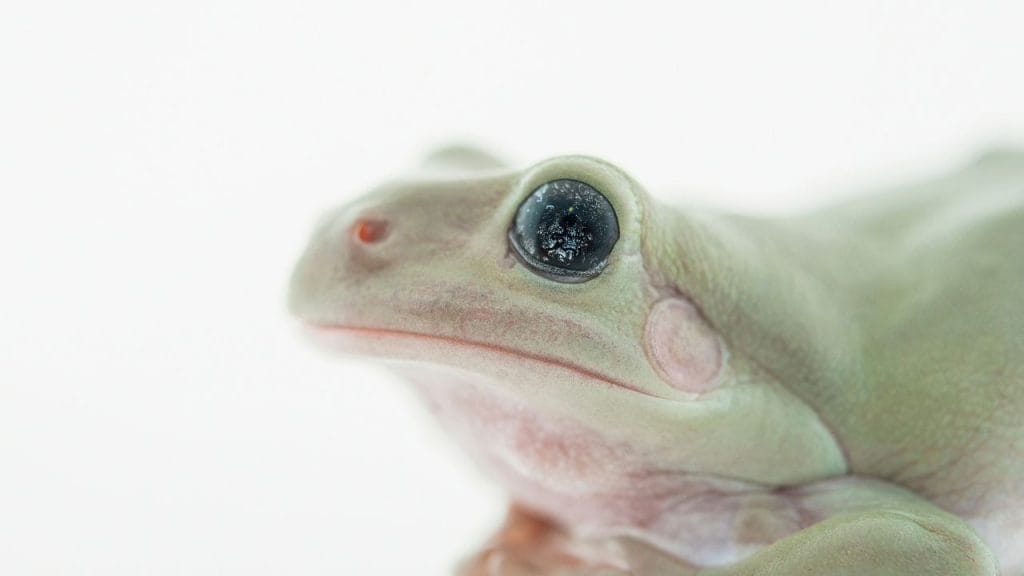
This is the frog to start with, full stop. White’s tree frogs look like a green stress ball that fell asleep on a branch, and they are almost impossible to kill by accident.
They tolerate temperature swings that would wreck a red-eyed tree frog. They eat anything that moves. They sit still enough that you can actually enjoy looking at them.
They also tolerate brief, gentle handling better than nearly any other frog, which is rare. Rinse your hands with plain dechlorinated water first, no soap, and keep it under a minute.
The one real risk is obesity. These frogs will eat until they look like a golf ball with legs, and fat rolls over the eardrum are a sign you’re overfeeding. Adults only need food two or three times a week.
Twenty-one years is a long time. Take that number seriously before you buy.
2. Pacman Frog
| Scientific name | Ceratophrys spp. |
| Adult size | 4 to 7 inches (females larger) |
| Minimum tank | 12 x 12 x 12 inches, floor space matters more than height |
| Temperature | 75 to 85°F |
| Humidity | 60 to 80% |
| Diet | Insects, the occasional pinky mouse for adults |
| Price | $25 to $90 depending on morph |
| Lifespan | 10 to 15 years |
| Care level | Easy |
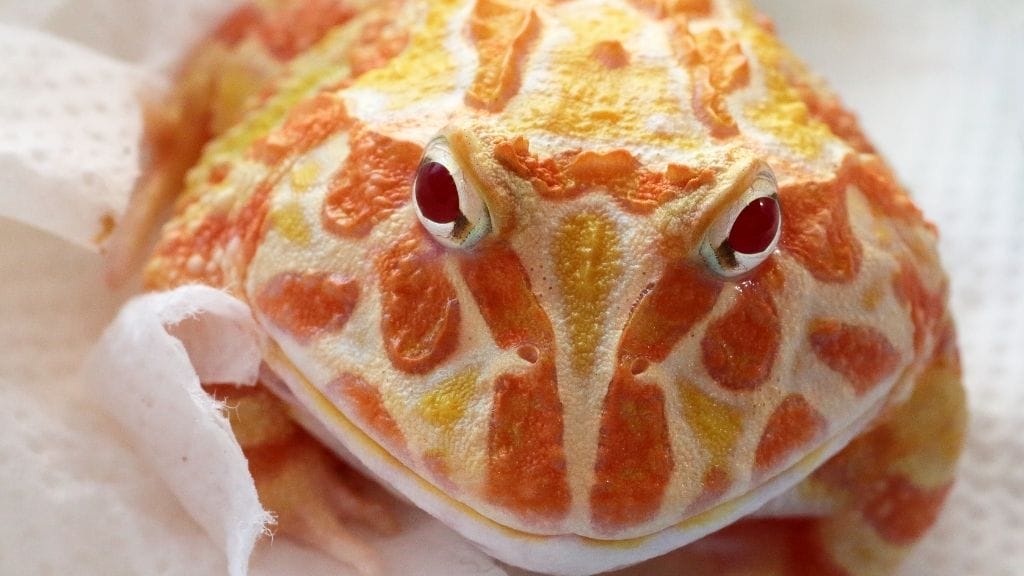
A Pacman frog is basically a mouth with a body attached. It sits in one spot, buried up to its eyeballs, waiting for something to walk past.
That laziness is exactly why they’re great beginner pets. No climbing, no escaping, no elaborate branch layout. Give them four inches of moist substrate to burrow into and they’re happy.
They come in a pile of colors too, and the Pacman frog morphs guide covers which ones cost what. If yours vanishes under the dirt for days, that’s normal, and there’s a whole post on why they burrow.
Two warnings. First, they bite, and for a frog it’s a genuinely strong bite. Second, people overfeed them constantly. An adult Pacman needs food every 5 to 7 days, not daily.
3. African Dwarf Frog
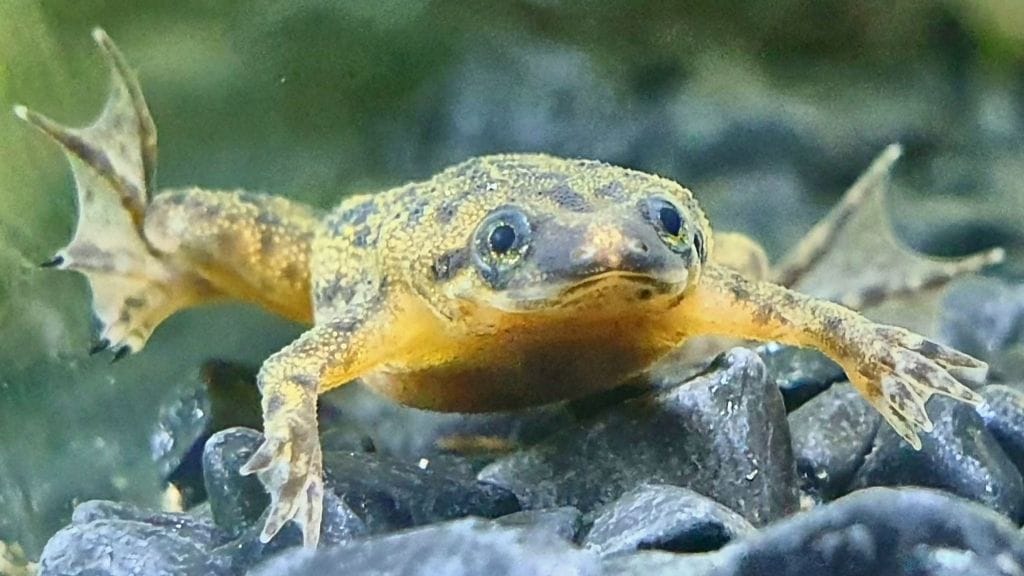
| Scientific name | Hymenochirus boettgeri |
| Adult size | 1 to 1.5 inches |
| Minimum tank | 10 gallons for a group of 3 |
| Temperature | 72 to 78°F |
| Humidity | Fully aquatic |
| Diet | Frozen bloodworms, sinking pellets, brine shrimp |
| Price | $4 to $10 each |
| Lifespan | 5 years |
| Care level | Easy, but water quality matters |
The cheapest frog on this list and the one most often kept wrong. People buy three, drop them in an unfiltered bowl, and wonder why they’re dead in a month.
They are fully aquatic. That means a cycled, filtered, heated tank with a proper water conditioner (what I use every water change), same as you’d give a fish. They cannot survive in a bowl of tap water.
They’re social, so keep at least three. They also can’t compete for food with fast fish, so pick tank mates carefully and target-feed with a turkey baster.
Here’s the part nobody prints: between 2009 and 2011, African dwarf frogs from a single California breeder caused a Salmonella outbreak that hit 376 people across 42 states, with 69% of cases in children under 10 and 30% hospitalized. Wash your hands after tank maintenance, every single time, and keep small kids away from the water.
They also love to try climbing out. Keep a lid on, and read why they jump out if yours is doing it.
4. African Clawed Frog

| Scientific name | Xenopus laevis |
| Adult size | 4 to 5 inches |
| Minimum tank | 20 gallons for one |
| Temperature | 68 to 77°F |
| Humidity | Fully aquatic |
| Diet | Omnivore, pellets, worms, anything it can grab |
| Price | $10 to $30 |
| Lifespan | 15 to 25 years |
| Care level | Easy care, hard legality |
Check your state law before you read another word. African clawed frogs are illegal to own without a permit in Arizona, California, Hawaii, Kentucky, Louisiana, Nevada, New Jersey, North Carolina, Oregon, Virginia, and Washington. In Nevada, knowingly keeping one can mean up to six months in jail and a $500 fine.
The reason is that released pets have set up wild breeding populations in California, Arizona, and Virginia, and they carry chytrid fungus that wipes out native frogs. Never, ever release one.
If it’s legal where you live, they’re genuinely easy. Room temperature water, a filter, and food. They live two decades.
They are also little vacuum cleaners with an eating disorder. Anything smaller than their mouth is food, which is why the honest answer on African clawed frog tank mates is “another clawed frog.” The full care guide covers the rest.
Do not confuse these with African dwarf frogs. Clawed frogs have unwebbed front feet with claws and no webbing between the front toes. Dwarf frogs are tiny and fully webbed on all four feet.
5. Red-Eyed Tree Frog

| Scientific name | Agalychnis callidryas |
| Adult size | 2 to 3 inches |
| Minimum tank | 18 x 18 x 24 inches, planted |
| Temperature | 75 to 82°F day, 66 to 72°F night |
| Humidity | 70 to 90% |
| Diet | Small crickets, flies, roach nymphs |
| Price | $50 to $90 |
| Lifespan | 5 to 10 years |
| Care level | Moderate |
The poster frog for the entire hobby. Neon green body, orange feet, those enormous red eyes.
And then you get it home and it sleeps glued to a leaf all day with its eyes shut, looking like a green blob. These are strictly nocturnal, and if you want a frog to watch at 6pm, this isn’t it.
They need a tall, heavily planted enclosure with a real night temperature drop and humidity in the 70s or higher. That usually means a fogger or a misting system, not a hand spray twice a day.
They’re also delicate. Don’t handle red-eyed tree frogs, they stress easily and their skin is thin. Beautiful, but this is a step up from a White’s.
6. Gray Tree Frog

| Scientific name | Dryophytes versicolor |
| Adult size | 1.5 to 2.5 inches |
| Minimum tank | 12 x 12 x 18 inches |
| Temperature | 68 to 80°F, tolerates a cool winter |
| Humidity | 50 to 70% |
| Diet | Crickets, moths, small roaches |
| Price | $15 to $40 |
| Lifespan | 7 to 9 years |
| Care level | Moderate |
A native North American frog that changes color from gray to green depending on mood and temperature. Genuinely cool to watch.
Two things to know. Their skin secretions are irritating, not deadly, but they will burn if you rub your eyes afterward. Wash your hands.
Second, most gray tree frogs sold are wild caught, and wild caught frogs come with parasites and stress. Ask the seller directly. If they can’t tell you it’s captive bred, look elsewhere.
Also check your state law here. In many places, collecting native amphibians from the wild needs a fishing or collecting license, or is flat out banned.
7. American Green Tree Frog
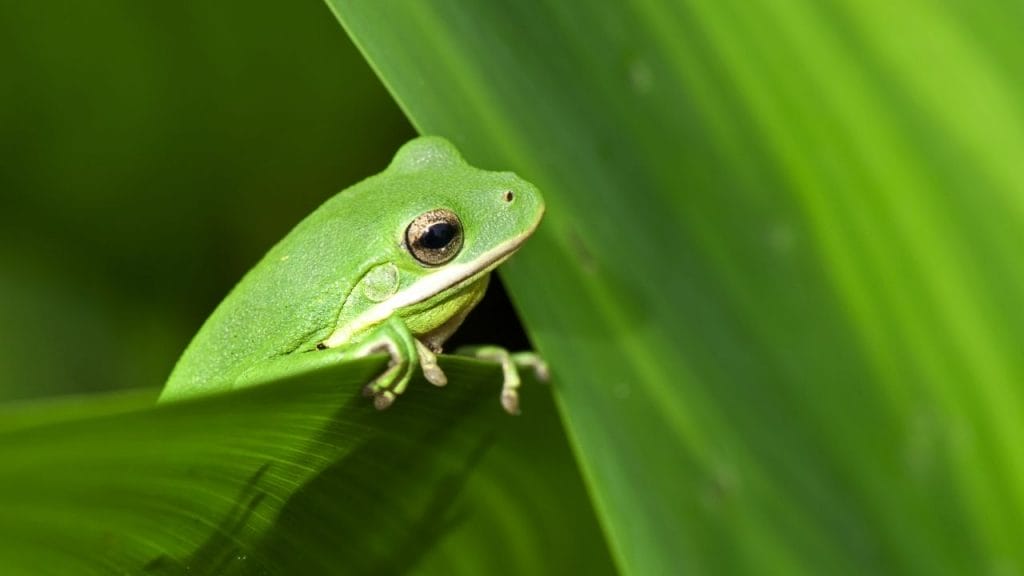
| Scientific name | Hyla cinerea |
| Adult size | 1.5 to 2.5 inches |
| Minimum tank | 12 x 12 x 18 inches for two |
| Temperature | 70 to 82°F |
| Humidity | 50 to 70% |
| Diet | Crickets, flies, small worms |
| Price | $10 to $30 |
| Lifespan | 5 to 6 years |
| Care level | Easy |
The cheap, underrated beginner frog. Bright apple green with a white racing stripe down each side.
They’re small, they’re social enough to keep in groups of two or three, and they don’t need anything exotic. A vertical 12x12x18 with fake vines and a water dish covers it.
The catch is noise. Males call, and a green tree frog call is loud enough to wake you up. If your enclosure lives in your bedroom, you’re going to hear about it in spring.
Same wild-caught warning as the gray tree frog. Buy captive bred.
8. African Bullfrog
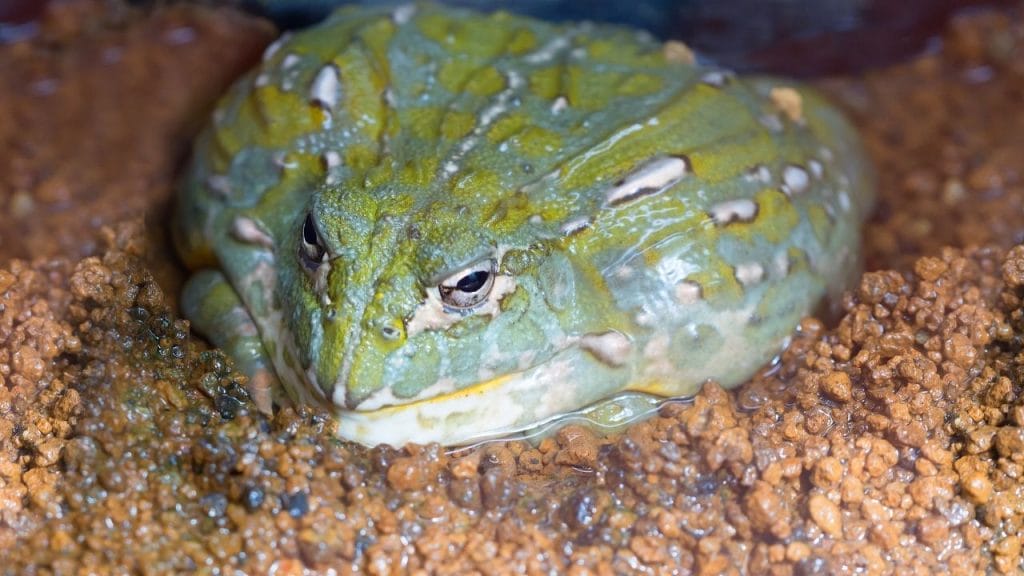
| Scientific name | Pyxicephalus adspersus |
| Adult size | 6 to 9.5 inches, males much bigger |
| Minimum tank | 36 x 18 inches of floor space for an adult male |
| Temperature | 75 to 85°F |
| Humidity | 50 to 70% |
| Diet | Carnivore, insects, worms, occasional rodents |
| Price | $30 to $90 |
| Lifespan | 20 to 35 years |
| Care level | Easy care, huge commitment |
Pixie frogs are sold as adorable little green marbles the size of a quarter. Two years later you have a bad-tempered dinner plate that can live longer than a horse.
They’re easy to care for, honestly. Substrate, warmth, food, done. The problem is scale. A male African bullfrog can pass 2 pounds and needs a 40-gallon breeder tank minimum.
And they bite. There’s real research measuring bite force in this species, and juveniles alone hit around 30 newtons. Adults are considerably worse. Feed with long tongs, not fingers. Our post on why frogs bite goes deeper.
Great pet. Just understand you’re signing up for thirty years.
9. Burmese Chubby Frog

| Scientific name | Kaloula pulchra |
| Adult size | 2 to 3 inches |
| Minimum tank | 12 x 12 x 12 inches |
| Temperature | 75 to 85°F |
| Humidity | 60 to 80% |
| Diet | Small insects, termites, crickets, ants |
| Price | $15 to $40 |
| Lifespan | 10+ years |
| Care level | Easy |
Also sold as the banded bullfrog or “chubby frog,” which is exactly what it looks like. Round brown body with cream stripes and a permanently unimpressed face.
They burrow, they’re nocturnal, and they’re extremely low maintenance. Good beginner frog that almost nobody recommends.
Two quirks. They have small mouths, so feeder insects need to be small. And when startled they secrete a sticky white glue that is genuinely unpleasant to get off your hands.
Most in the trade are still wild caught imports, so quarantine and a vet fecal check are worth the money here.
10. Bumblebee Dart Frog
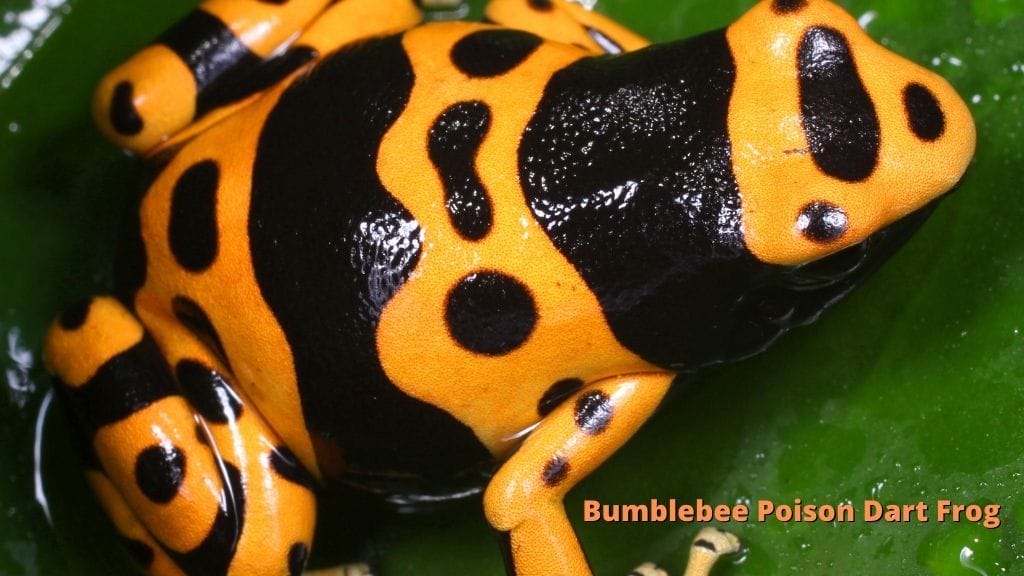
| Scientific name | Dendrobates leucomelas |
| Adult size | 1.25 to 1.5 inches |
| Minimum tank | 18 x 18 x 18 inches for a trio |
| Temperature | 72 to 80°F, never above 85°F |
| Humidity | 80 to 100% |
| Diet | Fruit flies, springtails, isopods |
| Price | $60 to $120 |
| Lifespan | 10 to 20 years |
| Care level | Advanced setup, easy once running |
Yellow and black, bold, active during the day, and one of the few frogs on this list you’ll actually see doing things at noon.
Here’s the thing everyone gets wrong: captive-bred dart frogs are not poisonous. They don’t make their own toxins. In the wild they sequester alkaloids from mites, ants, and beetles they eat. Feed one fruit flies its whole life and it never becomes toxic, permanently.
So the danger isn’t the frog. The danger is the setup. Dart frogs need a bioactive planted vivarium, high humidity that never crashes, and a live fruit fly culture you maintain every two weeks forever. Miss a culture and your frogs starve, because they won’t eat crickets.
If you like building terrariums, this is the best pet on the list. If you don’t, skip it. We compare the tradeoffs in dart frogs as pets.
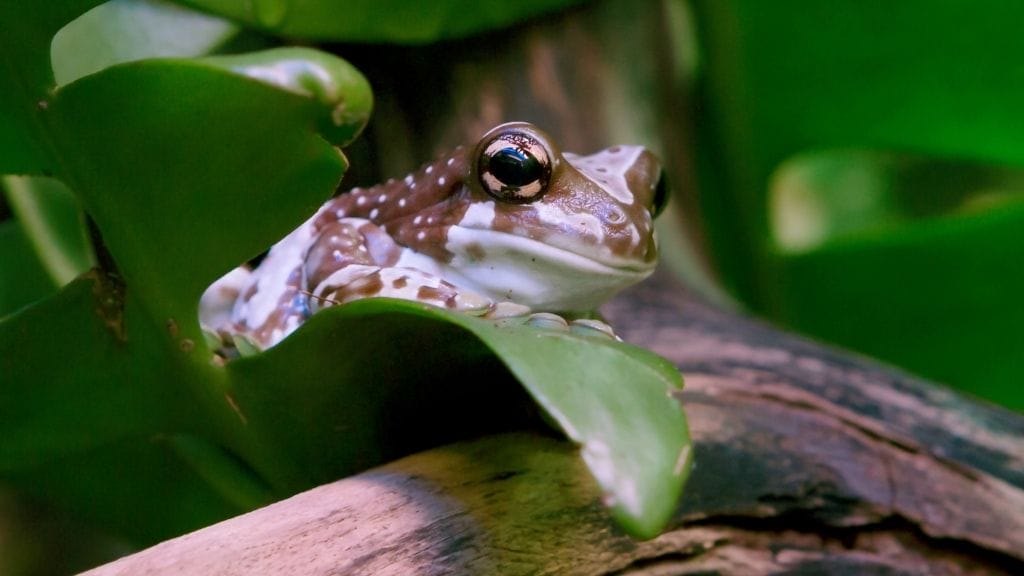
11. Amazon Milk Frog
| Scientific name | Trachycephalus resinifictrix |
| Adult size | 2.5 to 4 inches |
| Minimum tank | 18 x 18 x 24 inches |
| Temperature | 75 to 85°F |
| Humidity | 60 to 80% |
| Diet | Crickets, roaches, hornworms |
| Price | $50 to $90 |
| Lifespan | 8 to 12 years |
| Care level | Moderate |
Gray-blue with dark brown banding and huge cartoon eyes. They look like a frog designed by someone who really liked marble countertops.
They’re chunkier and hardier than red-eyed tree frogs, which makes them a good “second frog” if a White’s felt too easy. They also do well in groups.
The name comes from the milky white secretion they release when stressed. It’s sticky and mildly irritating, not dangerous. Full details are in our Amazon milk frog care guide.
They need real height and thick branches. In the wild they live in water-filled tree holes, so a deep water dish up off the floor is a nice touch.
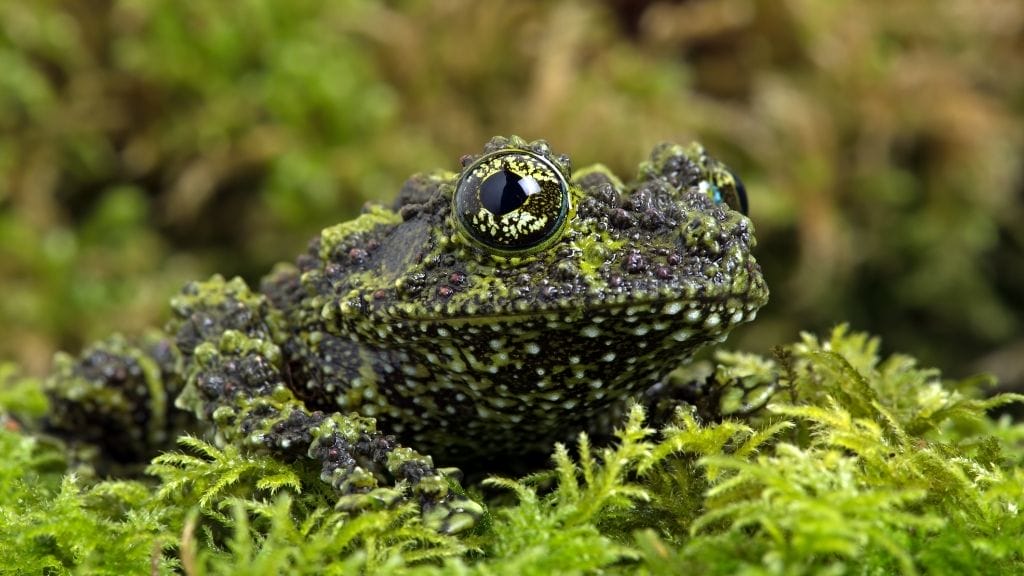
12. Vietnamese Mossy Frog
| Scientific name | Theloderma corticale |
| Adult size | 2.5 to 3.5 inches |
| Minimum tank | 18 x 18 x 18 inches, half water |
| Temperature | 65 to 75°F, cool room preferred |
| Humidity | 80 to 100% |
| Diet | Crickets, roaches, worms |
| Price | $60 to $120 |
| Lifespan | 10 to 15 years |
| Care level | Moderate |
Looks exactly like a clump of wet moss with eyes. When threatened it curls into a ball and plays dead, which is the single funniest defensive strategy in the hobby.
They’re semi-aquatic, so the enclosure is half land and half water, with the water kept clean. They’re also one of the few frogs that prefer cooler temps, which makes them easy if your house runs cold and hard if it runs hot.
They hide constantly. Expect to spend money on a frog you then can’t find. Our Vietnamese mossy frog care guide covers the water side properly.
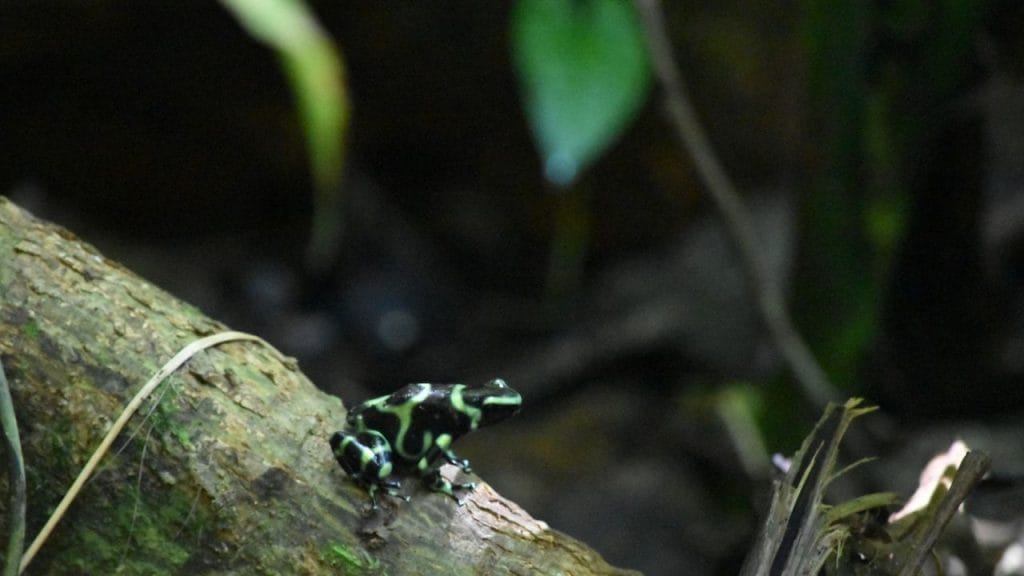
13. Green And Black Dart Frog
| Scientific name | Dendrobates auratus |
| Adult size | 1 to 1.5 inches |
| Minimum tank | 18 x 18 x 18 inches for two or three |
| Temperature | 72 to 80°F |
| Humidity | 80 to 100% |
| Diet | Fruit flies, springtails, isopods |
| Price | $50 to $100 |
| Lifespan | 10 to 15 years |
| Care level | Advanced setup |
The other beginner dart frog, and arguably the better first choice than bumblebees because they’re a bit shyer but very hardy.
They come in a stack of locality morphs: Costa Rican green, blue and bronze, El Cope, Pena Blanca. Same care across the board.
Everything from the bumblebee section applies here. Bioactive vivarium, fruit fly cultures forever, captive bred means non-toxic. If you want to build a mixed tank, read what can live with dart frogs first, because the answer is “less than you’d hope.”
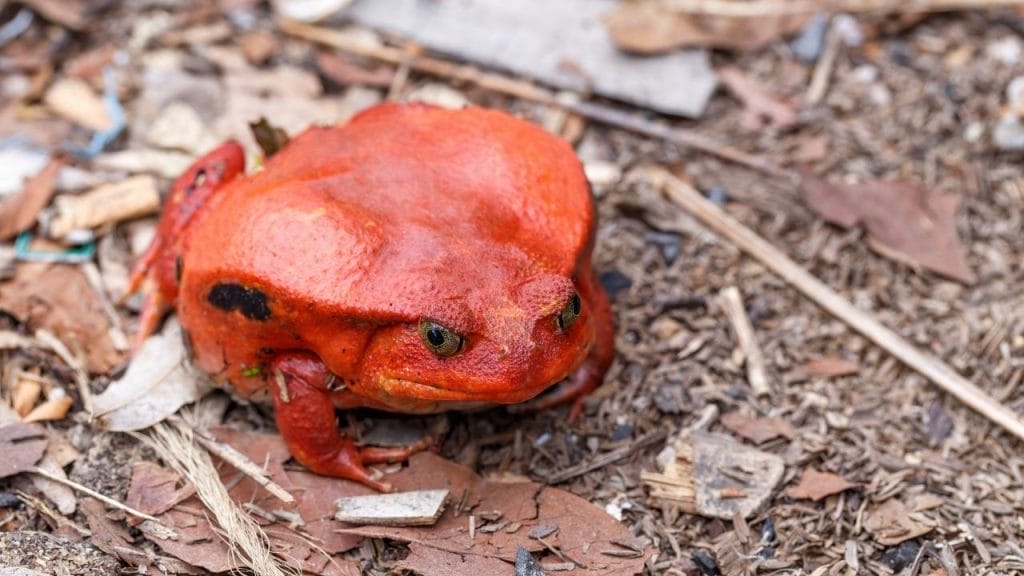
14. Tomato Frog
| Scientific name | Dyscophus guineti (the one you can buy) |
| Adult size | 2.5 to 4 inches, females much larger |
| Minimum tank | 18 x 18 x 12 inches |
| Temperature | 70 to 80°F |
| Humidity | 60 to 80% |
| Diet | Crickets, roaches, worms |
| Price | $30 to $70 |
| Lifespan | 6 to 10 years |
| Care level | Easy to moderate |
A fat orange-red frog from Madagascar that looks like someone dropped a tomato in the dirt and it grew legs.
Important detail every list gets wrong: the famous bright red Dyscophus antongilii is CITES Appendix I and essentially not available in the pet trade. The frog you’ll actually buy is the false tomato frog, Dyscophus guineti, which is a duller orange and perfectly legal. If a seller lists antongilii, ask questions.
They’re burrowers, so give them deep substrate. When stressed they puff up and secrete a sticky white goo that can irritate skin and eyes. Minimal handling.
15. Waxy Monkey Frog

| Scientific name | Phyllomedusa sauvagii |
| Adult size | 2.5 to 4 inches |
| Minimum tank | 18 x 18 x 24 inches |
| Temperature | 80 to 90°F day, basking spot needed |
| Humidity | 40 to 60%, low for a frog |
| Diet | Crickets, roaches |
| Price | $60 to $150 |
| Lifespan | 8 to 12 years |
| Care level | Advanced |
The weirdest frog here. It walks hand over hand like a tiny green sloth instead of hopping, and it waterproofs itself by wiping a waxy secretion over its own body with its feet.
That waxy coat means it comes from dry scrubland, not rainforest. So this is the one frog that wants a basking bulb, low humidity, and UVB while everything else on this list wants damp and shade.
Get that backwards and it dies. Which is exactly why beginners shouldn’t start here despite how easy the care sheets make it sound.
16. White-Lipped Tree Frog

| Scientific name | Litoria infrafrenata |
| Adult size | 4 to 5.5 inches |
| Minimum tank | 24 x 18 x 36 inches |
| Temperature | 75 to 85°F |
| Humidity | 60 to 80% |
| Diet | Crickets, roaches, hornworms |
| Price | $40 to $100 |
| Lifespan | 10 to 15 years |
| Care level | Moderate |
The largest tree frog in the world, and the giveaway is the bright white stripe along the lower lip. They’re bigger, longer-legged, and far more athletic than a White’s tree frog.
That athleticism is the whole story. These frogs launch themselves. A tank that holds a White’s comfortably is a jumping hazard for a white-lipped, and they need serious vertical space plus a secure lid.
They also call loudly at night, a barking sound people describe as a small dog. Not a bedroom pet.
17. Budgett’s Frog

| Scientific name | Lepidobatrachus laevis |
| Adult size | 3.5 to 5 inches |
| Minimum tank | 20 gallon long, mostly shallow water |
| Temperature | 75 to 85°F |
| Humidity | Semi-aquatic |
| Diet | Carnivore, fish, worms, roaches |
| Price | $70 to $150 |
| Lifespan | 15 to 20 years |
| Care level | Advanced |
Also called the Freddy Krueger frog or the hippo frog. It’s a flat gray pancake with eyes on top and an enormous mouth, and when it’s angry it stands up on its legs, inflates, and screams at you.
Yes, screams. It’s a real sound and it’s genuinely startling.
They live in shallow water with a land option and eat like they’re being timed. They also have two bony fang-like projections in the lower jaw and they will absolutely use them. Tongs only.
Keep them alone. Housed together, they eat each other.
18. Oriental Fire-Bellied Toad

| Scientific name | Bombina orientalis |
| Adult size | 1.5 to 2 inches |
| Minimum tank | 20 gallon long for a group of 4 |
| Temperature | 68 to 78°F |
| Humidity | Semi-aquatic, half water |
| Diet | Crickets, worms, small insects |
| Price | $12 to $30 |
| Lifespan | 12 to 20 years |
| Care level | Easy |
Technically a toad, sold as a frog everywhere, and one of the best value pets on this list. Bright green backs, shocking orange-red bellies they flash when threatened.
They’re active during the day, they’re social, they’re cheap, and they live twenty years. That combination is rare.
The catch is their skin toxin, which is stronger than most people expect and irritating enough that you wash your hands before and after any tank work. It also means they should never share a tank with other species, including other frogs.
Half land, half shallow water, and change the water often. They’re messy.
19. Golden Mantella

| Scientific name | Mantella aurantiaca |
| Adult size | 0.8 to 1.2 inches |
| Minimum tank | 12 x 12 x 12 inches for a trio |
| Temperature | 68 to 78°F |
| Humidity | 80 to 100% |
| Diet | Fruit flies, springtails |
| Price | $60 to $150 |
| Lifespan | 8 to 12 years |
| Care level | Advanced |
Madagascar’s answer to the dart frog. Tiny, solid orange, and unrelated to dart frogs despite looking exactly like one, which is a textbook case of two species evolving the same warning color independently.
Care is basically dart frog care: bioactive vivarium, fruit flies forever, high humidity, no handling.
One thing to know before buying. Golden mantellas are listed as Critically Endangered in the wild and are CITES-protected. Captive-bred stock exists and is what you want. Wild-collected animals arrive stressed, parasitized, and take a bite out of an already shrinking population.
What “Terrestrial,” “Arboreal,” And “Aquatic” Actually Mean For Your Tank
Every care sheet throws these words at you like you already know them. Here’s the practical translation.
| Type | Frogs | What the tank needs |
|---|---|---|
| Arboreal (climbers) | White’s, red-eyed, green, white-lipped, milk, waxy monkey | Height over floor space. Vertical tank, branches, broad leaves, foliage to sleep on |
| Terrestrial (ground) | Pacman, African bullfrog, chubby, tomato, dart frogs, mantella | Floor space over height. Deep substrate for burrowing, hides, shallow water dish |
| Semi-aquatic | Fire-bellied toad, mossy frog, Budgett’s | Split tank. Land section plus a real water section you actually filter or change |
| Fully aquatic | African dwarf, African clawed | A cycled, filtered, heated aquarium. Not a bowl |
Getting this wrong is the single most common beginner mistake. A tree frog in a long low tank spends its life stressed on the glass. A Pacman frog in a tall planted vivarium falls off things.
What Every Pet Frog Setup Needs
Regardless of species, the shopping list barely changes. Our full pet frog cost breakdown has the dollar figures, but here’s the equipment logic.
Enclosure with a locking lid. Frogs escape. All of them. A screen top that just rests on the rim is not a lid.
Substrate that holds moisture. Coco fiber, sphagnum moss (keeps the humidity right), or a bioactive soil (the bioactive base I use under my reptiles) mix, topped with leaf litter (the jackfruit leaves I top the tank with). Never gravel, sand, or small bark chips. Frogs swallow substrate while striking at food, and impaction kills them.
A heat source on the side, not underneath. Burrowing frogs escape heat by digging down. If the heat mat (side-mount this, never under the tank) is under the tank, digging down takes them toward the heat, and they cook. Side-mount it, always on a thermostat.
A digital thermometer and hygrometer (the combo gauge I keep on the screen). Guessing at humidity is how frogs die slowly.
A shallow water dish with dechlorinated water. Frogs drink through their skin. Chlorine and chloramine in tap water burn that skin. Treat every drop of water that touches your frog, including misting water.
Calcium powder and a multivitamin (I suggest this one). Dust feeders at nearly every feeding for young frogs, a few times a week for adults. Metabolic bone disease is the number one preventable killer of captive amphibians, and it starts with a frog that just seems a bit wobbly.
Our checklist post on things you need to keep a pet frog goes item by item.
Do Pet Frogs Need UVB?
For most species on this list, UVB is optional if your supplementation is consistent. It is not a substitute for dusting feeders.
The current thinking from amphibian vets is that low-output UVB in the 2.0 to 5.0 range is a genuine upgrade for most diurnal and semi-diurnal frogs. It supports vitamin D3 synthesis and encourages more natural basking and perching behavior.
Two exceptions. Waxy monkey frogs genuinely want UVB and a basking spot, because they come from open dry scrubland. And fully aquatic frogs like African dwarfs don’t need it at all.
Never use a high-output desert bulb on a rainforest frog. Their skin is thin and permeable, and too much UV causes real damage.
How To Feed A Pet Frog Without Killing It
The rules are simpler than the internet makes them sound.
Size the feeder to the frog’s head. The insect should be no wider than the space between your frog’s eyes. Bigger than that risks choking or impaction.
Feed at night for nocturnal species. Most frogs on this list won’t eat under bright room lights at 2pm.
Gut load your feeders. A cricket that ate cardboard for three days is a cricket with no nutrition in it. Feed your insects vegetables or a commercial gut load (the gutload I use weekly) for 24 to 48 hours first.
Remove uneaten crickets. Crickets left in overnight will chew on a sleeping frog. This is real and it happens.
Adults eat far less than juveniles. Growing froglets eat daily. Adults eat two or three times a week, and big ambush predators like Pacmans and bullfrogs eat weekly.
Can You Handle Pet Frogs?
Mostly no, and this is the hardest thing to accept about the hobby.
Frog skin is permeable. It absorbs whatever it touches, which means the soap residue, hand sanitizer, lotion, and salt on your hands go straight into the animal. Handling also spikes stress hormones fast.
The rough tiers:
- Brief handling tolerated: White’s tree frog, African bullfrog (carefully, they bite), Pacman frog (they bite too)
- Emergencies only: most tree frogs, milk frogs, mossy frogs, tomato frogs, chubby frogs
- Never: dart frogs, mantellas, fire-bellied toads, red-eyed tree frogs, African dwarf and clawed frogs
When you must move a frog, rinse your bare hands in dechlorinated water first, or use powder-free nitrile gloves rinsed the same way. We cover the technique in handling pet frogs for beginners and rank the species in best pet frogs for handling.
Which Frogs Can Live Together?
Same species, similar size, usually fine. Different species, almost never.
Mixed-species tanks fail for three reasons: different humidity and temperature needs, skin toxins that harm the other species, and one frog eventually eating the other. Fire-bellied toads in particular poison tank mates.
Even within one species, size matters. Two Pacman frogs in one tank means one Pacman frog eventually. Same with Budgett’s.
The safe multi-frog setups are dart frogs in pairs or trios, African dwarf frogs in groups, fire-bellied toads in groups, green tree frogs in small groups, and mantellas in trios. Our full breakdown lives in what frogs can live together peacefully.
Captive Bred vs Wild Caught: Why It Matters More Than Price
A wild-caught frog is usually $15 cheaper and dramatically more likely to die on you.
Wild imports arrive dehydrated, parasitized, and stressed from weeks in transit. They often refuse food. They also carry chytrid fungus, the disease that’s driven real extinctions in wild amphibians worldwide.
Captive-bred animals eat readily, are used to enclosures, and don’t drain wild populations.
Ask the seller one question: “Is this captive bred, and where?” A good breeder answers instantly. A big-box store employee usually can’t. That answer alone tells you where to buy.
Red flags on any frog you’re about to buy:
- Sunken eyes or visible hip bones
- Cloudy or reddish skin, especially red on the thighs and belly, which suggests red-leg
- Sitting with limbs splayed, or unable to right itself
- Open sores, or a rubbed-raw nose from glass-surfing
- A seller who can’t tell you when it last ate
Are Pet Frogs Dangerous To Humans?
Two real risks, both manageable.
Salmonella. Amphibians and reptiles carry it routinely. The African dwarf frog outbreak proved how easily it spreads to kids. Wash hands after any tank contact, don’t clean equipment in the kitchen sink, and don’t let children under five handle frogs or tank water.
Skin secretions. Fire-bellied toads, tomato frogs, chubby frogs, and gray tree frogs all secrete irritants. Not deadly, but it stings in your eyes. Wash before and after.
Captive-bred dart frogs and mantellas, despite the reputation, are not poisonous. That’s diet-driven, and captive diets don’t include the alkaloid-bearing insects.
How Long Do Pet Frogs Live? (The Part People Skip)
This is the number that should drive your decision more than looks or price.
| Lifespan | Frogs |
|---|---|
| 5 years or less | African dwarf frog, American green tree frog |
| 6 to 12 years | Red-eyed tree frog, tomato frog, Amazon milk frog, waxy monkey frog, golden mantella, Pacman frog, gray tree frog |
| 12 to 20 years | White’s tree frog, white-lipped tree frog, Vietnamese mossy frog, dart frogs, fire-bellied toad, Budgett’s frog |
| 20 years or more | African bullfrog, African clawed frog |
An African bullfrog bought by a college freshman is still alive when that person has school-age kids. Plan for it. We compare all of them in the pet frog lifespan comparison.
Common Mistakes That Kill Beginner Frogs
Every one of these is preventable, and together they cover most of why frogs die in their first year.
- Untreated tap water. Chlorine and chloramine burn amphibian skin. Treat everything.
- Heat mats under the tank. Burrowers dig toward the heat and cook.
- Gravel or sand substrate. Swallowed during feeding, causes fatal impaction.
- Skipping calcium dusting. Metabolic bone disease is slow, ugly, and irreversible late.
- Overfeeding ambush predators. Obese Pacman frogs and bullfrogs die young.
- Buying the pretty one instead of the easy one. Red-eyed tree frogs kill more beginner enthusiasm than any other species.
- No hygrometer. You cannot eyeball 70% humidity.
- Mixing species. It looks great for six weeks.
- A lid that isn’t secured. A dried-out frog behind the bookshelf is the saddest way to learn this.
- No quarantine on a new frog joining an existing collection. 30 days minimum, separate tank.
Frequently Asked Questions
What is the easiest pet frog for a total beginner?
White’s tree frog, with a Pacman frog a close second. Both tolerate mistakes, both are cheap, and both are captive bred everywhere.
What is the cheapest pet frog to keep?
African dwarf frogs cost the least to buy, at $4 to $10, but they still need a cycled, heated, filtered tank. On the land side, American green tree frogs and fire-bellied toads are the cheapest to run.
What is the best pet frog for a child?
Honestly, none of them are hands-on pets for a young kid. If a child wants a frog to watch, a White’s tree frog with an adult doing all tank maintenance is the best combination. Keep kids under five away from tank water entirely because of Salmonella.
Do pet frogs smell?
A properly maintained enclosure smells like soil, not like anything unpleasant. If your frog tank smells bad, you have uneaten food, a filthy water dish, or waste buildup. That’s a maintenance problem, not a frog problem.
Are pet frogs loud?
Some are, and it’s always the males. American green tree frogs, white-lipped tree frogs, and African bullfrogs are the loudest on this list, and they mostly call at night. Read more on why frogs croak at night.
Can a pet frog live alone?
Yes, and many prefer it. Pacman frogs, African bullfrogs, Budgett’s frogs, and most tree frogs are perfectly content solo. Only African dwarf frogs, dart frogs, mantellas, and fire-bellied toads genuinely benefit from company.
Do pet frogs recognize their owner?
They learn to associate you with food, and many will move toward the glass at feeding time. That’s conditioning, not affection. Enjoy it for what it is.
How much does a pet frog cost in total?
The frog is the cheap part. Expect $150 to $400 for a complete first setup depending on species, plus $15 to $40 a month for feeders and supplements. Dart frog vivariums run higher.
What is the friendliest pet frog?
White’s tree frog, by a distance. They’re calm, they tolerate short handling, and they’re bold enough to sit out in the open where you can see them.
So, Which One Are You Getting?
If you’re new, buy a White’s tree frog. Set the tank up two weeks before the frog arrives, get the temperature and humidity stable and boring, and then bring it home.
If you’ve kept an amphibian before and want something with more personality, an African bullfrog or a Budgett’s frog will give you a genuinely strange animal to watch for the next two decades.
And if you like building things as much as keeping them, dart frogs in a bioactive vivarium are the best thing in this hobby.
Whatever you pick, check the legality in your state, buy captive bred, and take the lifespan number seriously. These aren’t disposable pets.
Got one already? Head over to our pet frog cost breakdown to see if you’re overspending, or the tree frog enclosure designs gallery if your setup needs an upgrade.
About Author
Hello, I’m Muntaseer Rahman, the owner of AcuarioPets.com. I’m passionate about aquarium pets like shrimps, snails, crabs, and crayfish. I’ve created this website to share my expertise and help you provide better care for these amazing pets.
Disclaimer
This site is owned and operated by Muntaseer Rahman. AcuarioPets.com is a participant in the Amazon Services LLC Associates Program, an affiliate advertising program designed to provide a means for sites to earn advertising fees by advertising and linking to Amazon.com. This site also participates in other affiliate programs and is compensated for referring traffic and business to these companies.