This post was created with help from AI tools and carefully reviewed by a human (Muntaseer Rahman) . For more on how we use AI on this site, check out our Editorial Policy.
Check Out These FREE Tools We Made JUST For You!
Why Do Frogs Croak At Night? The Science (And How To Get Some Sleep)

It is 2am. There is a pond somewhere behind your house, and roughly four hundred frogs in it are all screaming at the same time.
You are not imagining the volume. A full spring chorus can hit 90 to 100 decibels up close, which is lawnmower territory. Puerto Rico’s coquí, a frog small enough to sit on a bottle cap, clears 100 decibels on its own.
So here is what is actually happening out there, what each sound means, why they all stop at the exact same second when you open the back door, and what you can realistically do about it.
Short version: it is almost entirely males, it is almost entirely about sex, and it will stop on its own when the season ends.
If you want to know what you are actually listening to, here are two of them. The first is a tree frog, the second is a Pacman frog, and both are species people keep at home.
The Quick Answer
Frogs croak at night because calling is dangerous, and darkness is cover.
A calling male is broadcasting his exact location. Owls, snakes, raccoons, herons and bigger frogs all use that signal to find him. Night lowers the odds of being eaten while doing it.
Three other things stack on top:
- Frogs dry out. Amphibian skin loses water fast. Night air is more humid, so a frog can sit exposed and call for hours without desiccating.
- The food shows up at night. Most of what frogs eat is nocturnal, and porch lights make it worse by concentrating insects.
- Their audience is out. Females are moving toward breeding water at night for the same safety reasons.
Everything below is detail on those points.
First, A Correction Most Articles Get Wrong
Not all frogs are nocturnal. You will read that they are on almost every page about this, and it is false.
Poison dart frogs are diurnal. They are active in daylight, they call in daylight, and they are loudest in the morning, often right after rain or a misting. Their bright colors only function as a warning if predators can actually see them, so hiding at night would defeat the point.
Mantellas are the same. So are several other small tropical species.
So the accurate version is: most frogs you are likely to hear in a North American backyard are nocturnal, and those are the ones keeping you awake. The rule is not universal.
What The Croaking Actually Means

Frogs are not making one noise. They have a vocabulary, and researchers have named the categories.
| Call type | Who makes it | What it means |
|---|---|---|
| Advertisement call | Males | “I am here, I am this big, come find me.” The one you hear all night |
| Territorial / encounter call | Males | “You are too close.” Aimed at rival males, often shorter and harsher |
| Courtship call | Males, sometimes females | Quieter, close-range, once a female has actually arrived |
| Release call | Both, usually females and wrong-species males | “Let go of me.” A grabbed frog vibrates and calls to be released |
| Rain call | Males | Triggered by weather rather than by females being present |
| Distress call | Both | An open-mouthed scream when grabbed by a predator. Startling to hear |
The advertisement call is the one running your night. It is repetitive and relentless because that is the job.
Females are listening for stamina. Longer, faster, more frequent calling signals a male in good condition, and call pitch correlates with body size, so a deep call advertises a big frog. Males that call harder get chosen more. That is why nobody takes a break.
There is a real cost to this. Calling burns an enormous amount of energy, and the calling male is the one the owl finds. Every night of chorus is a gamble.
How A Frog Physically Makes That Much Noise
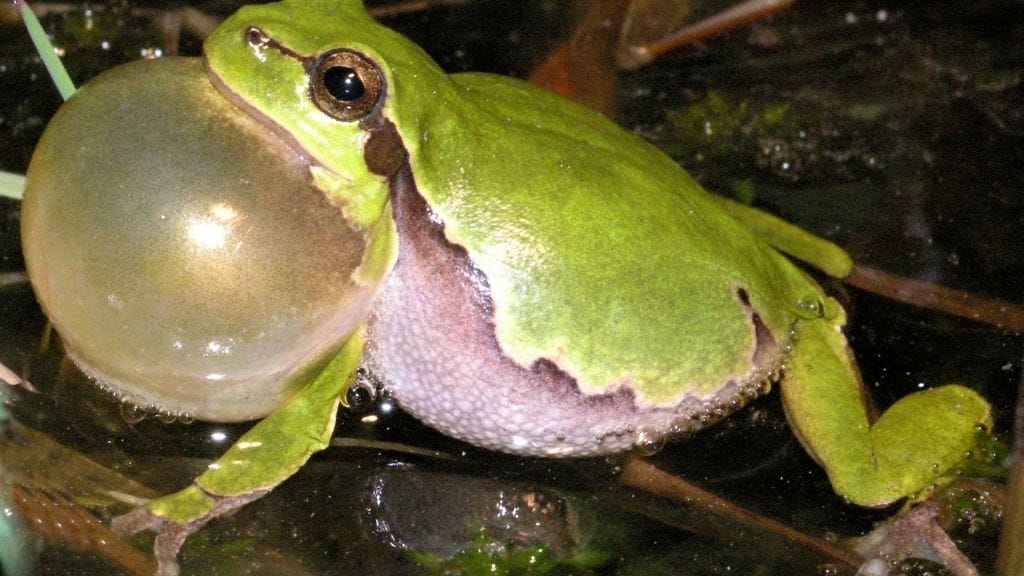
This part is genuinely strange, and it explains how something the size of a walnut gets to 100 decibels.
A frog calls with its mouth and nostrils shut. Air is pushed from the lungs across the vocal cords, into the vocal sac, and then back into the lungs again. It cycles in a loop rather than being exhaled.
The vocal sac is the balloon under the throat. It is not the sound source, it is the resonator — it amplifies and shapes what the larynx produces, the way a guitar body works on a string.
Two consequences fall out of that closed loop:
- Frogs can call continuously, without stopping to breathe between calls.
- Frogs can call underwater. No air escapes, so nothing gives them away and nothing is lost.
Most females do not have vocal sacs, which is a large part of why the noise is overwhelmingly male. It is also one of the more reliable ways to tell a male frog from a female.
Why They All Go Silent At Once

You walk outside. Four hundred frogs stop mid-syllable. You stand still for two minutes and it starts up again, one frog first, then everybody.
The old explanation floating around the internet involves sound waves and electromagnetic radiation. That is nonsense. Sound is not electromagnetic radiation, and nothing about frog hearing works that way.
Here is the real mechanism, and it is better anyway.
Frogs detect substrate and water vibration extremely well. The tympanum, that visible disc behind the eye, plus vibration sensing through the body, picks up your footsteps through the ground and through the water long before you are close.
Then the silence spreads socially. One frog cuts off. Its neighbors, which are listening intently to each other for timing reasons anyway, cut off too. The gap propagates across the pond in a second or so.
It is cheap insurance. A frog that goes quiet when its neighbor does is a frog that does not get eaten for guessing wrong.
Traffic noise and sudden sounds do the same thing, and studies show chorusing can stay suppressed for several minutes after the disturbance has passed.
Why They Croak Some Nights And Not Others
This is the question people actually want answered, because the noise is maddeningly inconsistent.
Season is the single biggest factor. In research covering 100 species, day of year predicted calling better than temperature or rainfall in 67 of them. Frogs call when it is their breeding window, and not much else overrides that.
Within the season, five things move the dial:
Rain. The strongest short-term trigger. Rain brings humid air and fresh shallow water to lay eggs in, and it flushes insects to the surface. Rain events routinely kick off the start of breeding outright.
Temperature. Warm nights mean more calling and faster calls. Warmth physically speeds up the call, and females can hear the difference and prefer it. In one study, an unusually warm March advanced first-calling dates by 11 to 18 days compared to two years earlier.
Moonlight. Real effect, and it runs the direction you would expect. Chorusing drops on bright moonlit nights and peaks near the new moon. A lit-up frog is a visible frog.
Wind. Suppresses calling. Wind scatters sound, so the call does not carry, and the energy is wasted.
Barometric pressure. Falling pressure ahead of a storm often precedes a burst of calling, which is where the folk belief about frogs predicting rain comes from. They are not forecasting, they are responding.
Why It Explodes After Rain

Rain hits several triggers at once, which is why the night after a storm is the loudest night of the year.
The pond refills, and temporary pools appear that were not there yesterday. Many species breed specifically in those temporary pools because they contain no fish to eat the tadpoles.
Humidity spikes, so calling costs a frog much less water.
Insects come out en masse, so there is food.
And crucially, other frogs are all responding to the same cue simultaneously. Explosive breeders can compress an entire season into a couple of nights after the right rainfall. That is not a gradual build, it is a switch.
If your pond is suddenly full of eggs a few days later, that is why. Here is what to do if you find frog eggs.
What Time Of Year Will You Hear Them?
It depends on latitude and on species, but the pattern is consistent.
| Period | What is calling |
|---|---|
| Late winter, first thaw | Spring peepers, wood frogs, chorus frogs. The earliest and often the loudest |
| Spring | The main event. Most species overlap here |
| Late spring into summer | Bullfrogs, green frogs, gray tree frogs. Deeper calls, longer season |
| Late summer | Tapering off. Occasional rain calls |
| Winter | Silence in most of the country. Frogs are overwintering |
In the warm south, calling can start in late winter and run much longer. In the far north the whole window may be six weeks.
Spring peepers are worth calling out specifically. They are the size of a paperclip, they emerge while there is still ice at the edges of the pond, and a full peeper chorus is loud enough to be physically uncomfortable standing next to.
Which Frog Is That?

You can identify most backyard species by ear alone, and it is genuinely a faster ID than trying to spot them.
- Spring peeper — a clean high peep, repeated, like a bird
- Green frog — a single loose banjo string plunk
- Bullfrog — a deep, slow jug-o-rum you feel more than hear
- Gray tree frog — a short musical trill
- American toad — a long, even, high trill that can run 30 seconds
- Wood frog — clucking, oddly like a duck
- Chorus frog — a rising crreek, like a thumb dragged down a comb
For the full breakdown by species, including the tree frogs, see what a tree frog sounds like and our tree frog identification guide.
Do Female Frogs Croak?
Mostly no, and the reason is anatomical rather than behavioral. Most females lack vocal sacs.
But “females are silent” is too strong. Females of various species do produce:
- Release calls when grabbed, including by a male of the wrong species
- Reciprocal calls answering a male during courtship in some species
- Aggressive calls in a handful of species where females defend territory
What females do not do is the all-night advertisement calling. If something is going for six hours straight outside your window, it is male.
Do Pet Frogs Croak At Night Too?

Yes, and this catches new keepers off guard constantly. The frog was silent in the shop and now it is 3am.
The loudest offenders among commonly kept species are American green tree frogs, white-lipped tree frogs (a barking call people compare to a small dog), and African bullfrogs.
Pacman frogs also call, and there is a full post on what Pacman frog croaking means, because with that species it is not always mating and can signal stress.
What triggers it indoors:
- A misting or a water change. This mimics rain, which is the strongest natural trigger you have
- A barometric pressure drop before a storm, even indoors
- Rising temperature in the enclosure
- Another male within earshot, including one on a video
- Seasonal cues from ambient light
If it is unbearable: do not mist in the evening, keep the enclosure out of the bedroom, and accept that a healthy sexually mature male frog calling is normal behavior, not a problem to fix. A frog that suddenly stops eating and starts calling constantly is a different matter and worth investigating.
How To Get Some Sleep
Honest framing first. You are not going to silence a wild pond, and in most places you legally cannot touch the animals. Many native frogs are protected, and collecting or killing them without a licence is an offence in a lot of states.
What actually helps, in order of how well it works:
1. Fix your own lighting. Outdoor lights concentrate insects, insects concentrate frogs. Switch to warm-toned or amber bulbs, put them on motion sensors, and aim them down. This is the highest-leverage change most people can make.
2. Remove standing water you do not want. Buckets, tarps, clogged gutters, saucers under pots, low spots that hold rain. Frogs breed in temporary water, and a lot of it is accidental.
3. Deal with the pool. A pool is a frog magnet and a frog death trap at once. Cover it at night, keep the water moving, and add an escape ramp. Full detail in keeping frogs away from a pool.
4. Cut the cover. Long grass, leaf piles, wood stacks and dense ground plantings near the house give frogs somewhere to sit and call from.
5. Soundproof your side of it. Genuinely the most reliable option for a seasonal problem. A white noise machine, a fan, or heavy curtains will do more for your sleep in one night than a month of yard work. The chorus is a few weeks long.
6. Wait it out. Not a cop-out. Calling collapses once breeding finishes, and the peak is usually a fortnight or so.
For the complete yard approach, see how to get rid of frogs in your yard.
What Not To Do
Every one of these appears on advice sites, and every one is cruel, illegal, ineffective, or all three.
- Salt — frogs drink and breathe through their skin. Salt dehydrates them and kills them slowly. It also wrecks your soil
- Bleach — chemically burns amphibian skin, and the runoff into storm drains is illegal in many areas
- Vinegar — an acid on permeable skin, and it washes off with the first rain anyway
- Coffee grounds — caffeine is toxic to amphibians. This is poisoning with extra steps
- Mothballs — illegal used this way in the US, toxic to pets and groundwater, and they do not repel frogs
- Banging pots to scare them — works for about ninety seconds, then you are awake and they are calling
The only narrow exception is a confirmed invasive species such as a cane toad or Cuban tree frog in Florida, where wildlife agencies specifically tell you not to relocate them and publish a humane euthanasia protocol. Get the identification confirmed by your county extension office first, because getting it wrong means killing a protected native.
Is All That Noise Actually A Good Sign?
Yes, and it is worth sitting with for a second at 2am.
Amphibians breathe through their skin and are unusually sensitive to pollution, pesticide runoff and habitat loss. Populations are collapsing globally. A loud chorus means the water near you is clean enough to breed in.
Frogs also eat a staggering number of mosquitoes, and their tadpoles graze algae. A pond that has gone silent over several years is telling you something, and it is not good news.
The noise is the healthy version.
Frequently Asked Questions
Why do frogs croak at night and not during the day?
Night gives cover from predators while they broadcast their location, keeps humidity high enough that they do not dry out while calling for hours, and lines up with when their insect prey and the females they are calling to are both active.
Do frogs croak in their sleep?
No. Most frogs rest during the day and calling is an active, energy-expensive behavior. What people take for sleep-croaking is usually a frog calling in a dark, quiet room at a time you assumed it was asleep.
Why did the frogs suddenly stop croaking?
Something vibrated. Your footsteps, a car door, a predator moving at the water’s edge. One frog cuts off, its neighbors copy it within a second, and the whole pond goes quiet. Stand still for a couple of minutes and it restarts.
How loud can frogs actually get?
A chorus close up runs 90 to 100 decibels, comparable to a lawnmower. The coquí passes 100 decibels solo. Volume relative to body size is where frogs are genuinely exceptional.
Do frogs croak all year?
No. Calling is tied to breeding season. In most of the US that means late winter through summer depending on species, with silence through winter while frogs overwinter.
Why are frogs louder after it rains?
Rain refills breeding pools, spikes humidity so calling costs less water, and brings insects out. It also synchronizes every frog in the area onto the same cue at once.
Can frogs croak underwater?
Yes. Air cycles between the lungs and vocal sac without being exhaled, so nothing is lost and no bubbles give the frog away.
Is it illegal to get rid of frogs in my yard?
In many places, yes, for native species. Protections vary by state and by species, and several are threatened. Habitat modification, which is drainage, lighting and cover, is legal everywhere and works better anyway.
Do female frogs make any noise at all?
Some do. Release calls when grabbed, reciprocal courtship calls in certain species, and aggressive calls in a few. The nonstop night calling is male.
Final Thought
The chorus outside is a few hundred males, each burning through energy reserves and risking being eaten, on the chance that one female picks him over the frog next to him.
It runs a couple of weeks, it means your local water is clean, and it will be gone by summer.
Close the window, run a fan, and if you want to know which species is keeping you up, our tree frog sound guide will let you name it by ear before you get back to sleep.

About Author
Hello, I’m Muntaseer Rahman, the owner of AcuarioPets.com. I’m passionate about aquarium pets like shrimps, snails, crabs, and crayfish. I’ve created this website to share my expertise and help you provide better care for these amazing pets.
Disclaimer
This site is owned and operated by Muntaseer Rahman. AcuarioPets.com is a participant in the Amazon Services LLC Associates Program, an affiliate advertising program designed to provide a means for sites to earn advertising fees by advertising and linking to Amazon.com. This site also participates in other affiliate programs and is compensated for referring traffic and business to these companies.