This post was created with help from AI tools and carefully reviewed by a human (Muntaseer Rahman) . For more on how we use AI on this site, check out our Editorial Policy.
Check Out These FREE Tools We Made JUST For You!
Dart Frog Tank Mates: What Works, What Doesn’t, and What’ll Kill Them

So you’ve got dart frogs — tiny, colorful, and full of attitude.
Now you’re staring at that vivarium thinking, “What if I added a roommate?”
I get it. A multi-species tank looks incredible when it works. But here’s the thing most people won’t tell you upfront: most experienced dart frog keepers strongly advise against mixing species.
That’s not me being a buzzkill. That’s decades of collective wisdom from forums like Dendroboard, breeders like Josh’s Frogs, and hobbyists who learned the hard way.
But if you’re set on it — and you’ve got the experience, the tank size, and the patience — there are a few animals that can coexist with dart frogs under the right conditions.
Let’s break it all down.
The Honest Truth: Dart Frogs Prefer Living Alone
Dart frogs are territorial, solitary, and not exactly looking for company.
They interact with other animals for exactly two reasons: fighting or breeding. That’s it. They’re not social butterflies. They’re tiny, grumpy rainforest landlords who don’t want tenants.
The consensus across dart frog communities is clear — single-species setups are the gold standard. If you’re designing a tank to be ideal for one species, adding another species means you’re compromising for both.
One veteran keeper on Dendroboard put it perfectly: if you manage to keep both species alive in a mixed tank, it’s more a testament to how tough the animals are than how skilled you are.
That said, people still do it. Some even do it well. Here’s what actually works — and what absolutely doesn’t.
Before You Mix: The Non-Negotiable Checklist
Before picking any tank mate, you need to nail these basics:
| Factor | What to Match |
|---|---|
| Temperature | 72-80°F (22-27°C) range |
| Humidity | 70-100% for dart frogs — tank mates must tolerate this |
| Activity period | Ideally opposite (nocturnal + diurnal) to minimize contact |
| Size | Tank mates shouldn’t be large enough to eat your frogs |
| Tank type | Arboreal tank mates work best since darts are terrestrial |
| Tank size | Minimum 50 gallons, bigger is always better |
| Quarantine | Always quarantine new animals for at least 30 days |
| Captive-bred only | Wild-caught animals carry parasites and diseases like chytrid fungus |
If your potential tank mate fails even one of these, it’s a no-go.
My Recommendation: Keep It Simple
Look, I know a multi-species vivarium sounds amazing.
And honestly? A well-executed one with dart frogs and mourning geckos in a massive tank is impressive.
But for 90% of keepers, single-species setups with a solid springtail and isopod clean-up crew will give you a healthier, lower-stress, and more rewarding experience.
Your frogs will be bolder. They’ll display more natural behaviors. They’ll breed more reliably. And you won’t be lying awake wondering if something went wrong while you were at work.
If you’re still determined to mix, here’s the priority order based on community success rates and risk level:
| Rank | Tank Mate | Risk Level | Experience Needed |
|---|---|---|---|
| 1 | Springtails + Isopods | Virtually none | Beginner |
| 2 | Mourning Geckos | Low-moderate | Intermediate |
| 3 | Small Tree Frogs (CB) | Moderate | Advanced |
| 4 | Micro Day Geckos | Moderate-high | Advanced |
| 5 | Green Anoles (CB) | High | Expert |
| 6 | Bolitoglossa Salamanders | Moderate | Advanced |
Start with the clean-up crew. Get your vivarium dialed in. Learn your frogs’ behavior inside and out.
Then, if you still want to add something after a year of experience — go for it with your eyes wide open.
Your dart frogs didn’t ask for a roommate. Make sure the one you pick is worth the risk.
5 Animals That Can Live With Dart Frogs

1. Mourning Geckos (Lepidodactylus lugubris)
This is the closest thing to a “safe bet” in the dart frog mixing world.
Mourning geckos are the most commonly kept tank mate with dart frogs, and for good reason. They’re small (about 3-4 inches), nocturnal, arboreal, and they thrive in the exact same temperature and humidity range as dart frogs.
| Factor | Mourning Geckos | Dart Frogs |
|---|---|---|
| Size | 3-4 inches | 1-1.5 inches |
| Activity | Nocturnal | Diurnal |
| Type | Arboreal | Terrestrial |
| Humidity | ~80% | 80-100% |
| Temperature | 70-80°F | 72-80°F |
| Diet | Fruit flies, CGD, small insects | Fruit flies, small insects |
| Temperament | Peaceful, docile | Territorial |
Because mourning geckos stick to the upper parts of the tank at night and dart frogs patrol the ground during the day, they barely cross paths.
Bonus: Mourning geckos actually help clean up leftover fruit flies that your darts didn’t eat. Uneaten flies lose their vitamin dusting over time, so having geckos mop those up is genuinely useful.
The catch? Mourning geckos reproduce through parthenogenesis — they don’t need a mate to breed. Get one, and suddenly you’ve got twelve. Population control becomes a real thing real fast.
Important warning: Don’t keep mourning geckos with thumbnail dart frogs (like Ranitomeya). The smaller dart frog species could become a snack for a large mourning gecko. Stick to bigger dart species like Dendrobates auratus, D. leucomelas, or D. tinctorius.
Also, there are documented cases of large dart frogs (particularly Phyllobates terribilis) attempting to eat mourning geckos. So even the “safest” pairing has risks.
2. Small Tree Frogs
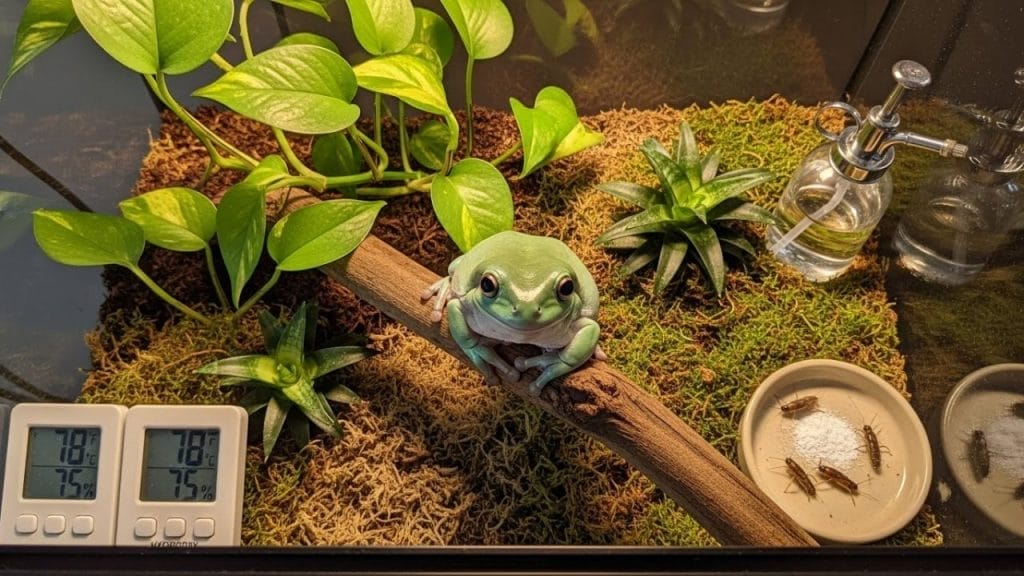
Certain small, arboreal, nocturnal tree frog species can work with dart frogs in a large, well-planned vivarium.
Josh’s Frogs specifically mentions these species as candidates:
- Lemur tree frogs
- Bird poop tree frogs (Dendropsophus marmoratus)
- Hourglass tree frogs
- Clown tree frogs
| Factor | Small Tree Frogs | Dart Frogs |
|---|---|---|
| Size | 1.25-2 inches | 1-1.5 inches |
| Activity | Nocturnal | Diurnal |
| Type | Arboreal | Terrestrial |
| Humidity | 60-70% | 70-100% |
| Temperature | 75-85°F | 72-80°F |
| Diet | Insectivore | Insectivore |
The logic here is the same as mourning geckos — different activity times, different zones in the tank.
Tree frogs stay high, dart frogs stay low. Tree frogs come out at night, darts during the day.
Critical rule: Only use captive-bred tree frogs. Wild-caught bird poop frogs and clown tree frogs are still commonly sold at reptile shows, and they can carry chytrid fungus and Ranavirus. Those diseases will absolutely wipe out your dart frogs.
You’ll need a tall tank — at least 24 inches, ideally 36 inches — to create a proper humidity gradient. Higher humidity at the bottom for the darts, slightly lower (but never below 60%) at the top for the tree frogs.

3. Micro Day Geckos (Phelsuma klemmeri and Similar)
For experienced keepers, small day geckos like Phelsuma klemmeri (neon day gecko) or Lygodactylus williamsi (electric blue day gecko) have been successfully kept with dart frogs.
| Factor | Micro Day Geckos | Dart Frogs |
|---|---|---|
| Size | 3-4 inches | 1-1.5 inches |
| Activity | Diurnal | Diurnal |
| Type | Arboreal | Terrestrial |
| Humidity | 60-80% | 80-100% |
| Temperature | 75-85°F | 72-80°F |
| Diet | Insects, fruit, nectar | Fruit flies, small insects |
Now, here’s the thing — both these geckos and dart frogs are diurnal. They’re awake at the same time. That’s a strike against this pairing compared to mourning geckos.
But because the geckos are strictly arboreal and the darts are terrestrial, experienced keepers report they mostly stay out of each other’s way.
This pairing is not for beginners. Multiple seasoned Dendroboard members emphasize that you need to deeply understand the behavior of both species before attempting this. One keeper reported successfully housing Phelsuma klemmeri with darts, but noted the setup required extensive experience.

4. Green Anoles
Green anoles are small, active lizards that share some environmental overlap with dart frogs.
| Factor | Green Anoles | Dart Frogs |
|---|---|---|
| Size | 5-8 inches | 1-1.5 inches |
| Activity | Diurnal | Diurnal |
| Type | Semi-arboreal | Terrestrial |
| Humidity | 60-80% | 80-100% |
| Temperature | 75-82°F | 72-80°F |
| Diet | Insects | Fruit flies, small insects |
| UVB | Required | Low-level or none |
Green anoles need UVB lighting and a basking spot, which dart frogs don’t typically require. So you’re designing a tank that serves two different lighting needs — doable, but it adds complexity.
Big concern: Most green anoles in pet stores are wild-caught. This is a massive disease risk. If you go this route, captive-bred only, and quarantine rigorously.
Some hobbyists have reported anoles hitchhiking into dart frog tanks via nursery plants. In large enclosures, they’ve coexisted without issues for months. But it’s not something most experts would recommend on purpose.

5. Bolitoglossa Salamanders
This is a niche pick, but it’s a legitimate one.
Bolitoglossa salamanders are tropical salamanders — unlike most salamanders that come from temperate zones. They share the warm, humid environment that dart frogs need.
| Factor | Bolitoglossa Salamander | Dart Frogs |
|---|---|---|
| Size | 4-6 inches | 1-1.5 inches |
| Activity | Nocturnal | Diurnal |
| Type | Arboreal | Terrestrial |
| Humidity | 70%+ | 80-100% |
| Temperature | 65-75°F | 72-80°F |
| Diet | Small insects | Fruit flies, small insects |
| Temperament | Docile | Territorial |
Being nocturnal and arboreal, they check the two biggest boxes for dart frog compatibility.
The temperature overlap is tight though. Bolitoglossa prefer the cooler end (65-75°F) while darts like it a bit warmer (72-80°F). You’d need to keep things right around 72-75°F to hit the sweet spot for both.
These salamanders are peaceful and won’t bother your darts despite being larger. But they’re harder to find in the hobby compared to mourning geckos or tree frogs.
The Clean-Up Crew: Tank Mates That Actually Make Sense
Here’s the plot twist — the best “tank mates” for dart frogs aren’t other reptiles or amphibians at all.
They’re invertebrates.
Springtails (Collembola)
Every single dart frog vivarium should have springtails. Period.
These microscopic detritivores eat mold, decaying plant matter, and frog waste. They regulate fungal blooms and keep your substrate healthy. They also serve as a supplemental food source, especially for newly morphed froglets that are too small to eat fruit flies.
Dwarf White Isopods (Trichorhina tomentosa)
The other half of your clean-up crew.
Dwarf white isopods break down larger organic waste — dead leaves, frog droppings, deceased feeder insects. They work deeper in the substrate than springtails and together, these two species create a genuinely self-maintaining ecosystem.
Both springtails and isopods should be added to your vivarium before the frogs go in, so the populations can establish themselves. Your darts will snack on them, but in a well-designed tank with enough leaf litter (the jackfruit leaves I top the tank with) and substrate depth, the populations sustain themselves.
Other Microfauna
Some advanced keepers also incorporate:
- Grindle worms — additional waste processors
- Tropical springtail varieties — for more diversity
- Various isopod species — though stick to dwarf varieties (larger isopods like powder blues have a bad habit of drowning in water features)
Animals You Should NEVER Keep With Dart Frogs
This list is just as important as the compatibility list.
Crested Geckos
Hard no.
Crested geckos need 50-60% humidity. Dart frogs need 80-100%. Those requirements are fundamentally incompatible.
Crested geckos also grow to 6-10 inches and are omnivorous. They will strike at moving targets — including your dart frogs. Multiple Dendroboard members have witnessed crested geckos bite aggressively enough to draw blood. Your darts would be in serious danger.
Leopard Geckos
Even worse than crested geckos.
Leopard geckos thrive in dry environments with 30-40% humidity. That’s basically the opposite of what dart frogs need. Plus, adults reach 7-11 inches. This pairing makes zero sense on any level.
Chameleons
Chameleons need around 50% humidity, grow up to 7-15 inches, and have extremely specific lighting and ventilation requirements. They would eat your dart frogs without thinking twice.
Fire-Bellied Toads
Despite being a common suggestion online, fire-bellied toads are a terrible match. They secrete skin toxins that can harm dart frogs, and their care requirements don’t overlap well.
Any Large Reptile or Amphibian
If it’s bigger than about 4 inches and shares the ground level with your darts, it’s a risk. Size differences in enclosed spaces almost always end badly for the smaller animal.
Quick Fact: Captive Dart Frogs Aren’t Actually Poisonous
One thing worth clearing up — captive-bred dart frogs are not toxic.
In the wild, dart frogs get their famous toxins from eating specific ants, mites, and millipedes that contain alkaloid compounds. Those bugs get the alkaloids from rainforest plants and fungi.
In captivity, dart frogs eat fruit flies and springtails. No alkaloid-rich bugs means no poison. Captive-bred dart frogs have been confirmed to be completely free of skin alkaloids by researchers including Dr. John Daly, one of the most prominent amphibian toxicologists.
So the concern about tank mates being “poisoned” by dart frogs? Not a real issue in captivity. The real concerns are stress, aggression, disease transmission, and incompatible environmental needs.
Can You Keep Multiple Species of Dart Frogs Together?
Short answer: no.
Longer answer: still no, but here’s why.
Different dart frog species can crossbreed, producing sterile or genetically compromised offspring. This is considered unethical in the hobby because it damages the genetic integrity of captive populations.
Even species that can’t crossbreed will fight. Dart frogs from different species don’t respect each other’s territorial boundaries the way same-species pairs do.
The rule is simple: one species per tank, one morph per tank. If you want variety, build more vivariums. That’s honestly half the fun anyway.
If you want to keep a group of the same species, stick to species known for communal behavior like Dendrobates leucomelas, D. auratus, or Phyllobates species. And even then, watch the male-to-female ratio carefully — female tinctorius, for example, can be incredibly territorial with each other.
About Author
Hello, I’m Muntaseer Rahman, the owner of AcuarioPets.com. I’m passionate about aquarium pets like shrimps, snails, crabs, and crayfish. I’ve created this website to share my expertise and help you provide better care for these amazing pets.
Disclaimer
This site is owned and operated by Muntaseer Rahman. AcuarioPets.com is a participant in the Amazon Services LLC Associates Program, an affiliate advertising program designed to provide a means for sites to earn advertising fees by advertising and linking to Amazon.com. This site also participates in other affiliate programs and is compensated for referring traffic and business to these companies.