This post was created with help from AI tools and carefully reviewed by a human (Muntaseer Rahman) . For more on how we use AI on this site, check out our Editorial Policy.
Check Out These FREE Tools We Made JUST For You!
17 Things You Need for a Pet Frog: Beginner Setup Checklist
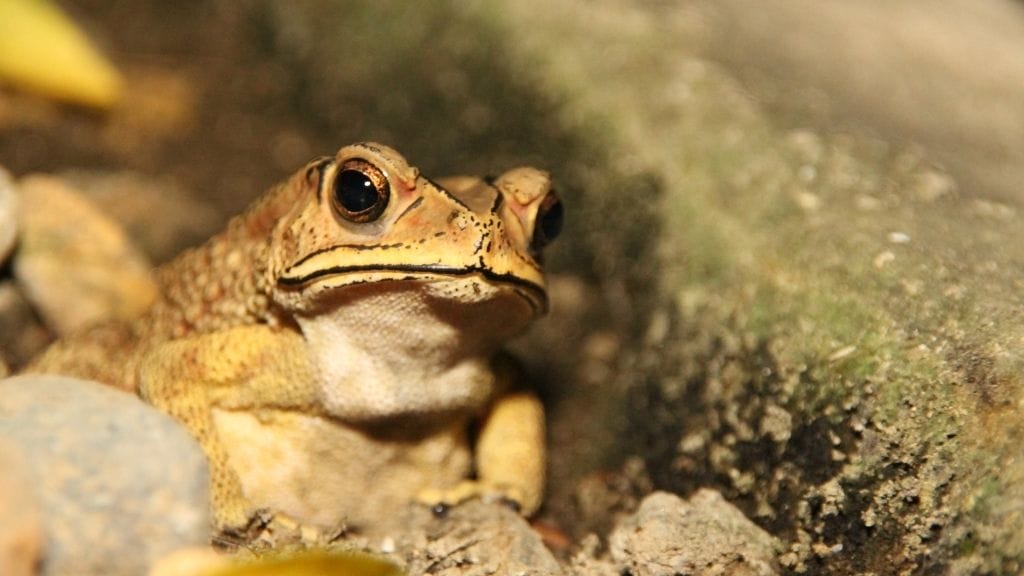
Here is the part nobody tells you before you fall in love with a tiny frog at the pet store.
The frog is the cheap bit. It is everything around the frog that costs money and takes planning.
A frog is not a goldfish you plop in a bowl. It is a little climate machine that needs the right heat, the right humidity, and the right light, all running before you ever bring it home.
So this is your shopping list. Seventeen things, why each one matters, and how the list changes depending on the kind of frog you pick.
Get this ready first, then get the frog. Your frog will be happier and you will save yourself a panicked midnight trip to the pet store.
The Quick Shopping List
Here is everything at a glance. We break down each item below.
- Tank of the right size and shape
- Tank lid or screen top
- Substrate (the tank floor)
- Décor and hides
- Live or artificial plants
- Water dish
- Water conditioner (dechlorinator (what I use every water change))
- Heat source (heat mat (side-mount this, never under the tank) or heat lamp)
- Thermometer
- UVB or day light (species dependent)
- Hygrometer
- Mister or fogger
- Water filter (aquatic and semi-aquatic frogs only)
- Food (live insects or aquatic frog food)
- Calcium and vitamin supplements
- Cleaning and maintenance supplies
- Gloves
That is the whole checklist. Now let’s talk about what actually matters when you buy each one.
First, Know Your Frog
Before you buy a single thing, answer one question. What kind of frog are you getting?
This is the step people skip, and it is the one that decides your entire shopping list.
Frogs are not one type of pet. A fully aquatic African dwarf frog and a tree-climbing White’s tree frog need almost opposite setups.
There are four rough lifestyles, and your frog fits one of them.
- Terrestrial (ground dwellers) like Pacman frogs. They want floor space and deep substrate to burrow.
- Aquatic (water dwellers) like African dwarf frogs and African clawed frogs. They live in water, so you basically run a fish tank.
- Semi-aquatic (land and water) like fire-bellied frogs. They need both a land area and a water area.
- Arboreal (climbers) like tree frogs and Amazon milk frogs. They want height and branches, not floor space.
If you are still deciding, our guide to types of pet frogs you can keep at home walks through the beginner-friendly options.
Pick your frog first. Then the rest of this list clicks into place.
1. The Tank (Enclosure)
The tank is the single most important thing you will buy, and the one people most often get wrong.
The mistake is buying for the frog’s size today instead of its lifestyle and adult size.
Match the Tank Shape to the Frog
A ground frog wants a long tank with lots of floor space. A climbing frog wants a tall tank with vertical room for branches.
Put a tree frog in a long, low tank and it has nowhere to climb. Put a Pacman frog in a tall tank and most of that height is wasted.
Glass is the popular choice because you can watch your frog and it holds humidity well. Front-opening terrariums make daily care easier and reduce the stress of reaching in from above.
Size Guide by Species
A rough rule for many frogs is 10 gallons of space per frog, but adult size changes everything.
Some frogs start small and get big. An adult American bullfrog is a giant that needs a large enclosure, not a starter tank.
| Frog | Adult Size | Minimum Tank |
|---|---|---|
| African dwarf frog | About 1.5 inches | 5 to 10 gallons for a small group |
| African clawed frog | 4 to 5 inches | 10 gallons for one, add 5 to 10 per extra |
| Dwarf tree frog | Up to 1.5 inches | 10 gallons, tall |
| White’s tree frog | 3 to 4 inches | 18 x 18 x 24 inches |
| Poison dart frog | About 1 to 2 inches | 18 x 18 x 18 inches for 1 to 2 |
| Pacman frog | 4 to 7 inches | 10 to 20 gallons |
| Amazon milk frog | 2.5 to 4 inches | 18 x 18 x 24 inches, tall |
| American bullfrog | 6 to 8 inches | 75 gallons or more |
When in doubt, size up. A little extra room is almost never a problem, and a cramped frog is a stressed frog.
Some frogs are also cannibals, so certain species must live alone. Pacman frogs will happily eat a tankmate, including another Pacman.
2. A Secure Lid
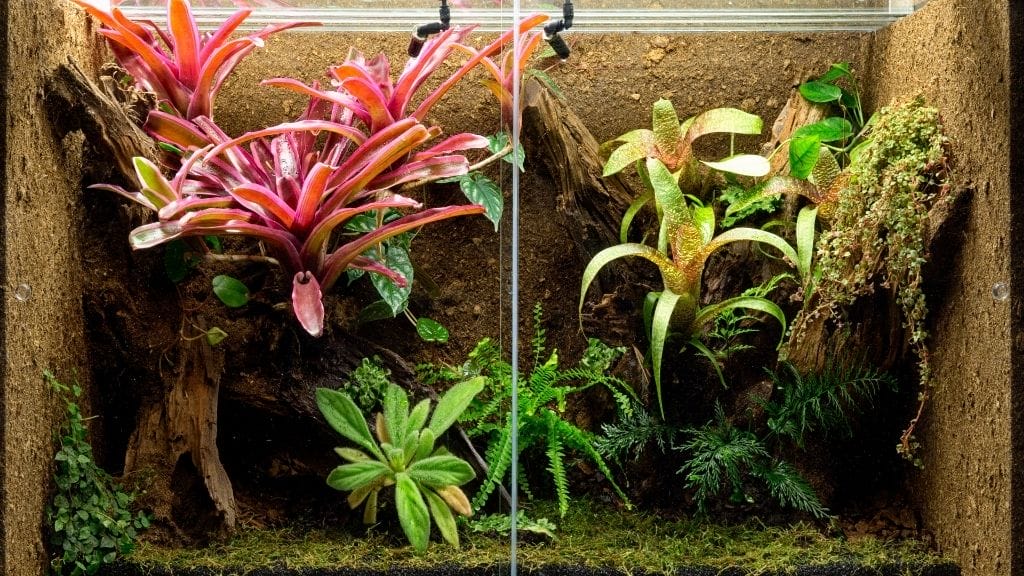
Frogs are escape artists. Small ones can squeeze through gaps you would swear were too tight.
You need a lid that seals well but still lets air move. A screen top gives ventilation, while a glass top holds more humidity.
Many keepers use a combination, covering part of a screen top to trap moisture while keeping airflow. For humidity-loving species, this balance is the whole game.
Whatever you choose, make sure it clips or locks. A curious cat or a determined frog can pop a loose lid.
3. Substrate (The Tank Floor)
Substrate is the material on the bottom of the tank, and it does more than look nice.
It holds moisture to keep humidity up, gives burrowing frogs somewhere to dig, and supports live plants.
Good options include coconut fiber (my go-to substrate base), coco husk, sphagnum moss (keeps the humidity right), and cypress mulch. These hold humidity well and are safe if your frog nibbles a little by accident.
Aim for at least 2 to 3 inches deep, and go deeper for burrowers. A Pacman frog likes 4 to 6 inches so it can bury itself with just its eyes poking out.
Skip the Loose Gravel and Perlite
Avoid gravel, sand, and small rocks that a frog could swallow. Frogs often eat with a lunge and gulp down whatever is nearby.
Perlite is a common one people ask about. It is not toxic, but the little white balls can be swallowed and cause impaction, which is a serious gut blockage.
Keep perlite in your potting soil, not in your frog tank.
For aquatic frogs, the floor is different. Bare bottom or large smooth river stones that are too big to swallow work best, since they are easy to keep clean.
4. Décor and Hides
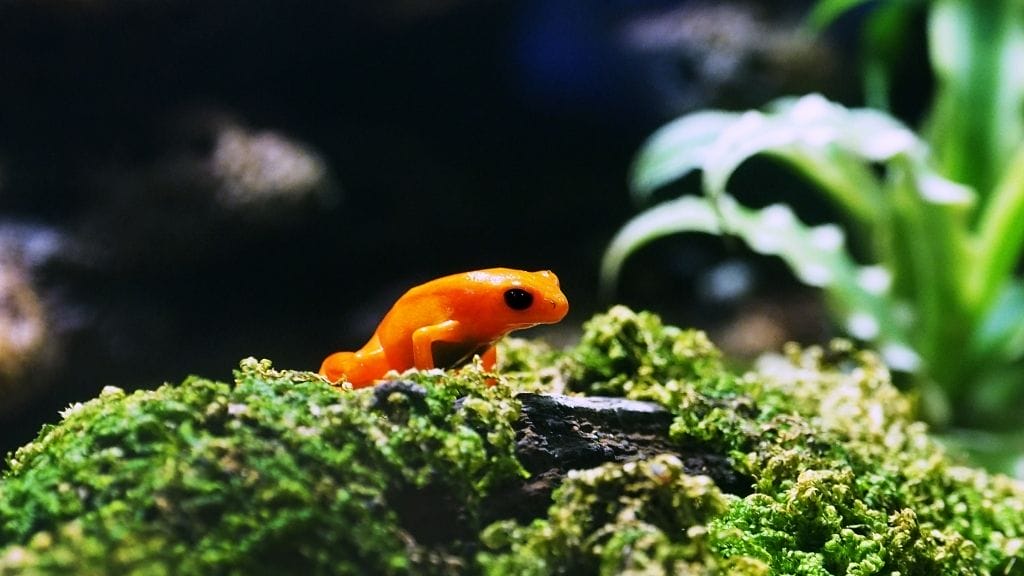
A frog without a hiding spot is a stressed frog. In the wild, being out in the open means something is about to eat you, and your frog’s instincts do not know it is safe.
Give it caves, cork bark, half logs, or a commercial reptile hide. At least one good hiding spot is not optional.
Beyond hides, décor makes the tank feel like home and gives your frog things to interact with. Think branches, vines, ledges, and smooth rocks.
Match the décor to the frog. Climbers want sturdy branches and vines. Ground frogs want logs and leaf litter (the jackfruit leaves I top the tank with) to hide under.
Always check that anything you add has no sharp edges and nothing that could tip over onto your frog.
5. Plants (Live or Fake)
Plants pull double duty. They give cover and climbing surfaces, and live ones help hold humidity.
Live plants that are safe and hardy include pothos, ferns, bromeliads, and various mosses. Bromeliads are a favorite for dart frogs because they collect little pools of water.
If you do not have a green thumb, artificial plants are totally fine. They do not raise humidity, but they clean easily and never die on you.
Just rinse fake plants well before use and skip anything with loose glitter, paint, or tiny parts.
6. Water Dish
Frogs drink and absorb water through their skin, not by sipping. A shallow water dish is where they soak and rehydrate.
Get one shallow enough that your frog can climb out easily. A frog that cannot get out of its own water dish can drown.
Clean it and refill it daily, because frogs often use their water bowl as a toilet too. Fresh water every day is one of the simplest ways to keep a frog healthy.
7. Water Conditioner
This one is small, cheap, and non-negotiable. Tap water contains chlorine and chloramine that are harmful to a frog’s sensitive skin.
A water conditioner, sometimes sold as a reptile-safe dechlorinator, neutralizes those chemicals instantly.
Treat every drop of water that touches your frog, whether it goes in the dish, the mister, or an aquatic tank. Never use straight tap water.
8. Heat Source
Frogs are ectothermic, which is the science way of saying they cannot make their own body heat. They borrow it from their surroundings.
Most frogs are comfortable around 72 to 80°F during the day and a few degrees cooler at night. Always check the exact range for your species, since a rainforest frog and a temperate frog want different things.
If your room already stays in that range, you may not need extra heat at all. If your home runs cold, you will.
An under-tank heat mat stuck to the side or back is gentle and common. A low-wattage heat lamp works for species that also want a warm basking spot.
One warning. Never let your frog sit directly on a hot surface, and never let the tank overheat. Use a thermostat if you can, and always pair a heater with a thermometer so you are not guessing.
9. Thermometer
You cannot manage a temperature you are not measuring. A thermometer takes the guesswork out.
A cheap stick-on strip is better than nothing, but a digital probe thermometer is far more accurate.
Place it where the frog actually spends its time, not just at the top of the tank where warm air gathers. For bigger tanks, two thermometers, one warm end and one cool end, tell the full story.
10. Lighting
Lighting does two jobs. It gives your frog a day-and-night rhythm, and for some species it provides UVB.
Even nocturnal frogs need a regular light cycle, usually about 12 hours on and 12 hours off, to stay healthy. A simple timer makes this effortless.
Whether you need special UVB lighting depends entirely on the species, which we cover in the FAQ below.
Keep any bright or warm light on the outside of a screen top so your frog cannot touch it and burn itself.
11. UVB Bulb (For Species That Need It)
UVB is a specific type of light that helps a frog make vitamin D3, which it needs to absorb calcium and keep its bones strong.
Some frogs benefit from low-level UVB. Others, like poison dart frogs that live on the shady rainforest floor, are usually kept without it and get their D3 from dusted food instead.
If you use UVB, a low-output bulb in the 2.0 to 5.0 range is plenty for most frogs. More is not better here, and too much UV can harm sensitive skin and eyes.
Give the frog shaded spots to retreat to, and replace UVB bulbs every 6 to 12 months since they stop emitting UV long before the light burns out.
12. Hygrometer
Humidity is as important as temperature for most frogs, and a hygrometer (the combo gauge I keep on the screen) is how you keep track of it.
Many frogs want humidity in the 60 to 80% range, and rainforest species can want even more. Too dry and your frog dehydrates. Too damp with no airflow and you grow mold and bacteria.
Combo units that read both temperature and humidity are handy and save space. A digital one with a probe beats the cheap analog dials, which drift and lie over time.
13. Mister or Fogger
Keeping humidity up usually means adding water to the air, and that is what a mister or fogger does.
For a small setup, a simple hand spray bottle (the manual mister I keep handy) and a daily misting routine is enough. Fill it with conditioned or distilled water.
For bigger tanks or thirsty species, an automatic fogger or misting system does the work for you and keeps levels steady while you are at work or asleep.
Use distilled or dechlorinated water so you do not leave white mineral crust all over the glass and plants.
14. Water Filter (Aquatic and Semi-Aquatic Frogs)
If your frog lives in water, you are really running an aquarium, and clean water is everything.
Aquatic frogs like African dwarf frogs and African clawed frogs produce waste that turns into ammonia. Ammonia is toxic and builds up fast in still water.
A gentle filter keeps the water cycling and safe. Go gentle on purpose, because these frogs dislike strong current and can get stressed by a filter that blasts them around the tank.
Terrestrial frogs with just a small water dish do not need a filter. You just swap the water daily.
15. Food
Almost all pet frogs are insect eaters, and most want their food alive and moving.
Staple feeders include crickets, dubia roaches, and various worms, rotated so your frog gets variety. Bigger frogs eat bigger prey, and some large species will even take the occasional pinky.
A good rule is to feed prey no wider than the space between your frog’s eyes, so nothing gets stuck going down.
Fully aquatic frogs are the exception. They often do well on sinking pellets and frozen foods like bloodworms made for aquatic frogs and tadpoles.
You will also want a small feeding setup, like a dish for worms or tongs, plus a way to keep feeder insects alive until dinner.
16. Calcium and Vitamin Supplements
Captive frog diets are missing nutrients that wild frogs get naturally, and the fix is cheap. You dust the food.
The two big ones are calcium and vitamin D3. Without them, frogs develop metabolic bone disease, where the skeleton literally weakens and deforms. It is common, painful, and completely preventable.
Here is the simple routine most keepers follow.
- Calcium with D3: dust feeders about 2 to 3 times a week, especially for frogs kept without UVB.
- Plain calcium: can be used on other feedings.
- Multivitamin: dust roughly once a week for overall nutrition.
Do not overdo it. More supplement is not safer, and too much of some vitamins causes its own problems. Gut-loading your insects with healthy food before feeding also boosts their nutritional value.

17. Cleaning and Maintenance Supplies
Last on the list, first in daily life. A clean tank is the difference between a thriving frog and a sick one.
Keep a set of supplies used only for the frog tank, so you never bring in household chemicals. Frogs absorb everything through their skin, so ordinary cleaners can be deadly.
A basic kit covers most needs.
- A dedicated sponge and scraper
- Reptile-safe cleaner or a simple vinegar-and-water mix
- Paper towels
- A small net for aquatic frogs
- Spot-cleaning tools to remove waste daily
- A pair of gloves
On gloves, a quick note. If you must handle your frog, wear clean, damp, powder-free gloves, or at least rinse your bare hands well with no soap residue.
The oils, salts, and lotions on human skin can harm a frog, and most frogs are happier being watched than held anyway.
What Does It All Cost?
Honest answer, the setup costs more than the frog.
Between the tank, heating, lighting, meters, and décor, a first-time frog setup often runs well past a hundred dollars before you add the animal.
The good news is that most of it is a one-time buy. After setup, your ongoing costs are food, supplements, and the occasional bulb.
Think of it like the frog’s whole world. You are building a climate, not decorating a box.
Frequently Asked Questions
Do frogs need UVB?
It depends on the species. Many frogs benefit from low-level UVB because it helps them make vitamin D3 and absorb calcium.
Some, like dart frogs, are usually kept without UVB and get their D3 from dusted food instead. When in doubt, low UVB plus proper supplements is a safe combination for most frogs.
Do frogs need a heat lamp?
Only if your room cannot hold the right temperature on its own. Check your species’ ideal range first.
If your home stays warm enough, you may need no heat source at all. If it runs cold, a heat mat or a low heat lamp fills the gap. Always pair heat with a thermometer.
Is perlite bad for frogs?
Yes, keep it out of the tank. Perlite is not toxic, but frogs can swallow the little balls and get a dangerous gut blockage.
Stick to safe substrates like coconut fiber, coco husk, or sphagnum moss instead.
Can I put live plants in my frog tank?
Absolutely, and most frogs love them. Safe choices include pothos, ferns, bromeliads, and mosses.
Rinse new plants well and skip any treated with pesticides or fertilizers, since your frog will be sitting right on them.
How often should I clean the tank?
Spot-clean waste and refresh the water dish daily. Do a deeper clean every few weeks, and a full substrate change on a schedule that fits your setup.
Bioactive tanks with cleanup crews need less hands-on cleaning, but daily spot checks still matter.
Final Thoughts
A pet frog is a genuinely rewarding little animal, but only if you build its world first.
Get the tank, the heat, the humidity, and the food sorted before the frog comes home, and the day-to-day care is simple.
Rush in without the gear and you will spend the first week stressed and improvising while your frog pays the price.
So work through this list, buy for your specific species, and set the tank up a few days early to make sure everything holds steady.
Do that, and you and your new frog are going to get along just fine.
Still choosing a species? Start with our roundup of small pet frogs that stay small, and if anything ever seems off with your frog’s health, ask a vet before it becomes an emergency.

About Author
Hello, I’m Muntaseer Rahman, the owner of AcuarioPets.com. I’m passionate about aquarium pets like shrimps, snails, crabs, and crayfish. I’ve created this website to share my expertise and help you provide better care for these amazing pets.
Disclaimer
This site is owned and operated by Muntaseer Rahman. AcuarioPets.com is a participant in the Amazon Services LLC Associates Program, an affiliate advertising program designed to provide a means for sites to earn advertising fees by advertising and linking to Amazon.com. This site also participates in other affiliate programs and is compensated for referring traffic and business to these companies.