
This post was created with help from AI tools and carefully reviewed by a human (Muntaseer Rahman) . For more on how we use AI on this site, check out our Editorial Policy.
Check Out These FREE Tools We Made JUST For You!
Red-Eyed Tree Frog Care For Absolute Beginners

Those glowing red eyes and neon-green body are exactly why you want one. They are also exactly why so many beginners panic once the frog is actually home.
Here is the good news. A red-eyed tree frog is not a hard pet once you get the setup right.
The trick is that almost everything comes down to the tank, not the frog. Nail the humidity, heat, and hiding spots, and this frog basically takes care of itself.
This guide walks you through the whole thing from scratch: what to buy, how to build the tank, what to feed, and the mistakes that trip up new keepers.
Are Red-Eyed Tree Frogs Good for Beginners?
Yes, with one honest caveat.
Red-eyed tree frogs are a moderate-level pet. They are not a “hold and cuddle” animal, and they are not a set-and-forget one either.
Their skin is thin and porous, so they soak up whatever is in their environment. That means clean water, stable humidity, and hands-off handling are non-negotiable.
But the daily routine is genuinely simple. Mist the tank, feed a few bugs a few nights a week, and keep an eye on your gauges. That is most of the job.
If you are still gathering gear, our list of the 17 things you need to keep a pet frog is a good shopping checklist.
Red-Eyed Tree Frog Overview
Before we build the tank, here is the quick stat sheet so you know what you are working with.
| Scientific name | Agalychnis callidryas |
| Adult size | Males 2 to 2.5 in, females up to 3 to 3.5 in |
| Lifespan | 5 to 10 years in captivity |
| Diet | Insectivore (crickets, roaches, worms) |
| Daytime temp | 75 to 85°F |
| Nighttime temp | 66 to 75°F |
| Humidity | 70 to 80% |
| Toxicity | Non-toxic to humans |
| Temperament | Shy, nocturnal, easily startled |
| Cost | Around $20 to $80 per frog |
Notice females run noticeably bigger than males. If you are buying a “pair,” expect a size gap.
How to Buy a Healthy Red-Eyed Tree Frog
Where you buy matters just as much as how you care.
Always try to buy captive-bred, not wild-caught. Wild-caught red-eyes arrive stressed, dehydrated, and often loaded with parasites, and a lot of them never adjust to tank life.
Captive-bred frogs are hardier and used to being kept. Just ask the seller directly which one you are looking at.
Before you commit to a frog, look for these signs of good health:
- A plump body, not bony hips or a sunken belly
- Clear, bright eyes with no cloudiness
- Smooth, unbroken skin with no sores, redness, or odd patches
- A firm grip and a reaction when you approach
- Perched up on a branch or leaf, not slumped on the floor
Walk away from any frog that looks thin, sits listlessly on the substrate, or shares a tank with sick-looking neighbors.
A healthy red-eye runs about $20 to $80. A rock-bottom price usually means wild-caught, so treat it as a red flag, not a bargain.
What You Need to Set Up the Tank
You do not need a lab. You do need the right basics before the frog arrives.
Here is the core shopping list:
- A tall arboreal glass terrarium (the glass terrarium I set up for them)
- A moisture-holding substrate like coco fiber (my go-to substrate base), plus sphagnum moss (keeps the humidity right)
- A drainage layer for the tank bottom
- A basking bulb and a low-level UVB bulb
- A heat mat (side-mount this, never under the tank) for cold rooms (side-mounted, never under the tank)
- A digital thermometer and a hygrometer (the combo gauge I keep on the screen)
- A spray bottle (the manual mister I keep handy), and a fogger or misting system if you want to automate it
- A shallow water dish
- Live or artificial plants, plus branches, cork bark, and leaf litter (the jackfruit leaves I top the tank with)
- Feeder insects (crickets are the staple) and calcium plus a multivitamin (I suggest this one) for dusting
Get the tank fully running and holding stable temps and humidity for a few days before the frog moves in. That settling window saves you a lot of stress later.
Tank and Enclosure
Red-eyed tree frogs are arboreal, which is a fancy way of saying they live up in the branches, not on the ground.
So height matters more than floor space. You want a tall glass terrarium, not a long low one.
The minimum size for one or two frogs is 18 x 18 x 24 inches. Bigger is better, and vertical space is the part that counts.
| Number of Frogs | Recommended Tank |
|---|---|
| 1 red-eyed tree frog | 18 x 18 x 18 in (minimum) |
| 2 to 3 frogs | 18 x 18 x 24 in |
| 4+ frogs | 24 x 18 x 24 in or larger |
Glass is the go-to material because it holds heat and humidity well and lets you watch the frog. A front-opening reptile terrarium makes misting and feeding much easier than a top-only tank.
If building from parts feels overwhelming, a rainforest terrarium kit bundles most of the basics so you are not sourcing ten items separately.
Substrate
The substrate has one main job here: hold moisture without turning into a swamp.
Good options are coco fiber, coconut husk, orchid bark, sphagnum moss, or a proper bioactive mix (the bioactive base I use under my reptiles). All of them soak up water and release it slowly to keep humidity up.
Aim for about 2 to 3 inches deep, sitting on a drainage layer so excess water has somewhere to go.
Keep it damp, never dripping wet. A soggy tank breeds mold and bacteria, and this frog’s skin will not forgive that.
Spot-clean poop daily and do a full substrate change roughly once a month. If you go bioactive with springtails and isopods, that cleanup crew handles a lot of the work for you.
Plants and Décor
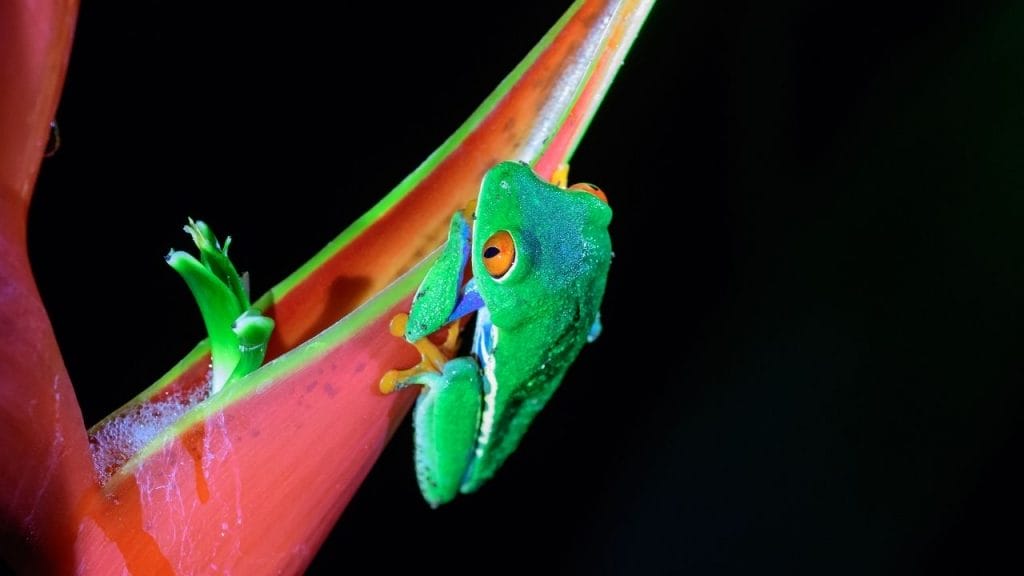
Plants are not just decoration for an arboreal frog. They are furniture.
Your frog will climb them, hide in them, and sleep on the leaves during the day. Live plants also help hold humidity.
Beginner-friendly live plants include:
- Pothos (golden pothos)
- Philodendron
- Bromeliads
- Ferns
- Monstera
- Peperomia
- Chinese evergreen (Aglaonema)
Add branches, cork tubes, driftwood, and vines to give climbing routes and cover. A few solid hiding spots make a shy frog feel safe enough to come out and eat.
Plants to Avoid
Skip anything toxic or treated with pesticides. Stay away from azalea, daffodil, hyacinth, honeysuckle, and bracken fern.
When in doubt, rinse any new plant well and quarantine it before adding it, since garden-center plants often carry chemical residue.
Temperature
These frogs come from Central American rainforests, so they like it warm by day and cooler at night.
| Time | Temperature |
|---|---|
| Daytime | 75 to 85°F |
| Basking spot | around 84°F |
| Nighttime | 66 to 75°F |
That natural day-night swing is actually healthy, so you do not need to keep it pinned to one number around the clock.
Use a basking bulb for daytime warmth and check the tank with a digital thermometer. In a cold room, add a heat mat on the side of the tank, never underneath, and always run it through a thermostat so it cannot cook your frog.
One warning: prolonged cold is a slow killer. If your home dips below the low 70s for long stretches, sort out heating before anything else.
Humidity
This is the number most beginners get wrong, and it is the one that matters most.
Keep humidity between 70% and 80%, and never let it fall below 60%. Track it with a hygrometer, not by eyeballing the glass.
The simplest way to hit that range is misting. Spray the tank down first thing in the morning and again at night after lights-out.
Hit the plants and branches too. Red-eyed tree frogs drink by licking water droplets off leaves, so those droplets are basically their water fountain.
For a big tank or a dry home, a fogger or an automatic misting system takes the pressure off and keeps humidity steady while you are at work.

Lighting and UVB
Give your frog a regular day-night cycle of about 10 to 12 hours of light per day. A timer makes this effortless.
These are nocturnal frogs, so they do not want harsh, bright lighting. Ambient room light plus a soft terrarium light is plenty for daytime.
Do Red-Eyed Tree Frogs Need UVB?
This one gets debated, but the modern answer leans yes.
A low-level UVB bulb (2.0 or 5.0) helps your frog make vitamin D3, which it needs to absorb calcium. In the wild they get filtered UV through the canopy, so a weak UVB source mimics that.
Mount the UVB bulb on top of the tank, and replace it every 6 months even if it still lights up. The UV output fades long before the bulb dies, which is a mistake tons of keepers make.
Diet: What to Feed a Red-Eyed Tree Frog
Red-eyed tree frogs are insectivores, and the menu is simple.
Crickets are the staple. Build around them and rotate in variety for balance.
Good feeders include:
- Crickets (the main food)
- Dubia or discoid roaches
- Phoenix worms and black soldier fly larvae
- Occasional treats: silkworms, hornworms, waxworms
Two hard rules. Never feed mealworms as a staple, since the hard shell risks impaction. And never offer prey bigger than the space between your frog’s eyes, or it simply will not eat it.
For a deeper breakdown, see our full tree frog diet and feeding guide.
How Often and How Many?
Feeding frequency depends on age.
- Babies and juveniles: small feeders daily, or every other day
- Adults (over 3 in): 2 to 3 times a week
For an adult, a typical serving is about 3 to 6 crickets every 2 to 3 days. These frogs get fat easily, so resist the urge to overfeed.
Always pull uneaten crickets out at night. Leftover crickets will nibble on your sleeping frog, which is as bad as it sounds.
Supplements
Dust feeders with a calcium plus D3 powder at most feedings, and a multivitamin once a week or so.
Also gut-load your insects for 24 hours before feeding. Feed the crickets fresh veg and a quality gut-load so your frog gets real nutrition instead of an empty bug.
What If My Frog Stops Eating?
A missed meal or two is normal, especially around a shed or a cool spell. A long hunger strike is not.
If your frog refuses food for more than a week or two, walk through our guide on why a tree frog stops eating to find the cause before it becomes an emergency.
An adult can safely go a couple of weeks without food, and a well-fed one longer. Juveniles have far less of a buffer, so watch them closely.
Water
Your frog needs constant access to clean, safe water.
Keep a shallow water dish in the tank, shallow enough that the frog cannot drown in it. Change it daily.
Never use straight tap water. Chlorine and chloramine hurt amphibian skin, so treat the water with a reptile-safe dechlorinator first.
Handling: Can You Touch a Red-Eyed Tree Frog?
Short version: look, don’t touch.
Red-eyed tree frogs do not enjoy handling, and their porous skin absorbs oils, lotions, soap, and salt right off your hands. That can genuinely make them sick.
If you absolutely must move your frog, wet your hands first with dechlorinated water, or wear clean powder-free gloves, and keep it quick. Wash up afterward too.
For a frog you can actually interact with, our roundup of the best pet frogs for handling points you at friendlier options.
Normal Behavior: Is My Frog Okay?
New red-eye keepers panic over stuff that is completely normal. Here is what healthy weird looks like.
It sleeps flat and gray all day
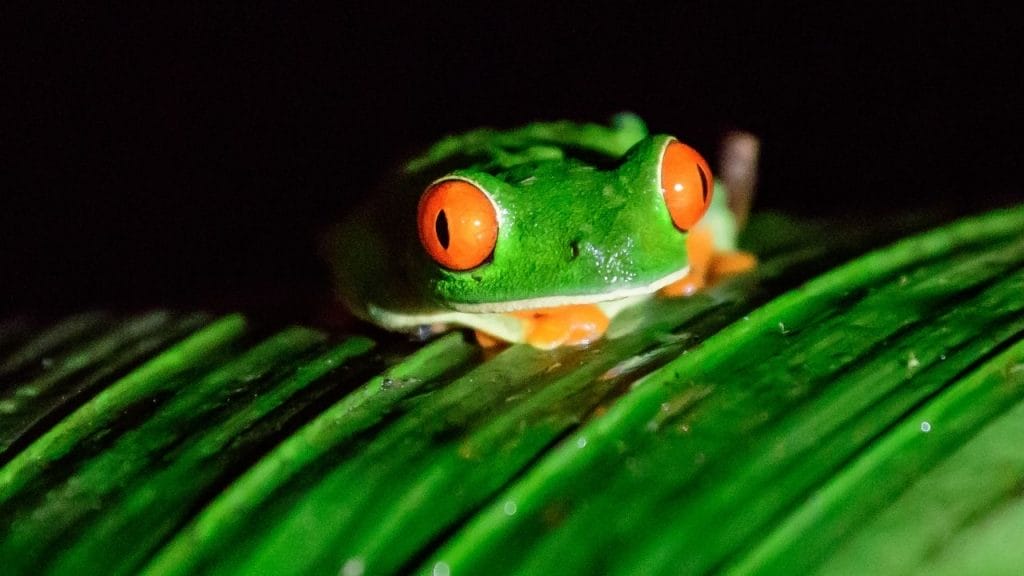
Red-eyes are nocturnal. By day, yours will tuck its legs in, close its eyes, flatten against a leaf, and often fade to a dull green, brown, or gray.
It can honestly look dead. It is just asleep, and it will brighten and perk up once the lights go off.
It changes color
These frogs shift shade with mood, temperature, and time of day, going darker at night or when cool and brighter when warm and active. That is normal as long as the skin stays smooth.
It flashes its eyes when startled
Disturb a sleeping red-eye and it may suddenly pop open those red eyes and flash blue-and-orange markings on its flanks.
That is a built-in scare tactic to startle predators, not a sign of illness. It does mean you woke it up, though, so ease off.
The males call at night
A male red-eye clicks and croaks after dark, especially when humidity rises after a misting. It is a normal mating call, not a problem.
It sheds its skin
Every so often your frog will shed, and it usually eats the skin right afterward. You might catch it looking dull, then suddenly clean and bright.
Totally normal. Just keep humidity up so the shed comes off in one clean piece.
The rule of thumb: a frog that is plump, smooth-skinned, and active at night is fine, even if it looks like a sad gray lump all day.
Tank Mates and Companions
Red-eyed tree frogs are not social in the way a dog is, but they tolerate their own kind just fine.
You can keep multiple red-eyed tree frogs together as long as the tank is big enough and everyone is a similar size. Two males can share a tank without drama since they are peaceful.
Mixing species is where people get into trouble. It is safest to keep red-eyes with only other red-eyes, and our guide on what frogs can live together explains why cross-species tanks so often go wrong.
Breeding Basics
Breeding is an advanced-ish project, but here is the shape of it.
In the wild they breed in the rainy season, so you recreate that with a “winter” cool-down followed by a rain chamber.
- Cool the tank and shorten daylight for 1 to 2 months to simulate the dry season.
- Move mature males and females into a rain chamber, keeping more males than females.
- Females lay 20 to 100 eggs on leaves above water, and the tadpoles drop in once hatched.
- Rear tadpoles at a stable temperature and feed them tadpole foods and soft greens.
For the full walkthrough, see our tree frog breeding guide.
Maintenance and Health
Keep a simple routine and most health problems never start.
- Spot-clean waste daily
- Deep-clean the tank monthly with an amphibian-safe cleaner
- Replace the substrate about once a month
- Check temperature and humidity gauges every day
- Refresh the water dish daily
Watch for warning signs like weight loss, dull or discolored skin, cloudy eyes, bloating, or a frog that hides constantly and stops eating. Those mean it is time for an exotic vet.
If you ever lose a frog and cannot figure out why, our breakdown of why tree frogs die covers the usual culprits so you can prevent a repeat.
Common Health Problems
Almost every red-eye illness traces back to a husbandry slip. Here are the big ones to recognize early.
| Problem | Usual cause | What you’ll see |
|---|---|---|
| Metabolic bone disease (MBD) | Too little calcium or D3, weak UVB | Weak grip, bent limbs, tremors, won’t climb |
| Red leg disease | Bacterial infection from dirty conditions | Red flushing on the belly and thighs, lethargy |
| Chytrid fungus | Contagious fungal infection | Excess shedding, skin patches, weight loss |
| Skin infection | Dirty or too-wet tank | Sores, discoloration, cloudy patches |
| Impaction | Swallowed substrate or oversized prey | Bloating, straining, no poop, not eating |
The fix for nearly all of these starts the same way: correct the husbandry (clean tank, right humidity, proper supplements, safe substrate) and get an exotic vet involved early.
Amphibians hide illness until it is advanced, so act on the first warning sign instead of waiting to see if it passes.
Frequently Asked Questions
Are red-eyed tree frogs poisonous?
No, they are non-toxic to humans. They can secrete mild skin compounds, so wash your hands after any contact, but they are not dangerous to keep.
How big do red-eyed tree frogs get?
Males reach about 2 to 2.5 inches, and females can hit 3 to 3.5 inches. Females are clearly the larger sex.
How long do red-eyed tree frogs live?
With good care, 5 to 10 years in captivity. Stable humidity, clean water, and a proper diet are what get you to the high end.
Do red-eyed tree frogs need a heat lamp?
Usually yes, unless your home stays reliably in the mid-to-high 70s. A basking bulb by day plus a side-mounted heat mat on a thermostat covers most homes.
Can red-eyed tree frogs live together?
Yes, multiple red-eyes can share a large enough tank, including two males. Just avoid mixing them with other species.
Final Thoughts
Red-eyed tree frogs look exotic, but caring for one really comes down to a well-built tank.
Get the humidity, heat, UVB, and hiding spots right, and the daily routine is a few minutes of misting and a handful of crickets a week.
Do that, and one of the most striking frogs on the planet will happily hang out in your living room for years.
About Author
Hello, I’m Muntaseer Rahman, the owner of AcuarioPets.com. I’m passionate about aquarium pets like shrimps, snails, crabs, and crayfish. I’ve created this website to share my expertise and help you provide better care for these amazing pets.
Disclaimer
This site is owned and operated by Muntaseer Rahman. AcuarioPets.com is a participant in the Amazon Services LLC Associates Program, an affiliate advertising program designed to provide a means for sites to earn advertising fees by advertising and linking to Amazon.com. This site also participates in other affiliate programs and is compensated for referring traffic and business to these companies.