This post was created with help from AI tools and carefully reviewed by a human (Muntaseer Rahman) . For more on how we use AI on this site, check out our Editorial Policy.
Check Out These FREE Tools We Made JUST For You!
Frog Eggs: What to Do When You Find Them (Hatching, Tadpoles & Froglets)
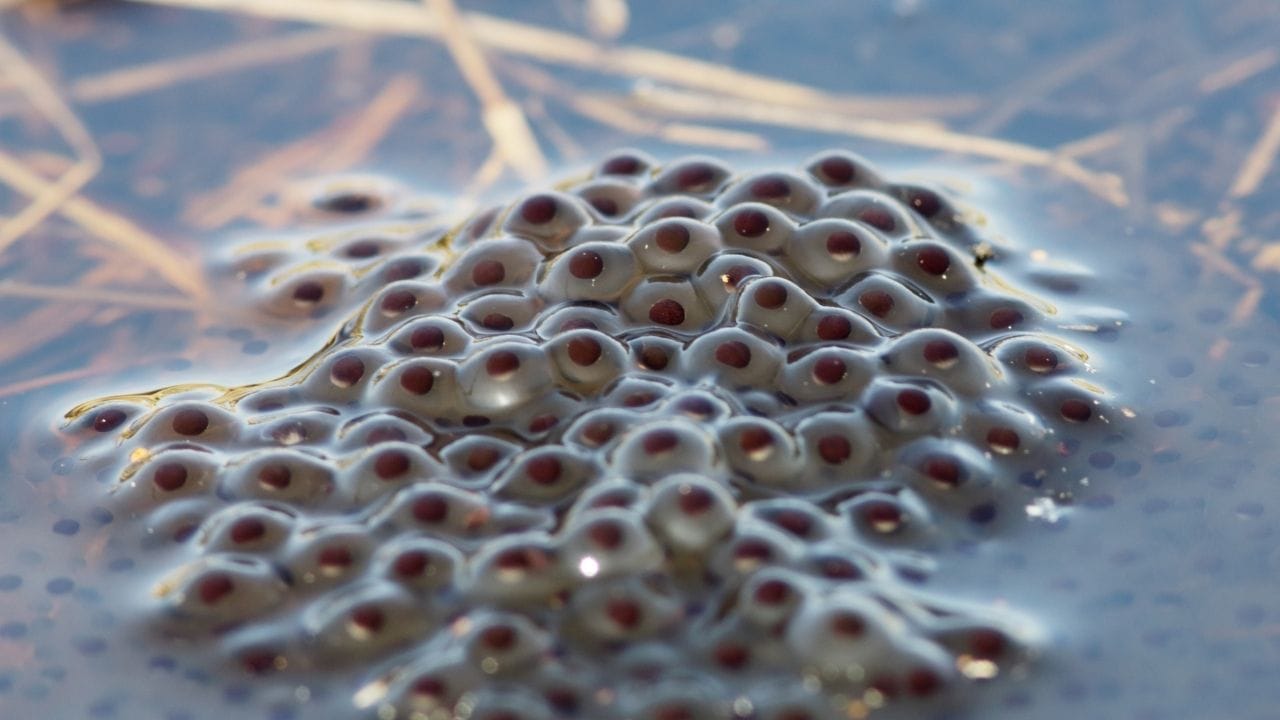
You went out to check the pond and found a blob of jelly the size of a grapefruit, packed with little black dots. Or your kid scooped some into a bucket and is now looking at you expectantly.
Here is the honest short answer. In most cases the best thing you can do for frog eggs is leave them exactly where they are.
That is not a cop-out. Eggs left in a healthy pond have better odds than eggs in a bucket on your porch, and moving spawn between bodies of water is how two of the worst amphibian diseases on the planet get spread around.
But if the eggs are already in your care, if they are somewhere they will definitely die, or if you are breeding your own frogs on purpose, then yes, you can raise them. This guide covers the whole run from jelly blob to froglet, including the one step that kills more home-raised tadpoles than anything else.
Quick Answer Box
| Question | Short answer |
|---|---|
| Should I move them? | Usually no. Leave them unless they are doomed where they are. |
| Water | Pond water, rainwater, or dechlorinated tap. Never distilled or softened. |
| Temperature | Match the source pond. Roughly 59-68°F for temperate species, warmer for tropical. |
| Hatch time | 3 days to 4 weeks depending on species and temperature |
| How many to take | A small handful, not the whole clump |
| Biggest killer | Froglets drowning because they cannot climb out of the water |
| Egg to froglet | Around 12-16 weeks for most common species |
First Things First: Should You Even Move Them?
Most people who find frog eggs assume the eggs need rescuing. Nine times out of ten they do not.
A frog chose that spot. Frogs are not brilliant, but they are considerably better at picking a spawning site than we are at guessing one.
Leave the eggs alone if they are in a pond, ditch, slow stream, or garden water feature that holds water reliably. That is a working nursery.
Consider intervening if the eggs are in a puddle that will dry up in days, a swimming pool that gets chlorinated, a water trough due to be emptied, or a container you are about to drain. In those cases the eggs are dead anyway and moving them is a genuine improvement.
Never move them if you are planning to put them in a different pond. More on why in a moment, because this is the part almost every other guide skips.
Is It Legal to Collect Frog Eggs?
This one genuinely depends on where you live, and the answer is less relaxed than most people assume.
In the UK, collecting a small amount of common frog spawn is generally tolerated, but several amphibians including the natterjack toad and great crested newt are fully protected, and disturbing them or their eggs is a criminal offence. Conservation groups actively campaign against moving spawn at all.
In the US, rules are set state by state. Many states class amphibians under fish and wildlife regulations, which can mean you need a fishing licence to collect them, and some species are protected outright. A few states prohibit collection from the wild entirely.
In Australia, taking frogs or spawn from the wild without a permit is generally illegal, and the chytrid situation there makes enforcement strict.
The practical rule: check your local wildlife agency before you scoop, and never collect from public land or a nature reserve. If you cannot identify the species, assume it might be a protected one.
The Disease Problem Nobody Mentions
This is the section that changes how you should think about the whole project.
Amphibians worldwide are being hammered by two pathogens. Chytrid fungus attacks the skin, which amphibians use to breathe and manage water balance, and has driven mass die-offs and extinctions. Ranavirus causes internal bleeding and organ failure, and can wipe out an entire pond population in a season.
Here is the problem. Both travel in water, on plants, on mud, and on the bucket and net you used. Neither is visible until animals start dying.
So when you move spawn from pond A to pond B, you may be moving a pathogen into a population that never had it. UK charity Froglife runs a campaign called Stop the Swap specifically about this.
What this means in practice:
- Do not move spawn between ponds, ever, even well-meaningly
- If you raise eggs indoors, release the froglets back at the exact spot the eggs came from and nowhere else
- Never release captive-raised froglets that shared water with pet frogs, fish, or aquarium equipment
- Scrub and dry any net, bucket, or container between water bodies
- If you want frogs in your garden pond, build the pond and wait. They find it themselves, usually within a season or two
Are These Actually Frog Eggs?
Plenty of “frog eggs” turn out to be something else entirely. Here is how to tell.
| What you found | What it actually is |
|---|---|
| Rounded clump of jelly, dots throughout, floats or sits in a mass | Frog spawn |
| Long strings or double strands of jelly, like a beaded necklace | Toad spawn |
| Single eggs wrapped individually in leaves underwater | Newt eggs |
| Firm jelly sausage or grape-like cluster attached to a stick | Salamander eggs |
| Thin film of tiny dots spread flat on the surface | Bullfrog or green frog spawn |
| Neat rows of dots on a hard surface above the waterline | Snail eggs |
| Small packets of 10-40 eggs stuck to leaves over water | Tree frog spawn |
Frog Eggs vs Toad Eggs
The easiest split in the whole hobby. Frogs lay clumps, toads lay strings.
Frog spawn arrives as a rounded mass, often the size of a fist or larger, with the eggs distributed through the jelly in no particular order. Toad spawn comes out as long ropes, usually wound around plant stems, with the eggs arranged in lines like beads.

The tadpoles differ too. Toad tadpoles are small, uniformly black, and often shoal together in dense groups out in the open, because they taste unpleasant and can afford to be visible. Frog tadpoles are browner, flecked with gold or bronze, and tend to scatter for cover.
If you did end up with toad spawn, the raising process is broadly the same, and our guide on what toads eat covers where the diet diverges once they leave the water.
Frog Eggs vs Newt and Salamander Eggs
Newts are fussy. A female newt wraps each egg individually inside a folded leaf, one at a time, which takes her weeks. So if you are looking at single eggs in folded leaves rather than a mass, those are newts, and in some regions they are protected.
Salamander eggs come in a firmer, denser jelly mass, often attached to a submerged branch, and hold their shape rather than slumping.
What Species Laid These?
Clutch size alone tells you a lot.
| Species | Eggs per clutch | Egg appearance | Hatch time |
|---|---|---|---|
| Common frog | 1,000-2,000 | Single floating clump | 2-4 weeks |
| Wood frog | 1,000-3,000 | Globular mass, often communal | 9-30 days |
| American bullfrog | 10,000-20,000 | Thin film on the surface | 3-5 days |
| Green frog | 1,000-7,000 | Loose surface film | 3-7 days |
| Northern leopard frog | 3,000-6,000 | Firm rounded clump | 1-3 weeks |
| Gray tree frog | 1,000-2,000 total | Small packets of 10-40 | 3-7 days |
| Spring peeper | 800-1,000 | Laid singly or in tiny clusters | 4-15 days |
| American toad | 4,000-12,000 | Long paired strings | 3-12 days |
| Poison dart frog | 2-12 | Laid on land, not in water | 10-18 days |
| Red-eyed tree frog | 20-40 | On leaves overhanging water | 6-7 days |

Notice the spread. A dart frog lays a dozen eggs and guards them. A bullfrog lays twenty thousand and abandons them. Those are two completely different strategies, and it is why survival statistics for “frogs” as a group are close to meaningless.
If you are trying to pin down a tree frog specifically, our tree frog identification guide walks through the common species by sight and call.
How to Tell If Frog Eggs Are Alive or Dead
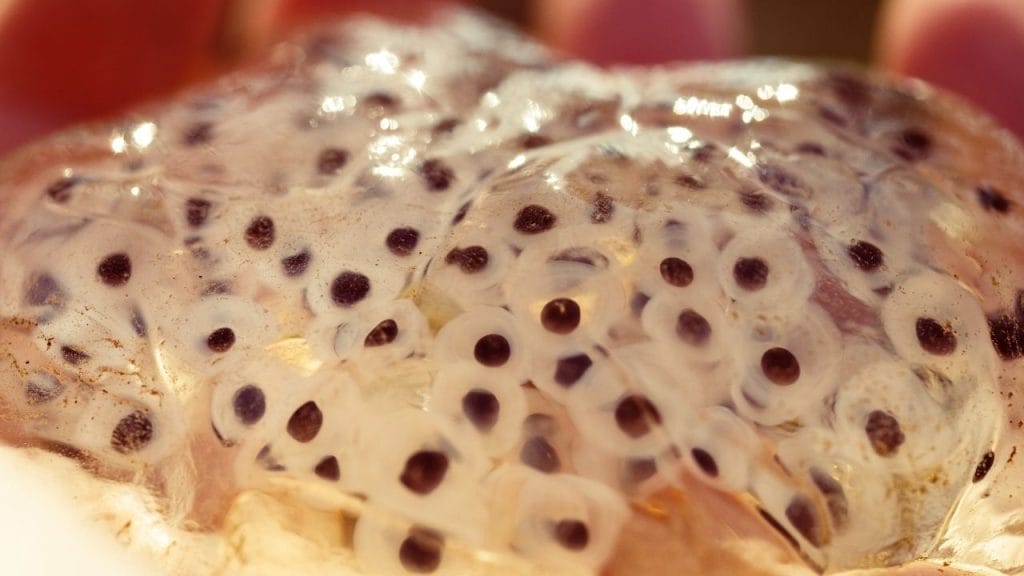
Healthy eggs are clear jelly capsules with a distinctly dark embryo inside. Early on that embryo is a round dot, usually black or dark brown on top and paler underneath. Within a few days it starts to elongate into a comma shape, and that change is the clearest sign development is happening.
Dead or unfertilised eggs go opaque white or cloudy grey throughout. The dark dot either never appears or fades out.

Check for the comma. If an egg still holds a perfectly round dot after several days while its neighbours have elongated, that one is not developing.
Why Frog Eggs Turn White
Two causes, and they look similar at first.
Unfertilised eggs were never viable. In any clutch a percentage simply miss out, and they turn white within a day or two. Normal, expected, nothing you did.
Water mould is the one to act on. Dead eggs get colonised by a fungus-like organism called Saprolegnia, which shows up as a white cottony fuzz. It feeds on dead tissue, but a heavy bloom will spread through a crowded clutch and smother healthy eggs beside it.
Remove white eggs with a pipette or a spoon as you spot them. In the wild this happens naturally through decay and water flow, but in a still tank the dead ones just sit there fouling the water.
Do Frog Eggs Need to Be Fertilised?
Yes, and unlike birds or reptiles, frogs handle this outside the body.
During breeding the male grips the female from above in a hold called amplexus, sometimes for hours or days. When she releases her eggs he releases sperm over them simultaneously, so fertilisation happens in the open water in the same moment.
That timing is why the male’s grip matters so much. Poor positioning means eggs and sperm miss each other and the whole clutch fails.
A handful of species do it differently. Tailed frogs use internal fertilisation, and various tropical species fertilise eggs laid on land. But for the spawn you are likely to find in a pond, external fertilisation is the rule.
Unfertilised eggs never develop. They cannot be rescued, warmed, or coaxed into hatching.
How to Move Frog Eggs Without Killing Them
If you have established the eggs are genuinely doomed where they are, here is how to move them with the least damage.
- Take the water with them. Fill your container from the same pond. The eggs should never be moved into unfamiliar water directly.
- Support the mass from underneath. Use a jug, a container, or cupped hands, not a net. Spawn tears easily and a net slices through the jelly.
- Keep them submerged the whole time. Do not lift the clump into the air, and do not let it fold over on itself.
- Take a portion, not the lot. A small handful is plenty.
- Move fast and keep them cool. A closed container in a warm car cooks them.
- Acclimatise on arrival. Float the container in the destination tank for 20-30 minutes so temperatures equalise before you release them.
Sudden temperature change kills more relocated spawn than anything else. A swing of a few degrees in a few minutes is enough.
Tank Setup for Frog Eggs and Tadpoles
Good news: this is one of the cheapest setups in the entire hobby. Tadpoles do not want a fancy home.
How Many Eggs Should You Take?
The old rule of one litre of water per three to five eggs falls apart the moment you do the arithmetic. A common frog clutch of 1,500 eggs would need around 400 litres.
Think in tadpoles, not eggs. Plan for roughly one litre of water per tadpole once they hatch, and take only what your container can handle at that density.
For a standard 10 litre tub, that is about 10 tadpoles, which means taking a piece of spawn about the size of a walnut. Overcrowding is the single most common mistake, and it causes stunted growth, fouled water, and in some species outright cannibalism.
Take fewer than you think you need. Every single one you take is one you are responsible for.
Water
Best to worst, in order:
- Water from the source pond. Familiar chemistry, and it carries the microscopic algae the tadpoles will graze on.
- Rainwater collected in a clean butt.
- Dechlorinated tap water. Either use a dechlorinator, or let it stand uncovered for 24 hours. Note that standing does not remove chloramine, which many water suppliers now use instead of chlorine, so a treatment product is the safer choice.
Never use distilled or reverse osmosis water on its own. It has no minerals, and developing tadpoles need them. Never use softened water either, because ion-exchange softeners load it with sodium.
Temperature
The single biggest correction to make to the usual advice: there is no one temperature for “frog eggs.”
| Species type | Target range | Notes |
|---|---|---|
| Temperate pond frogs | 59-68°F (15-20°C) | Common frog, wood frog, leopard frog |
| Warm-climate natives | 68-77°F (20-25°C) | Bullfrog, green frog |
| Tropical species | 75-82°F (24-28°C) | Dart frogs, red-eyed tree frogs |
The safest target is whatever the source pond was. If you collected spawn from cold spring meltwater, keeping it at 20°C will speed development up in a way the tadpoles are not built for, and you will get weak, undersized froglets.
Stability matters more than hitting a precise number. Keep the container out of direct sun and away from radiators.
Light
Tadpoles need a day and night cycle, and a little light drives the algae growth that feeds them. What they do not need is a sunbeam.
An hour of gentle sun or a spot of bright indirect light is plenty. A clear container in direct summer sun can gain 10 degrees in an hour and cook everything inside.
Filtration and Aeration
Frog eggs need oxygen but hate current. During the egg stage, run nothing at all and rely on surface area, which means a wide shallow container beats a tall narrow one.
Once tadpoles are swimming, a gentle air stone or a small sponge filter turned right down helps, particularly as they grow and their waste output climbs. Anything that creates visible flow is too strong.
Skip gravel. A bare bottom is far easier to clean, and you can add a few smooth stones and a live plant like elodea for grazing surface.
How Long Do Frog Eggs Take to Hatch?
Anywhere from 3 days to about 4 weeks, driven by species and temperature.
Warm-water species are fast. A bullfrog clutch can hatch in three days. Cold-water temperate species are slow, and a common frog clutch in a chilly early spring pond can take a month.
Colder water means slower development, not failed development. Do not panic and start heating things because nothing happened in the first week.
Watch the embryos rather than the calendar. Round dot, then comma, then a visible tail, then wriggling inside the jelly, then out.
What Happens Right After Hatching
Newly hatched tadpoles are not the swimming, grazing animals you are picturing. They are barely mobile.
For the first 24 to 48 hours they cling to the remains of the jelly or the side of the container and do almost nothing. They are living off the last of their yolk and their mouthparts are not functional yet.
Do not feed them during this window. Food they cannot eat just rots.

They breathe through external gills at this stage, visible as tiny feathery tufts behind the head. Within about a week those get covered over by a flap of skin as internal gills take over, and by then they are swimming and grazing properly.
Feeding Tadpoles
Once they are moving and grazing, tadpoles are mostly herbivorous, though that shifts toward omnivory as they grow and some species turn distinctly predatory near the end.
The basics: blanched greens such as lettuce or spinach that has been boiled soft and cooled, algae wafers, and the algae film that grows on the container walls and stones. Boiling matters, because raw leaves are too tough for them to rasp.
Feed small amounts and remove anything uneaten after a day. Fouled water kills tadpoles far faster than mild hunger does.
We have a full stage-by-stage feeding schedule in our guide to what tadpoles eat, including a week-by-week chart and what to do as they turn carnivorous.
Water Changes and Keeping Tadpoles Alive
Tadpoles produce a surprising amount of waste for their size, and ammonia is the usual invisible killer.
Change 20-30% of the water twice a week. Always replace with water at the same temperature, treated the same way as the original.
Never do a full water change. You would strip out the beneficial bacteria and the algae film along with the waste, and the shock alone can kill them.
Siphon debris off the bottom while you are at it. A length of airline tubing works fine as a mini gravel vacuum.
If the water goes cloudy or smells, you are overfeeding or overcrowded. Fix both immediately.
Metamorphosis Stage by Stage
| Stage | Roughly when | What you see |
|---|---|---|
| Hatching | Week 0 | Tiny tadpoles clinging to jelly, external gills |
| Free swimming | Week 1 | Grazing, gills now internal |
| Growth | Weeks 2-6 | Body fills out, no legs yet |
| Hind legs | Weeks 6-9 | Back legs bud and lengthen |
| Front legs | Weeks 9-12 | Front legs pop through, lungs functional |
| Tail resorption | Weeks 12-14 | Tail shrinks, body reshapes, not eating |
| Froglet | Weeks 12-16 | Fully formed, on land, tiny |

Those numbers cover common temperate species. Tropical species are faster, and bullfrog tadpoles are dramatically slower, sometimes spending one to three years as tadpoles and overwintering in that form.
The Land Exit: The Step That Kills Most Home-Raised Tadpoles
If you take one thing from this guide, take this.
The moment front legs appear, the tadpole has switched from gills to lungs. It now has to reach air, and if it cannot climb out of the water, it drowns.
This is the single most common way home-raised tadpoles die, and it happens right at the finish line after three months of work. People set up a beautiful deep tank with smooth vertical walls and no exit, and the froglets tire out and go under.

Watch for the front legs. Hind legs alone are not the trigger, but front legs mean act today.
How to give them a way out:
- Tilt the whole container so one end is shallow and one end is dry. Propping one side on a book works
- Add a large smooth stone or a piece of cork bark that breaks the surface and slopes gently
- Lower the water level as more froglets emerge
- Cover the container with mesh, because froglets climb glass and escape, and a dried-out froglet on the carpet is a grim discovery
- Keep the land area damp, not dry
Also worth knowing: froglets do not eat while absorbing the tail. The tail is a nutrient store and it gets recycled internally. If a new froglet ignores food for several days, that is normal, and food will only foul the water. Start offering once the tail is a stub.
Froglet Care
Here is where most guides go badly wrong, and where the old version of this article was flatly incorrect.
What Froglets Eat
Froglets are carnivores. The instant metamorphosis completes, the diet flips completely.
A tadpole rasps algae and softened greens. A froglet hunts live moving prey and nothing else. Lettuce, rabbit pellets, algae wafers, and fish flakes are tadpole food, and a froglet offered them will starve surrounded by it.

They are also tiny, often under half an inch, so the food has to be tiny too:
- Springtails are the ideal first food, small enough for the smallest froglets
- Flightless fruit flies (Drosophila melanogaster) are the standard staple
- Pinhead crickets once they have grown a little
- Aphids off untreated garden plants
- Bean weevils as a size step up
Feed daily. Growing froglets have fast metabolisms and burn through food.
Dust the prey with a calcium powder (my daily dusting pick) every few feeds, because captive insects are poor in calcium and young amphibians building a skeleton need it. Improving the insects themselves helps too, and a proper gut load (the gutload I use weekly) given to the feeders 24 hours before offering them passes straight through to the froglet.
Froglet Housing
They need damp, they need cover, and above all they need a lid.
A small plastic tub with ventilation holes works fine. Damp paper towel makes the easiest substrate for the first weeks because you can see the froglets and swap it out daily, and once they are bigger you can move to soil topped with leaf litter (the jackfruit leaves I top the tank with) for a more natural setup.
Add a shallow water dish they cannot drown in, no more than a few millimetres deep, and mist lightly with a spray bottle (the manual mister I keep handy) to keep humidity up.
Keep them away from adult frogs. Adults eat anything that fits in their mouth, including their own offspring.
If you are keeping any of them long term, our pet frog setup checklist covers what the permanent enclosure actually needs.
Handling
Do not, beyond what is strictly necessary.
Amphibian skin is permeable, which is the whole reason they are so vulnerable to pollutants. Soaps, lotions, hand sanitiser, and salt from your skin all pass straight through it.
If you must move one, wet your hands with the same dechlorinated water first, be quick, and stay low over a soft surface. Young froglets jump unpredictably and a fall onto a hard floor does real damage.
Should You Release Them?
For wild-collected spawn, yes, and this is the responsible ending to the project.
Release at the exact location you collected from. Not a nicer pond, not a friend’s garden, not a park. The same spot, for the disease reasons covered earlier.
Release once they are fully formed froglets with the tail absorbed and four working legs, not as tadpoles.
Release in the morning in mild damp weather. Not in the midday heat, not during a cold snap, not in a drought.
Do not release anything that shared water with pet animals. If your froglets were in a tank with pet frogs, aquarium fish, or equipment used on other tanks, they cannot go back to the wild. You have committed to keeping them.
Also check, before you get attached, whether releasing is legal where you live. Some jurisdictions prohibit releasing captive-held animals even back to their source.
Survival Rates: What to Actually Expect
The statistics on this get mangled constantly, including in the previous version of this article, so let us be precise about which number applies to which stage.
| Stage | Typical wild survival |
|---|---|
| Egg to hatching | Often high, frequently over half the clutch |
| Hatching to froglet | Brutal, most are eaten or starve |
| Egg through to breeding adult | Around 1-5%, often quoted as fewer than 1 in 50 |
The mortality is concentrated in the tadpole stage, not the egg stage. Eggs mostly hatch. It is the months afterwards, exposed to fish, newts, dragonfly larvae, birds, and drying ponds, that do the damage.
Indoors, with no predators and stable water, your numbers should be far better. A well-run tub can bring the majority through to froglet, which is precisely why taking a small amount of spawn matters. You are not compensating for wild losses, you are removing the losses entirely.
And to correct one more myth: favourable conditions lower mortality. Some versions of this advice have that backwards.
Troubleshooting
| Problem | Likely cause | Fix |
|---|---|---|
| Eggs turning white in the first days | Unfertilised | Normal, remove them |
| White cottony fuzz spreading | Saprolegnia water mould on dead eggs | Remove affected eggs immediately, improve water quality |
| Eggs not developing after 2 weeks | Water too cold, or unfertilised | Check temperature against species, be patient if cold |
| Tadpoles dying in ones and twos | Ammonia from overfeeding or crowding | Water change, cut feeding, reduce numbers |
| Cloudy or smelly water | Overfeeding | Remove uneaten food, 30% change |
| Tadpoles not growing | Overcrowded or underfed | Split into more containers |
| Tadpoles eating each other | Overcrowding or protein shortage | Separate immediately, more space |
| Legs never develop | Too cold, poor nutrition, or a slow species | Check species, check temperature |
| Froglet floating dead with legs | Drowned, no land exit | Add a ramp for the rest, urgently |
| Froglet ignoring food | Still absorbing its tail | Normal, wait for the tail to reduce |
| Deformed legs | Genetic, parasites, or pollutants | Not fixable, keep water clean |
How Many Eggs Do Frogs Lay?
It ranges from a dozen to twenty thousand, and the pattern behind that range is the interesting part.
Species that abandon their eggs lay enormous numbers. A bullfrog dumps up to 20,000 into a pond and leaves, betting on volume.
Species that care for their eggs lay very few. A poison dart frog lays 2 to 12, guards them, keeps them moist, and carries the tadpoles to water on her back. Far more of hers survive.
Neither strategy is better. They are just different bets, and both have worked for millions of years.
Do Frogs Eat Their Own Eggs?
Sometimes, though the framing of frogs as cannibals is a bit unfair.
Most frogs abandon spawn immediately and never encounter it again, so the question rarely arises. Frogs also hunt largely by movement, and a static clump of jelly does not read as food.
Where it does happen, it is usually opportunistic rather than targeted. African clawed frogs will hoover up their own eggs and tadpoles readily, which is why breeders separate adults from spawn as soon as it is laid.
Tadpole-on-tadpole cannibalism is the more common issue in a home tank, and it is almost always a symptom of overcrowding or not enough protein.
If the eggs turned up in your aquarium rather than a pond, that is a different situation entirely, and our guide to African dwarf frog eggs and baby care covers the fully aquatic species most likely to be responsible.
If you are breeding deliberately, our guide on how to breed tree frogs covers separating adults at the right moment.
Can Frog Eggs Survive Out of Water?
Pond-spawning frog eggs, no. They have no shell, only jelly, and that jelly relies on surrounding water to stay hydrated. Out of water they dry out within hours and cannot be revived.
But “frog eggs need water” is too simple as a blanket statement, because plenty of species have got clever about it.
Red-eyed tree frogs lay on leaves overhanging water, and the hatching tadpoles drop in. Some rain frogs skip the water stage entirely and develop straight into froglets inside the egg. Dart frogs lay on land in damp leaf litter and the male keeps them moist.
What all of these have in common is constant moisture, not necessarily submersion. If you find spawn stranded above the waterline in a drying pond, nudging it back into the water is one of the few clear-cut cases where intervening helps.
Found Frog Eggs in Your Pool?
A swimming pool is a death trap for spawn. Chlorine kills the eggs, and any that hatch get sucked into the skimmer.
Scoop the spawn out with a jug of pool water, then move it to the nearest natural pond only if that pond is the likely origin. Otherwise, honestly, this is a case for raising them indoors or accepting the loss, because introducing them somewhere new carries the disease risk covered earlier.
The longer-term fix is to stop frogs choosing your pool in the first place. Our guide on keeping frogs away from a pool covers pool covers, lighting, and what actually deters them.
Raising Frog Eggs With Kids
It is a genuinely great project, and a few adjustments make it go better.
Keep the container at eye level for a child, because most of the value is in the daily watching. Use a clear tub rather than anything decorative.
Set expectations early that some will die. They will, even in a well-run tub, and it lands much better as an expected part of the process than as a surprise.
Get the land exit built before front legs appear, not after. There is no sadder end to a school project.
And plan the release from day one, including the promise that they go back exactly where they came from.
Frequently Asked Questions
How long do frog eggs take to hatch?
Between 3 days and about 4 weeks, depending on species and water temperature. Warm-water species like bullfrogs are fastest.
Can I hatch frog eggs in a jar?
For a very small number, briefly, yes. But a jar has poor surface area for oxygen and heats up fast, so a wide shallow tub is much better. Ten litres per ten tadpoles.
Why are my frog eggs turning white?
They are unfertilised or dead. Remove them, because white cottony growth on dead eggs can spread to healthy ones nearby.
Do frog eggs need an air pump?
Not during the egg stage, where still water and good surface area are enough. A gentle air stone helps once tadpoles are growing, but strong current is harmful.
Can I put frog eggs in tap water?
Only if it has been dechlorinated. Chlorine and chloramine both kill spawn, and letting water stand overnight removes chlorine but not chloramine.
How many frog eggs should I take?
Enough for about one litre of water per tadpole. For a typical tub, a walnut-sized piece of spawn is plenty.
What do I feed newly hatched tadpoles?
Nothing for the first day or two while they absorb their yolk. After that, boiled lettuce, algae wafers, and the algae growing in the tank.
When can froglets leave the water?
As soon as the front legs appear they need access to land, because their lungs are working and they can drown. Do not wait for the tail to disappear.
Do froglets eat plants?
No. Froglets are carnivores and need live prey such as springtails, fruit flies, or pinhead crickets. This is the most common and most fatal mistake people make.
Can I keep the frogs I raised?
Sometimes, depending on species and local law, but be honest about the commitment. Many native frogs live 5 to 15 years, and our pet frog lifespan comparison is worth reading before you decide.
Is it illegal to take frog spawn?
It depends entirely on where you live and which species it is. Check your local wildlife agency, and never collect from protected land or protected species.
Final Words
Raising frog eggs is one of the few nature projects where you genuinely watch an animal rebuild itself from scratch. A grazing, gilled, tailed swimmer turns into an air-breathing, four-legged hunter in about three months, and there is nothing else quite like it to watch up close.
Just do it with a light touch. Take a small piece of spawn rather than the whole clump, keep them somewhere they cannot cook, build the ramp before the front legs appear, remember that froglets want live food and not lettuce, and put them back exactly where you found them.
And if the eggs are sitting safely in a pond doing fine without you, the best possible outcome is that you leave them there and go back to check on them every few days.
About Author
Hello, I’m Muntaseer Rahman, the owner of AcuarioPets.com. I’m passionate about aquarium pets like shrimps, snails, crabs, and crayfish. I’ve created this website to share my expertise and help you provide better care for these amazing pets.
Disclaimer
This site is owned and operated by Muntaseer Rahman. AcuarioPets.com is a participant in the Amazon Services LLC Associates Program, an affiliate advertising program designed to provide a means for sites to earn advertising fees by advertising and linking to Amazon.com. This site also participates in other affiliate programs and is compensated for referring traffic and business to these companies.