This post was created with help from AI tools and carefully reviewed by a human (Muntaseer Rahman) . For more on how we use AI on this site, check out our Editorial Policy.
Check Out These FREE Tools We Made JUST For You!
What Do Toads Eat? Complete Diet Guide (Wild vs Pet Toads + Feeding Schedule)

Toads are carnivores. They eat live insects, worms, spiders, slugs, snails, beetles, and pretty much anything else that moves and fits down their throat.
They have no teeth worth mentioning, so nothing gets chewed. A toad flicks out a sticky tongue, swallows the prey whole, and blinks its eyeballs down into its skull to help shove the meal down.
Here is the part most people get wrong: adult toads do not eat plants, fruit, or vegetables at all. Not lettuce, not banana, not a single leaf. Their gut cannot process it.
Toad tadpoles are the exception. They are herbivores that scrape algae and biofilm until they sprout legs, and then they flip to a full meat diet for the rest of their lives.
This guide covers what wild toads eat, what to feed a pet toad at every age, how often to feed, how to dust with calcium so your toad does not end up with crumbling bones, and the 13 foods that range from useless to fatal.
Quick Toad Feeding Guide
| Question | Short answer |
|---|---|
| What do they eat? | Live insects and invertebrates: crickets, roaches, earthworms, beetles, slugs, snails, spiders, moths |
| Do they eat plants? | No. Adults are strict carnivores. Only tadpoles eat plant matter |
| Live or dead prey? | Live only. Toads hunt by movement and usually ignore anything that sits still |
| Adult feeding | 2 to 3 times per week, about 3 to 6 insects per session |
| Juvenile feeding | Every day or every other day, smaller prey |
| Toadlet feeding | Daily, tiny prey only (fruit flies, springtails, pinhead crickets) |
| Supplements | Dust with calcium plus D3 at most feedings, vitamin powder once a week |
| Prey size rule | No wider than the gap between the toad’s eyes |
| Water | They do not drink with their mouth. They soak it up through the skin |
| Never feed | Cat or dog food, bread, rice, fruit, fish food, fireflies, wild-caught bugs, dead prey |
What Do Toads Eat In the Wild?
A wild toad’s menu is basically “whatever crawled past at the wrong moment.” They are ambush predators with zero standards.
Sit still, wait, and when something moves within tongue range, take the shot. Miss? Fine, another bug will be along shortly.

Here is what actually shows up in wild toad stomach content studies, grouped by how common it is:
| Prey group | Examples | How much of the diet |
|---|---|---|
| Beetles and ground insects | Ground beetles, weevils, click beetles | The single biggest chunk for most species |
| Ants and true bugs | Ants, aphids, leafhoppers | Very high by count, low by weight |
| Worms and soft-bodied prey | Earthworms, grubs, caterpillars, insect larvae | Major, especially after rain |
| Molluscs | Slugs, snails | Common, and the reason gardeners love them |
| Arachnids and myriapods | Spiders, harvestmen, centipedes, millipedes | Regular but smaller share |
| Flying insects | Moths, flies, mosquitoes, grain moths | Mostly taken near porch lights at night |
| Crustaceans | Woodlice, pill bugs, sowbugs | Steady filler prey |
| Small vertebrates | Tiny mice, small snakes, lizards, other frogs | Only in big species. Not on the menu for an American toad |
That last row is where most articles mislead people. A 3-inch American toad is not eating mice or snakes.
Prey size scales with toad size, and it scales fast. A cane toad or a Sonoran Desert toad genuinely can swallow a mouse. Your backyard toad is working with beetles and worms.
How Toads Actually Catch Prey
Toad vision is wired for movement. Their eyes and brain filter hard for small moving objects, which is why a toad will strike a wiggling worm and completely ignore the same worm lying dead an inch away.
The tongue is attached at the front of the mouth, not the back, so it flips outward like a party blower. It is coated in a saliva that behaves like a shear-thinning glue, going runny on impact to grab the bug, then thickening to hold it on the way back in.
Then comes the weird part. Toads pull their eyeballs down through openings in the skull to physically push the prey down the throat. That blink you see every time a toad swallows is not a blink. It is chewing, with eyeballs.
Bigger prey gets stuffed in by hand. Toads will shove a fat earthworm into their mouth with their forelimbs like someone eating a sandwich too aggressively.
Do Toads Eat Slugs and Snails?
Yes, and enthusiastically. This is the main reason having toads around a garden is a win.
Slugs and snails are soft, slow, and easy for a toad to swallow. A resident toad will work through a meaningful number of them over a season.
The catch is for pet toads. Wild-caught slugs and snails can carry parasites, including rat lungworm, and they concentrate whatever pesticide or slug bait is in the soil.
If you want to feed snails to a pet toad, buy captive-bred ones. Do not grab them off your lawn.
Do Toads Eat Ants, Bees, and Wasps?
Ants, constantly. Some toad species eat ants by the hundreds, and they show up in stomach contents more than almost anything else.
Bees and wasps are a different story. Toads will occasionally take one, and toads that sit near hive entrances have been recorded eating bees, but a sting inside the mouth is a real risk.
Never deliberately feed a stinging insect to a pet toad.
What Do Toads Eat by Species?
“Toad” covers a lot of ground. The differences matter most at the extremes.
| Species | Adult size | Typical diet | Notes |
|---|---|---|---|
| American toad (Anaxyrus americanus) | 2 to 3.5 in | Beetles, ants, worms, slugs, spiders | The classic backyard toad. Invertebrates only |
| Fowler’s toad (Anaxyrus fowleri) | 2 to 3 in | Similar to American toad, more ants | Avoids earthworms more than American toads do |
| Southern toad (Anaxyrus terrestris) | 1.5 to 3 in | Ants, beetles, roaches | Common in Florida yards |
| Woodhouse’s toad (Anaxyrus woodhousii) | 3 to 5 in | Beetles, moths, larger insects | Bigger prey range |
| European common toad (Bufo bufo) | 3 to 5 in | Worms, slugs, beetles, woodlice | The classic UK garden toad |
| Cane toad (Rhinella marina) | 6 to 9 in | Insects, small vertebrates, carrion, pet food, garbage | The one true exception. Genuinely opportunistic and will eat non-living food |
| Colorado River / Sonoran Desert toad (Incilius alvarius) | 5 to 7 in | Large insects, mice, other toads | Big enough to take vertebrates |
The cane toad is worth flagging because it is responsible for most of the internet’s bad toad-diet advice. Cane toads will eat dog food out of a bowl on a Florida porch and scavenge carrion.

That is a cane toad thing. It is not a toad thing. Applying cane toad behavior to your American toad is how people end up feeding kibble to an animal that cannot digest it.
What Do Baby Toads (Toadlets) Eat?
This is where most rescued toads die, and it is almost always the same mistake: the food is too big.
A toadlet that just crawled out of the pond is often smaller than a fingernail. A standard pet-store cricket is enormous to it, and the toadlet will either refuse it or choke.

Feed toadlets the smallest live prey you can get:
- Springtails (the best starter food, and you can culture them right in the enclosure)
- Flightless fruit flies (Drosophila melanogaster first, then hydei as they grow)
- Pinhead crickets (newly hatched, under 1/8 inch)
- Aphids and tiny soft-bodied insects
- Bean beetles once they size up a bit
Feed every single day. Toadlets are growing at a brutal rate and have almost no energy reserves.
Dust with calcium plus D3 at nearly every feeding. Fast-growing young toads are the group most likely to develop metabolic bone disease, and once their spine and legs deform, it does not reverse.
What Do Toad Tadpoles Eat?
Toad tadpoles are herbivores. They spend their whole swimming phase grazing.
Right after hatching they absorb their yolk sac and do not need feeding at all. After that they scrape algae, biofilm, decaying plant matter, and detritus off rocks and plant stems.
They do it with rows of tiny keratin ridges called keratodonts, not real teeth. People call them teeth constantly, but they are more like a rasp, and tadpoles have them from very early on rather than growing them at week 6.
As the back legs come in, tadpoles start taking protein: fish larvae, water fleas, and in crowded ponds, each other. Toad tadpoles are documented cannibals when food runs short.
Then the front legs appear and everything stops. During metamorphosis the tadpole eats nothing at all and lives off its own tail, which is why a “not eating” toadlet at that stage is completely normal.
If you are raising tadpoles specifically, the full stage-by-stage feeding chart is in the tadpole feeding guide.
What Do Pet Toads Eat?
A captive toad eats a rotation of gut-loaded feeder insects, dusted with supplements. That is the whole system.
The failure mode is feeding one thing forever. A toad on nothing but crickets will be undernourished, and a toad on nothing but mealworms will get sick.
Best Feeder Insects for Toads
| Feeder | Ca:P ratio | Use as | Notes |
|---|---|---|---|
| Crickets | Poor (~1:9) | Staple | Cheap, active, triggers the feeding response well. Must be dusted |
| Dubia roaches | Poor (~1:3) | Staple | High protein, soft shell, easy to digest, do not climb glass |
| Black soldier fly larvae | Excellent (~2:1) | Staple | The only common feeder with naturally good calcium. Often needs no dusting |
| Earthworms / nightcrawlers | Good | Staple | Excellent nutrition and moisture. Big favorite of most toads. Cut to size |
| Hornworms | Fair | Frequent | Very high moisture, good for a dehydrated or constipated toad. Grow fast |
| Silkworms | Good | Frequent | Soft, high protein, well digested |
| Snails (captive-bred) | Excellent | Occasional | Natural prey and a calcium source, shell included |
| Waxworms | Poor | Treat only | Very high fat. Toads get addicted and refuse better food |
| Mealworms | Very poor (1:8 to 1:17) | Treat only | Hard chitin shell, badly inverted calcium ratio |
| Superworms | Very poor | Treat only | Same problems as mealworms, bigger |
| Springtails / fruit flies | Fair | Toadlets | Too small to matter for adults |
Rotate at least three staples. Variety covers the nutritional holes that any single feeder leaves.
Gut-Loading: The Step Everyone Skips
A feeder insect is a delivery vehicle. Whatever is in the insect’s gut goes into your toad.
Feed your crickets or roaches something nutritious for 24 to 48 hours before they get fed out. Dark leafy greens, carrot, squash, and a commercial gut-load diet all work.
A cricket that has been sitting in a plastic tub eating cardboard for a week is close to nutritionally empty. Gut-loading is not optional if you want a toad that lives its full 10 to 15 years.
Calcium and Vitamin Dusting Schedule
Metabolic bone disease is the number one husbandry killer of pet toads, and it comes down entirely to calcium and D3.
| Toad age | Calcium + D3 | Vitamin powder |
|---|---|---|
| Toadlets and juveniles | Almost every feeding | Once per week |
| Adults | 2 to 3 times per week | Once per week |
Put the insects in a bag or cup, add a light dusting of powder, and shake until they look faintly sugar-coated. Feed immediately, because the powder falls off fast.
Do not use a supplement with added phosphorus. Toads already get far too much phosphorus from insects, and extra phosphorus blocks the calcium from being absorbed at all.
Repashy and Rep-Cal are the two supplement brands most keepers use, and both make a calcium-with-D3 and a separate multivitamin (I suggest this one).
The Prey Size Rule
The safe maximum is simple: nothing wider than the space between your toad’s eyes.
Anything bigger risks choking or impaction. When in doubt, go a size down, because a toad will happily eat three small crickets and will not resent you for it.
Toad Feeding Schedule by Age
| Stage | How often | How much |
|---|---|---|
| Tadpole | Constant grazing, top up daily | Algae, blanched greens, tadpole food |
| Toadlet (just morphed) | Every day | 5 to 10 tiny prey items |
| Juvenile | Daily to every other day | 3 to 6 small insects |
| Adult | 2 to 3 times per week | 3 to 6 appropriately sized insects |
| Large adult / big species | 2 times per week | Fewer, larger prey |
| Brumating toad | Not at all | Nothing. This is normal |
Adults genuinely do not need daily food. Their metabolism is slow, and a well-fed adult toad skipping a day is fine.
Watch the body, not the calendar. A toad should look rounded but still have a visible line where the body meets the legs. If it looks like an inflated balloon with no waist, back the feeding off.
How Many Mealworms Should You Feed Your Toad?
Very few, and not as a staple. Two or three as an occasional treat, once a week at most.
Mealworms have a calcium to phosphorus ratio somewhere between 1:8 and 1:17, which is badly inverted. Amphibians need roughly 1.5:1 to 2:1 going the other direction.
All that extra phosphorus binds calcium in the gut and blocks absorption, so a mealworm-heavy diet actively drives metabolic bone disease even if you are dusting.
The second problem is the shell. Mealworms are wrapped in hard chitin that small toads struggle to pass, which can lead to impaction.
You will see older articles claim mealworms cause liver damage in toads. That one is not well supported. The real, documented problems are the calcium ratio and the chitin, and they are bad enough on their own.
How Much Should I Feed My American Toad?
An adult American toad does well on 3 to 6 appropriately sized insects, 2 to 3 times per week.
Juveniles need more like 3 to 6 small insects every day or every other day, because they are still growing.
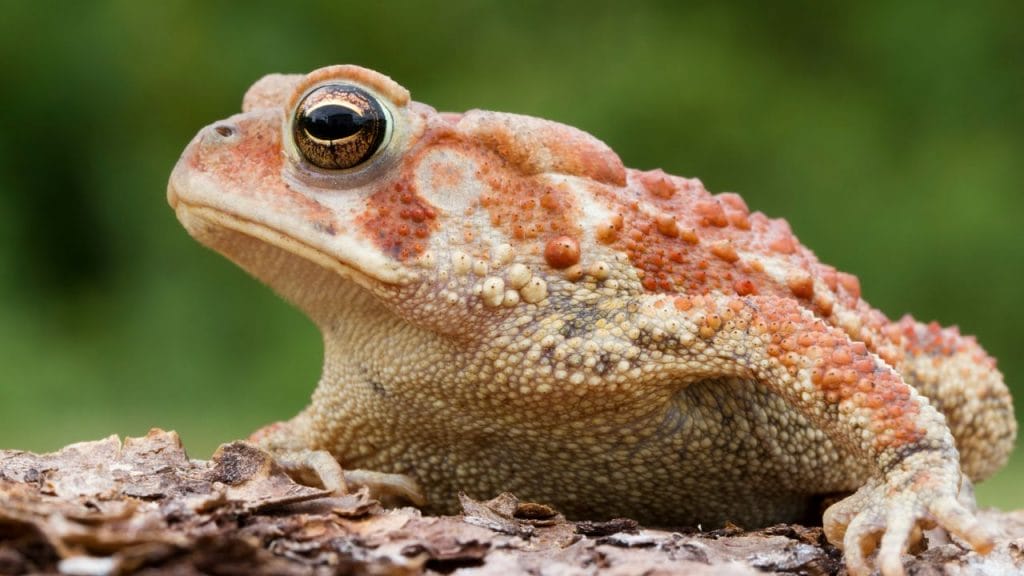
American toads top out around 3.5 inches, so “appropriately sized” here means crickets, small roaches, and cut earthworms. Not mice, not pinkies, no matter what a listicle told you.
Dust with calcium plus D3 two to three times a week and add a multivitamin once a week.
Do Toads Drink Water?
Toads never drink with their mouth. Not once in their entire life.
They absorb water straight through the skin, and they do it through a specific patch on the belly and inner thighs called the pelvic patch or seat patch.
The numbers on this are genuinely impressive. That patch is only about 10% of the toad’s skin area but handles over 70% of total water uptake in a dehydrated toad.
When a toad is thirsty it presses that patch flat against damp ground or into a shallow dish and spreads its back legs to increase contact. That is a toad taking a drink.

What this means practically:
- Provide a shallow dish the toad can climb in and out of easily. Toads are poor swimmers and can drown in deep water
- Dechlorinate tap water. Chlorine and chloramine go straight through that permeable skin into the bloodstream
- Do not use distilled water. It has no minerals and pulls electrolytes out of the toad through osmosis
- Change the water daily, because toads defecate in it constantly
Can You Overfeed a Toad?
Yes, easily. Toads have no real off switch and will eat as long as food keeps moving.
An overfed toad gets obese, and obesity in amphibians causes fatty liver disease and shortens life significantly. It is one of the most common problems in captive toads.
Stick to the schedule rather than feeding whenever the toad looks interested, because the toad always looks interested.
The tell is body shape. A healthy toad is plump with a slight indent where the hind legs meet the body. An overfed toad is smooth and swollen with no definition and may have fat pads bulging behind the arms.
How Long Can a Toad Go Without Food?
A healthy adult toad can go 2 weeks to a couple of months without eating, depending on size, temperature, and fat reserves.
This is not a license to skip feedings. It is context for when a toad stops eating on its own.
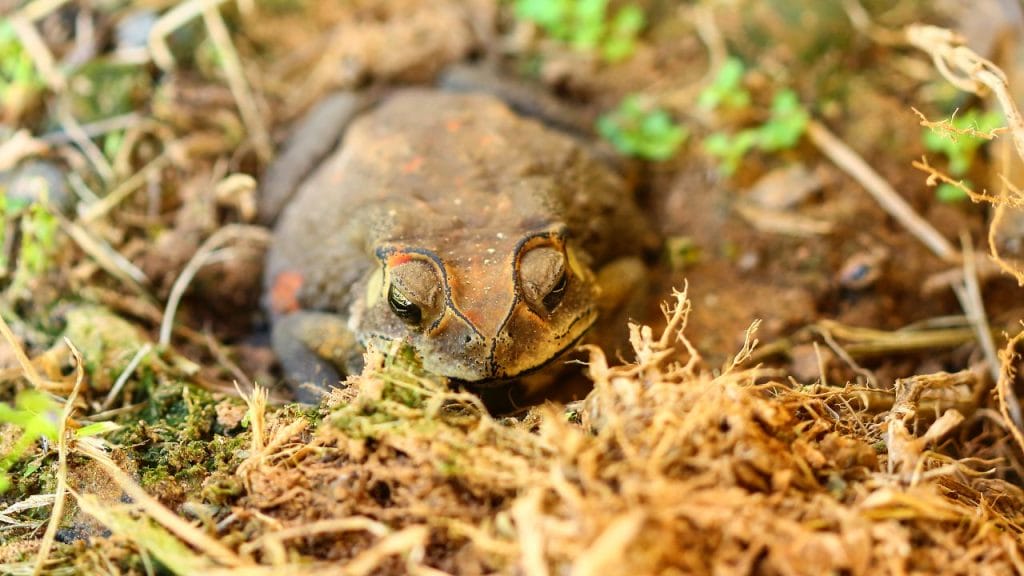
Two normal reasons a toad fasts:
- Brumation. As temperatures drop, toads burrow down and shut their metabolism way off. They eat nothing for months and that is exactly what they are supposed to do
- Aestivation. Same idea in hot, dry conditions. The toad digs in and waits it out
A toad refusing food in a cooling enclosure in autumn is usually just following its calendar. A toad refusing food at stable room temperature in June is a problem.
Why Is My Toad Not Eating?
| Cause | What you will see | Fix |
|---|---|---|
| Prey too large | Strikes and spits it out, or ignores it | Drop a size |
| Prey not moving | Total disinterest in food that is sitting still | Live, active feeders only |
| Temperature too low | Sluggish, hiding, slow everything | Check the ambient temperature against the species range |
| Brumation cue | Autumn, cooling, burrowing | Normal. Let it happen |
| About to shed | Dull skin, hiding, brief refusal | Normal. Passes in a day or two |
| New home stress | Just moved in, hides constantly | Give it a week undisturbed, feed at dusk |
| Dehydration | Wrinkled skin, sunken eyes, sitting in water | Shallow clean dechlorinated water, raise humidity |
| Impaction | Bloated, straining, no droppings | Warm soak, and see a vet if it persists |
| Parasites or infection | Weight loss while still eating, or lethargy | Exotics vet, fecal test |
If a toad refuses food for more than two weeks outside of brumation and is also losing weight or looking lethargic, that is a vet visit. Amphibians hide illness until late, so waiting rarely helps.
Foods Toads Should Never Eat
| Food | Why it is a problem |
|---|---|
| Cat or dog food | Wrong nutrient profile entirely, far too much protein and fat, and toads cannot process the plant fillers |
| Bread | Starch with no nutrition. Toads have no way to digest it |
| Rice | Same as bread, plus a swelling risk |
| Fruit, including bananas | Toads are carnivores. They do not eat fruit in the wild and their gut cannot handle sugar loads |
| Vegetables and lettuce | Same. Adult toads have no use for plant matter |
| Fish food (flakes and pellets) | Formulated for fish, missing what a toad needs, and toads usually will not recognize it as food |
| Fireflies / lightning bugs | Contain lucibufagins, cardiac toxins. Documented deaths in captive amphibians and reptiles. Never worth the gamble |
| Wild-caught insects | Carry parasites and concentrate lawn pesticides and slug bait |
| Stinging insects | Bees and wasps can sting inside the mouth |
| Hairy caterpillars | Irritating hairs and some are outright toxic |
| Seasoned or cooked meat | Salt, oil, and spices are all bad news for an animal with permeable skin and no salt tolerance |
| Sugar and salt | Toads have no mechanism for either |
| Dead prey | Toads hunt by movement and mostly will not touch it. Leftover dead insects rot and foul the enclosure |
A note on the cat food question, because it comes up constantly: cat food is not a poison that kills a toad in one bite. You will see that claim everywhere and it is not accurate.
What actually happens is slower and less dramatic. It is nutritionally wrong for a toad, it is far too rich, it contributes to obesity and calcium imbalance, and it does not move, so most toads ignore it anyway.
The exception, again, is the cane toad, which will absolutely raid a pet bowl. That is a reason to bring pet food indoors in cane toad territory, not a reason to feed kibble to toads.
I Found a Toad in My Yard. What Do I Feed It?
Nothing. Genuinely, that is the answer.
A wild toad in your yard is already eating better than anything you can offer it, and it is finding that food itself every night. Feeding it does not help.
If you want to support it, make the yard work for it instead:
- Leave a shallow dish of dechlorinated water at ground level
- Stop using pesticides and slug pellets, which poison the toad through its prey
- Leave a damp shaded hiding spot: a log, a broken pot on its side, a pile of leaves
- Keep a corner of the yard unmown
If you have genuinely rescued an injured toad and need to hold it briefly, offer live earthworms or crickets from a pet store and get it to a wildlife rehabber. Do not keep it. In many US states, taking native amphibians from the wild is illegal without a permit.
More on the legality and the practical reality of this in our guide on whether you can keep wild frogs as pets.
Are Toads Good for the Garden?
Very. A toad is a free, self-operating pest control unit that works the night shift.
Their diet is dominated by exactly the things gardeners hate: slugs, snails, cutworms, grubs, beetles, and various larvae. A single resident toad works through a serious volume of them across a season.

The trade-off is that you have to stop poisoning their food. Slug pellets and broad-spectrum insecticides move up the chain into the toad, and a yard sprayed regularly will not hold toads for long.
If you have the opposite problem and want fewer amphibians around, we covered that separately in how to get rid of frogs in your yard.
What Eats Toads, and Why That Matters for Pets
Toads are not defenseless. The parotoid glands behind the eyes secrete bufotoxin, which is why most predators learn to leave them alone after one attempt.
This matters if you have a dog. A dog that mouths a toad can get a nasty reaction, and with a cane toad it can be an emergency.
Snakes like hognose snakes are largely immune and eat toads regularly. Raccoons have learned to flip toads over and eat the belly to avoid the glands, which is grim but effective.
Toad Diet FAQ
Do toads eat worms?
Yes, earthworms are one of the best foods you can give a toad. They are nutritious, high in moisture, and most toads go after them hard. Cut nightcrawlers into toad-sized pieces.
Do toads eat other toads?
Larger species will eat smaller frogs and toads, including their own kind. Cane toads and Colorado River toads do this regularly. American toads generally do not, because nothing smaller is around.
Can toads eat lettuce or vegetables?
No. Adult toads cannot digest plant matter. Only tadpoles eat greens, and even then it should be blanched.
Do toads eat mice?
Only the large species. Cane toads and Colorado River toads can and do. An American toad or garden toad cannot fit a mouse in its mouth.
Do toads eat spiders?
Yes, regularly. Spiders are standard prey for most toad species.
Do toads eat during the day?
Mostly not. Toads are nocturnal or crepuscular and do most of their hunting from dusk onward. Feed pet toads in the evening for the best response.
How do toads find food in the dark?
Mainly by sight. Toad eyes are unusually good in low light and are tuned to detect small moving shapes. They also position themselves near reliable insect traffic, which is why toads park under porch lights.
Can toads eat human food?
No. Nothing from your plate is appropriate. Cooked, seasoned, sugary, or salty food is all off-limits.
Should I feed my toad in winter?
If it is brumating, no. A cold, burrowed toad is not digesting and food sitting in its gut can rot. Let it fast and resume when it warms and becomes active.
How long do toads live if fed properly?
Most common pet species live 10 to 15 years in captivity, and some individuals go well past 20. Diet and calcium supplementation are the biggest levers you control.
Before You Go
The short version: live bugs, correctly sized, dusted with calcium, on a schedule that matches the toad’s age. That covers 90% of it.
The other 10% is knowing what not to do. No fruit, no bread, no kibble, no dead prey, no bugs from a sprayed lawn, no fireflies ever.
Get that right and a toad is one of the easiest and longest-lived pets you can keep. Get it wrong and you get metabolic bone disease, which is heartbreaking and completely preventable.
If you are weighing up whether to actually get one, the running costs are worth a look first.
[Pet Frog Cost Breakdown [Full Buying Guide]](https://acuariopets.com/pet-frog-cost-breakdown/)

About Author
Hello, I’m Muntaseer Rahman, the owner of AcuarioPets.com. I’m passionate about aquarium pets like shrimps, snails, crabs, and crayfish. I’ve created this website to share my expertise and help you provide better care for these amazing pets.
Disclaimer
This site is owned and operated by Muntaseer Rahman. AcuarioPets.com is a participant in the Amazon Services LLC Associates Program, an affiliate advertising program designed to provide a means for sites to earn advertising fees by advertising and linking to Amazon.com. This site also participates in other affiliate programs and is compensated for referring traffic and business to these companies.