This post was created with help from AI tools and carefully reviewed by a human (Muntaseer Rahman) . For more on how we use AI on this site, check out our Editorial Policy.
Check Out These FREE Tools We Made JUST For You!
Why Is My Chameleon Staying at the Bottom of the Cage?

You walked over to check on your chameleon. Instead of finding him perched up high gripping a branch like a tiny green gargoyle, he’s down there. On the floor. Walking around in the dirt like a confused gecko.
This is bad. Or it could be totally normal. The problem is, you don’t know which one yet.
Here’s the deal: chameleons are tree dwellers. Their entire body — the prehensile tail, the mitten feet, the rotating eyes scanning for hawks — is built for life in the canopy. A healthy chameleon does not hang out on the ground. When yours does, something has changed.
Let’s walk through every reason this happens, in the order you should actually check them.
First: Is She a Gravid Female?
Stop and answer this before you panic.
If your chameleon is an adult female and she’s pacing the floor or trying to dig, she’s probably looking for a place to lay eggs. Female chameleons lay eggs even without a male around. Yes, really.
This is normal behavior — but it’s also a ticking clock. If she can’t find suitable substrate to dig in, she risks becoming egg bound, which is a vet-emergency-level problem.
What to do: set up a laying bin immediately. A deep container of moist sand or sand-soil mix, at least 8-12 inches deep, placed in a quiet spot in her cage. We have a full guide on female chameleon egg-laying, and if you suspect she’s already in trouble, read egg binding in chameleons right now.
If your chameleon is a male, or a juvenile, skip this section and keep reading.
Reason 1: Metabolic Bone Disease (MBD)
This is the answer the chameleon community jumps to first, and for good reason. MBD is the most common reason captive chameleons end up on the floor.
What happens: bad UVB lighting, poor calcium supplementation, or both, slowly turn your chameleon’s bones into rubber. He literally cannot grip the branch anymore. So he falls. Or he climbs down on purpose because climbing hurts.
Look for: rubbery jaw, bowed legs, weird kinked spine, swollen joints, tremors, or a tongue that won’t fully shoot out. If you see any of these alongside floor behavior, you have your answer.
What to do: book a reptile vet appointment. MBD can be halted and partially reversed if you catch it early. Then audit your setup — read chameleon UVB lighting and our full metabolic bone disease in chameleons breakdown.
Reason 2: Dehydration
Dehydrated chameleons climb down to the substrate looking for water. In the wild, they drink dew off leaves and runoff from the forest floor. Your guy is doing the same thing — he’s just looking in the wrong place because nothing on his branches is wet enough.
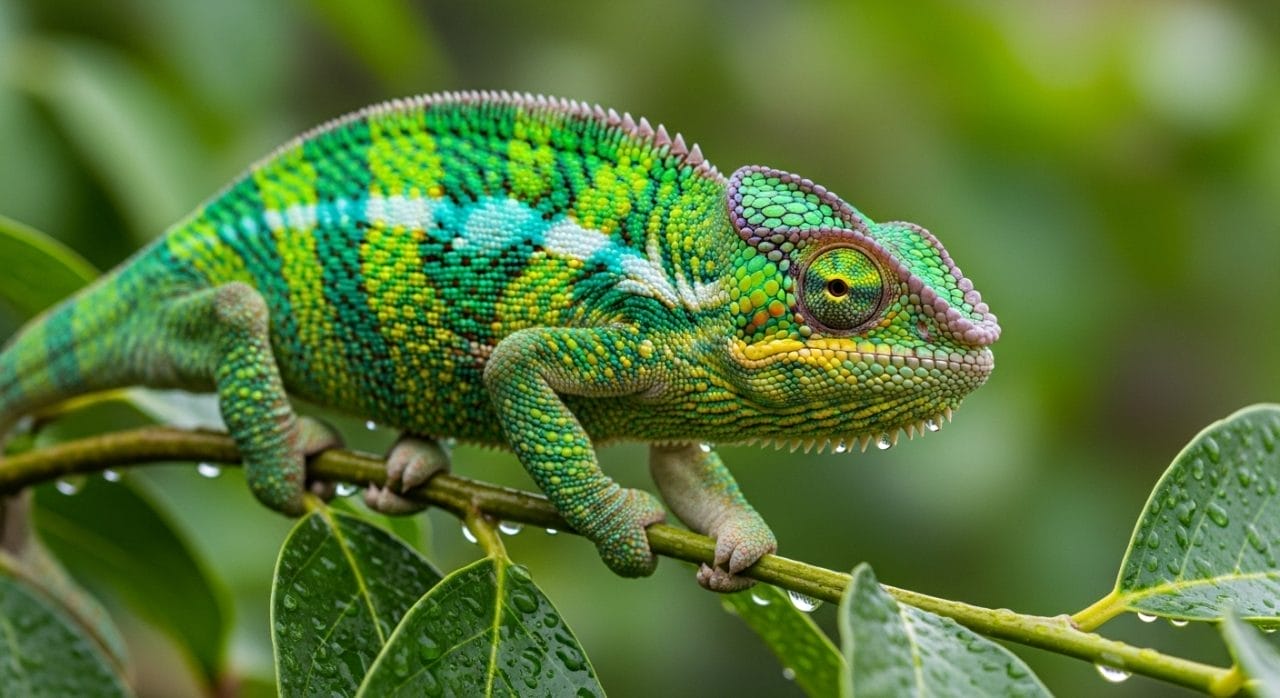
Look for: sunken eyes, orange-tinted urates (the white pellet should be white, not yellow or orange), sticky-looking saliva, skin that doesn’t snap back when gently pinched.
What to do: mist way more than you currently do. Like, a lot more. Get a real misting system (the only one I trust for chameleons), not a spray bottle. Our guides on keeping chameleons hydrated and the best chameleon misting systems cover the full setup.
Reason 3: Respiratory Infection
A chameleon with a respiratory infection (RI) feels like garbage. He gets weak, he stops climbing, and he ends up on the bottom because that’s where gravity put him.
Look for: open-mouth breathing, wheezing or popping sounds, mucus or bubbles around the mouth or nose, that classic chin-tilted-up “stargazing” pose trying to get air.
RIs do not get better on their own. They need antibiotics. Read chameleon respiratory infections for early signs, then call a vet.
Reason 4: He Fell
Chameleons almost never fall — until they do. And when they do, there’s usually an underlying reason like MBD weakening their grip.
If yours is on the floor and there’s a branch right above where he was perched, look carefully. Is one leg held weird? Hanging? Not bearing weight? Is his back twisted? He might have a fracture or spinal injury.
What to do: do not pick him up unless you absolutely have to, and if you do, support his whole body. Get to a reptile vet immediately. Splints and calcium therapy can save broken limbs, but only if a professional sets them.
Reason 5: Cage Is Too Cold (or Wrong Temperatures)
Chameleons are cold-blooded. If the basking spot isn’t hot enough, or the whole cage has dropped into the 60s, your chameleon physically cannot generate the energy to climb and digest food. He gets sluggish. He gives up. He sits.
Check your basking temp with an actual digital probe thermometer. Not a stick-on dial, those are useless. The basking branch should hit the right range for your species — generally 85-90°F for veiled and panther chameleons, cooler for Jackson’s.
Our guide on creating proper temperature gradients in chameleon enclosures covers the exact numbers per species.
Reason 6: The Cage Setup Is Stressing Him Out
Sometimes chameleons leave the high branches because the high branches are not safe.

A cage with sparse foliage gives a chameleon nowhere to hide. He feels exposed. Other times the branches are too thin, too smooth, or too far apart — he literally can’t get comfortable up there. So he climbs down.
Watch for: glass surfing, screen climbing, pacing the bottom, dark stress colors (especially in veiled chameleons turning black or dark brown).
Fix: add dense leafy cover in the upper third of the cage. Live or fake plants like pothos, ficus, or schefflera create the visual barrier chameleons need to feel safe. Branches should be the diameter of his grip, angled, and form a network at multiple heights. Our chameleon cage setup guide walks through the right layout.
Reason 7: He’s Just Exploring (Sometimes)
Here’s the one situation where it’s not a crisis.
A chameleon you just brought home or just moved to a new cage may wander the floor for a day or two while he maps out his territory. Adult males in particular sometimes patrol — including the ground level — as part of their normal territorial routine.
The rule: one to two days of exploration is normal. Beyond that, something is wrong. If he’s still on the floor on day three, start working through the rest of this list.
Reason 8: Geophagia (He’s Eating Dirt)
If you catch your chameleon actually chewing the substrate, this has a name: geophagia. Reptiles do it when they’re missing minerals in their diet.
Two problems here. One, the underlying mineral deficiency. Two, eating substrate is itself dangerous — fertilizers, parasites, or impaction risk if it’s something he can’t pass.
Fix: switch to a substrate he can’t eat (or remove substrate entirely — many keepers run bare-bottom cages for exactly this reason). Then audit his supplements. He should be getting calcium without D3 (my daily dusting pick) at every feeding, calcium with D3 lightly twice a month, and a multivitamin (I suggest this one) twice a month. See the best feeder insects for chameleons for the full nutrition breakdown.
Reason 9: He’s Sick (General)
When chameleons feel terrible, they go down. Their last reserves of energy can’t fight gravity. Combine “on the floor” with closed eyes during the day, weight loss, refusing food, or sunken sides, and you’re looking at a chameleon who is genuinely dying.
This is the one where you stop reading articles and call a vet. Seriously. Closed eyes during daylight is a red-line emergency in chameleons — read chameleon eye problems and is your chameleon sick for the full warning sign list.
The Quick Diagnosis Table
| Sign alongside floor behavior | Likely cause | Urgency |
|---|---|---|
| Adult female, digging | Looking to lay eggs | Set up lay bin today |
| Rubbery jaw, bowed legs, tremors | MBD | Vet within days |
| Sunken eyes, orange urates | Dehydration | Fix misting today |
| Open-mouth breathing, wheezing | Respiratory infection | Vet now |
| Limb hanging, twisted posture | Fall / fracture | Vet emergency |
| Sluggish, won’t eat, cold cage | Temperature too low | Fix tonight |
| Pacing, dark colors, glass surfing | Cage stress / no cover | Add foliage |
| Chewing substrate | Mineral deficiency | Audit supplements |
| Closed eyes during day | Critical illness | Vet emergency |
| Just moved in (day 1-2) | Normal exploration | Wait and watch |
What You Should Do Right Now
Forget the fancy diagnostics for a second. Walk over and answer these three questions.
One: Is the cage at the right temperature and humidity, with working UVB? If you don’t know, check now. Half of “sick chameleon” cases are husbandry problems wearing a costume.
Two: Are his eyes open? Is he alert when you approach? Or is he limp and unresponsive? Alert means you have time. Limp means vet today.
Three: When did you last see him drink, eat, and poop? Write it down. Your vet will ask, and the answer matters.
If you’re seeing multiple symptoms from the table above — say, on the floor and closed eyes and not eating — skip the troubleshooting and book the vet appointment now. Chameleons are masters at hiding illness. By the time it’s obvious, you’re already late.
Don’t Wait It Out
The biggest mistake new chameleon owners make is the “let’s see if it gets better in a few days” approach. With chameleons, it almost never does. Whatever is going on, it’s been going on longer than you’ve noticed — they hide weakness until they can’t anymore.
If you’re standing there reading this and your chameleon is at the bottom of the cage right now, here’s the order: rule out gravid female, do a 60-second husbandry audit, check for the warning signs above, then either fix what you find or call a reptile vet. Today, not tomorrow.
These guys are tough — but they’re tough on the inside, hiding it. Your job is to catch the problems they’re working so hard to mask. The fact that you noticed and started searching means you’re already doing the right thing.
About Author
Hello, I’m Muntaseer Rahman, the owner of AcuarioPets.com. I’m passionate about aquarium pets like shrimps, snails, crabs, and crayfish. I’ve created this website to share my expertise and help you provide better care for these amazing pets.
Disclaimer
This site is owned and operated by Muntaseer Rahman. AcuarioPets.com is a participant in the Amazon Services LLC Associates Program, an affiliate advertising program designed to provide a means for sites to earn advertising fees by advertising and linking to Amazon.com. This site also participates in other affiliate programs and is compensated for referring traffic and business to these companies.