This post was created with help from AI tools and carefully reviewed by a human (Muntaseer Rahman) . For more on how we use AI on this site, check out our Editorial Policy.
Check Out These FREE Tools We Made JUST For You!
Egg Binding in Chameleons: Prevention and Emergency Care

Your female chameleon has been restless for days. She’s pacing the bottom of her enclosure, digging half-hearted holes, and now she’s just… sitting there. Eyes sunken. Not eating. Not moving.
If that scene sounds familiar, you might be dealing with egg binding. And it’s one of the scariest things a chameleon owner can go through.
Egg binding (also called dystocia) is one of the leading causes of death in female chameleons. The good news? Most cases are preventable. The bad news? Once it happens, you’re racing the clock.
Let’s break down everything you need to know so your girl never has to go through this.
What Is Egg Binding in Chameleons?

Egg binding is when a female chameleon physically cannot pass her eggs. They get stuck inside her body, and if they stay there too long, things go downhill fast.
Here’s what most new owners don’t realize: female chameleons lay eggs even without a male present. Just like chickens. A healthy adult female veiled chameleon will develop and lay infertile clutches of 20 to 70 eggs every 90 to 120 days throughout her reproductive life.
That’s a LOT of eggs. And every single clutch has to come out.
When the eggs can’t come out, pressure builds inside her body. The retained eggs can rupture, causing a condition called yolk coelomitis — basically, egg yolk leaking into her body cavity. That triggers severe internal inflammation and infection.
Left untreated, it’s almost always fatal.
What Causes Egg Binding?
Egg binding doesn’t just happen randomly. There’s almost always a reason, and it usually comes down to one (or more) of these:
Bad Husbandry
This is the #1 cause. If her environment isn’t right, her body won’t cooperate.
- Wrong temperatures — If her basking spot is too hot or the ambient temperature is off, it throws everything out of whack.
- Poor nutrition — Not enough calcium, not enough vitamins, too much or too little food.
- No UVB lighting — Without proper UVB, her body can’t produce vitamin D3, which means she can’t absorb calcium. No calcium = weak muscle contractions = eggs stuck inside.
- Dehydration — A dehydrated chameleon doesn’t have the muscle strength or lubrication to pass eggs.
No Suitable Laying Site
This is the one that catches people off guard.
Female chameleons are picky about where they lay. If she doesn’t have a proper laying bin with the right substrate at the right depth and moisture level, she’ll just… hold them in. Indefinitely.
She needs to feel safe and private while digging. If her enclosure is in a high-traffic area or she feels watched, she may refuse to dig.
Some chameleons have held eggs for nearly a year because they didn’t have an appropriate spot to lay. That’s not stubbornness. That’s a survival instinct gone wrong in captivity.
Physical Obstructions
Sometimes it’s a medical issue:
- Oversized or malformed eggs that physically can’t fit through the oviduct
- Adhesions or scar tissue from previous egg-laying complications
- Constipation blocking the reproductive tract
- Tumors or infections in the reproductive system
Overfeeding
Here’s one most people don’t think about. Overfeeding your female chameleon leads to larger and more frequent clutches. More eggs = more strain on her body = higher risk of binding.
Experienced keepers recommend limiting adult females to 3 to 4 feeder insects, 3 days a week. Keep basking temperatures no higher than 80F (27C) for females. This slows down egg production significantly.
It sounds harsh, but it can literally save her life.
Signs Your Chameleon Is Egg Bound
Catching it early makes all the difference. Here’s what to watch for:
Early Warning Signs
| Sign | What It Looks Like |
|---|---|
| Restlessness | Pacing the bottom of the cage, scratching at walls |
| Digging without laying | She starts holes but abandons them repeatedly |
| Loss of appetite | Refuses food for several days |
| Swollen abdomen | Visibly bloated belly, you might even see bumps |
| Color changes | Stress colors, often darker than normal |
Danger Zone Signs
These mean you need a vet NOW:
| Sign | What It Looks Like |
|---|---|
| Lethargy | Barely moving, lying on the cage floor |
| Sunken eyes | Eyes look recessed and dull |
| Eyes closed during the day | This is a major red flag for any chameleon |
| Gaping | Mouth open, struggling to breathe |
| Straining | Visible pushing with no eggs coming out |
| Complete food and water refusal | Won’t eat or drink anything for days |
If your chameleon is showing danger zone signs, do not wait. Every hour matters.
How to Prevent Egg Binding
Prevention is 10x easier than treatment. Here’s your checklist.
1. Set Up a Proper Laying Bin

This is non-negotiable for any female chameleon owner.
What you need:
- A container at least 12 x 12 x 12 inches (bigger is better)
- Fill it with 8 to 12 inches of substrate
- Use a 50/50 mix of play sand and organic topsoil (no fertilizers, no perlite)
- The substrate should be moist enough to hold a tunnel shape when you squeeze it, but not wet or soggy
Place the bin at the bottom of her enclosure. Some keepers put a plant or branch near it so she can climb down to it easily.
The laying bin should be available at all times once your female is sexually mature (around 4 to 6 months for veiled chameleons). Don’t wait until you see signs of gravidity.
2. Give Her Privacy
When she starts showing gravid colors or digging behavior, leave her alone. Seriously.
Don’t watch her. Don’t peek. Don’t open the cage to check. Cover the sides of the enclosure if needed.
Chameleons will stop digging and abandon the hole if they feel observed. This is one of the most common triggers for egg binding in captivity.
Walk away and come back in 24 to 48 hours.
3. Nail Your Calcium and Supplement Routine
Every clutch of eggs is a massive drain on her calcium reserves. Get this wrong and you’re looking at egg binding, metabolic bone disease, or both.
The standard protocol:
- Calcium without D3 — dust feeders at every feeding
- Calcium with D3 — twice per month
- Multivitamin — twice per month (on different days than calcium with D3)
Don’t skip. Don’t guess. Be consistent.
4. Get Your UVB Right

UVB light (this is the bulb chameleon keepers actually use) is how chameleons produce vitamin D3 in their skin, which is what allows them to actually absorb all that calcium you’re dusting onto their bugs.
Without proper UVB, all the calcium supplementation in the world won’t matter.
Key points:
- Use a linear T5 or T8 UVB bulb (not compact coils)
- Replace the bulb every 6 to 12 months even if it still produces visible light — UVB output drops long before the bulb burns out
- Make sure there’s a proper gradient so she can self-regulate her exposure
5. Control Her Diet
For adult females, less food means smaller, less frequent clutches.
- 3 to 4 appropriately-sized feeder insects, 3 days per week
- Keep basking temperature at 80F (27C) or below for females
- Gut-load your feeders with calcium-rich greens (collard greens, mustard greens, dandelion greens)
This controlled feeding approach is widely practiced by experienced breeders and has been shown to significantly reduce reproductive stress.
6. Keep Her Hydrated

Mist her enclosure thoroughly at least twice daily. Provide a dripper (simple but it gets them drinking) system. Some keepers offer a shallow water dish, but most chameleons prefer drinking droplets off leaves.
Dehydration weakens muscle contractions and makes it harder for her to push eggs out.
Emergency Care: What to Do If She’s Egg Bound
You’ve noticed the signs. She’s lethargic, swollen, not eating, and it’s been more than 48 hours since she started showing gravid behavior with no eggs laid.
Here’s your game plan.
Step 1: Don’t Panic, But Act Fast
Time is critical, but panicking leads to bad decisions. Take a breath and assess the situation.
Step 2: Check Her Laying Bin
Is the substrate deep enough? Moist enough? Is the bin in a quiet, private spot? Sometimes simply fixing the laying setup is enough to get things moving.
If she doesn’t have a laying bin, set one up immediately. It sounds basic, but this alone has resolved many cases of suspected egg binding.
Step 3: Warm Soak
Give her a warm (not hot) shallow bath for 10 to 15 minutes. The water should be about 85F (29C) and only deep enough to reach her belly.
This helps with hydration and can stimulate muscle contractions.
After the soak, put her back under her basking light at 85 to 90F to warm up.
Step 4: Get to a Reptile Vet
If the warm soak and laying bin improvements don’t produce results within a few hours, you need a vet. Not tomorrow. Not next week. Now.
A reptile-experienced vet will:
- Take X-rays to see how many eggs are inside and whether any are oversized or malformed
- Administer calcium injections to strengthen muscle contractions
- Give oxytocin injections to stimulate the oviduct and induce laying
- Provide fluids to combat dehydration
Step 5: If Medical Treatment Fails — Surgery
If calcium and oxytocin don’t work, the next step is surgery.
An ovariosalpingectomy (basically a chameleon spay) involves removing the ovaries and oviducts along with all the retained eggs.
It sounds extreme, but it’s a well-established procedure for reptiles. It also means she’ll never produce eggs again, which eliminates the risk of future egg binding entirely.
Recovery typically takes a few weeks with antibiotics and pain management.
What NOT to Do
- Do NOT try to massage eggs out yourself. You can rupture the oviduct or other internal organs. This kills chameleons.
- Do NOT squeeze her abdomen. Same reason.
- Do NOT wait “one more day” if she’s showing danger zone signs. Egg binding kills fast once it reaches the critical stage.
- Do NOT try to give oxytocin without veterinary supervision. Wrong dosage or timing can cause fatal complications.
Which Chameleon Species Are Most at Risk?
Not all chameleons are equally prone to egg binding, but some species are more commonly affected:
Veiled Chameleons (Chamaeleo calyptratus)
The most commonly kept species and the most frequently egg-bound. Veiled females are prolific egg layers, producing large clutches regularly. Their high reproductive output makes them especially vulnerable.
Panther Chameleons (Furcifer pardalis)
Less prolific than veileds but still at risk, especially when husbandry is suboptimal. They tend to lay smaller clutches of 10 to 40 eggs.
Jackson’s Chameleons (Trioceros jacksonii)
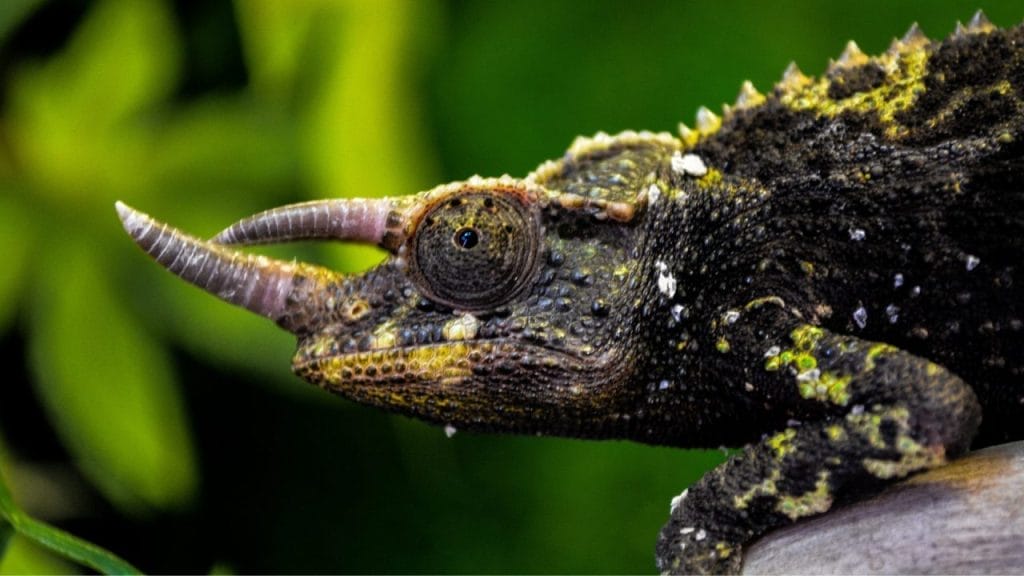
These give live birth instead of laying eggs, but they can still experience dystocia. A stuck baby is just as dangerous as a stuck egg.
The Cost of Treatment
Let’s talk money, because this catches people off guard.
| Treatment | Estimated Cost |
|---|---|
| Vet exam + X-rays | $100 – $250 |
| Calcium + oxytocin injections | $75 – $200 |
| Surgery (ovariosalpingectomy) | $500 – $1,500+ |
| Post-op care (meds, follow-ups) | $100 – $300 |
That’s potentially $800 to $2,000+ for a full surgical case. Prevention through proper husbandry costs a fraction of that.
Find a reptile vet BEFORE you need one. The Association of Reptilian and Amphibian Veterinarians (ARAV) has a vet finder tool that can help you locate exotic vets in your area.
Long-Term Care After Egg Binding
If your chameleon survives egg binding (and with prompt treatment, many do), here’s what comes next:
- Follow all vet instructions for medications and follow-up visits
- Review your entire husbandry setup — something failed, and you need to find out what
- Consider spaying if she wasn’t spayed during the emergency. Repeated egg binding is common, and spaying eliminates the risk permanently
- Increase calcium supplementation temporarily as recommended by your vet
- Monitor closely during her next gravid cycle (if she wasn’t spayed)
Final Thoughts
Egg binding is scary, but it’s also one of the most preventable emergencies in chameleon keeping.
The formula is simple: proper laying bin + good nutrition + correct lighting + controlled feeding + privacy during laying = a chameleon that passes her eggs without drama.
If you own a female chameleon, your job is to make egg-laying as easy as possible for her. Set up that laying bin today. Get your supplement schedule dialed in. Find a reptile vet and save their number.
Because the best time to deal with egg binding is before it ever happens.
About Author
Hello, I’m Muntaseer Rahman, the owner of AcuarioPets.com. I’m passionate about aquarium pets like shrimps, snails, crabs, and crayfish. I’ve created this website to share my expertise and help you provide better care for these amazing pets.
Disclaimer
This site is owned and operated by Muntaseer Rahman. AcuarioPets.com is a participant in the Amazon Services LLC Associates Program, an affiliate advertising program designed to provide a means for sites to earn advertising fees by advertising and linking to Amazon.com. This site also participates in other affiliate programs and is compensated for referring traffic and business to these companies.