
This post was created with help from AI tools and carefully reviewed by a human (Muntaseer Rahman) . For more on how we use AI on this site, check out our Editorial Policy.
Check Out These FREE Tools We Made JUST For You!
Training Your Bearded Dragon: Ways to Play and Tricks to Teach Your Scaly Friend

Look, I’m gonna level with you right from the start.
When most people get a bearded dragon, they’re thinking “cool lizard that sits on a rock.” They’re not exactly expecting a circus performer who’ll shake hands and fetch the newspaper.
But here’s the thing that’s going to blow your mind: bearded dragons are way smarter than anyone gives them credit for.
I’m talking about lizards that can learn by watching videos, solve mazes, and yes, even get potty trained. Scientists have been studying these guys for years and keep finding out they’re more intelligent than we thought.
So buckle up, because we’re about to turn your beardie from a professional rock-sitter into the Einstein of reptiles.
Why You Should Even Bother Training Your Bearded Dragon
Before we get into the how, let’s talk about the why.
Training your beardie isn’t just about showing off to your friends (though that’s a nice bonus). It’s about three major things that actually matter.
They Need Mental Stimulation
Your beardie isn’t meant to stare at the same four walls all day.
In the wild, these lizards are constantly hunting, exploring, and figuring out their environment. Stuck in a tank? Their brain basically turns to mush without enrichment.
Bored bearded dragons often glass surf – that thing where they frantically scratch at the glass like they’re trying to escape. It’s their way of screaming “I’m dying of boredom in here!”
Exercise Prevents Obesity
This one’s huge.
Pet beardies get fat. Like, concerningly fat.
We overfeed them, they don’t move around much, and boom – chunky dragon. Regular play and training keeps them active and healthy, which means they’ll stick around longer.
It Strengthens Your Bond
Training time is quality time.
When you consistently work with your beardie, they start recognizing you, trusting you, and actually wanting to hang out with you. It’s not dog-level affection, but it’s something real.
The Science Behind Bearded Dragon Intelligence
Okay, nerd alert for a second because this stuff is actually fascinating.
Research published in 2024 by Elsenberg et al. showed that bearded dragons can learn through true imitation. Not just “monkey see, monkey do” basic stuff, but actually understanding the intention behind actions.
In one study, researchers trained a bearded dragon to open a sliding door with its claws to get food. Then they let seven other beardies watch a video of the trained dragon doing it.
The result? Those seven dragons learned to open the door too. Just from watching the video.
That’s a cognitive ability scientists used to think was exclusive to humans and advanced primates. And here’s your lizard pulling it off like it’s nothing.
Temperature Affects Their Smarts
Here’s something wild that came out of recent research.
The temperature bearded dragon eggs are incubated at actually affects how intelligent the babies will be. Warmer incubation temperatures have been linked to better learning abilities and social behaviors.
This matters because as global temperatures rise, it could change how smart wild populations are. But for you? It just means your beardie’s brain is literally temperature-dependent.
When they’re cold, they get sluggish and can’t learn well. When they’re properly warmed up? That’s when the magic happens.

Your Beardie Has More to Say…
This article tells you WHAT to do, but do you know WHY your dragon needs it? Or what they’re thinking when you do it wrong?
Read the full rant (all 20 chapters of it) in: “What Your Bearded Dragon Wishes You Knew”
*Told by a very frustrated beardie who’s had ENOUGH of watching you guess.*
Before You Start Training: The Foundation
You can’t just grab your beardie and start barking commands.
Training requires trust, and trust takes time to build. If your dragon isn’t comfortable with you yet, all the training techniques in the world won’t work.
Step 1: Just Exist Near Them
For the first week or two, don’t even try to handle them.
Just hang out near their enclosure. Read a book, watch TV, scroll through your phone. Let them get used to your presence without any pressure.
They need to learn that you’re not a predator who’s going to eat them.
Step 2: Hand Feeding
Once they stop freaking out when you walk by, start hand feeding.
Use tweezers at first if they’re skittish. Offer their favorite bugs and repeat their name in a calm voice. The key is associating your presence with good things (food).
Over time, they’ll start looking at you and thinking “oh hey, that’s the food guy!”
Step 3: Gentle Handling
When your beardie is comfortable eating from your hand, start with short handling sessions.
Five minutes max at first. Support their body fully, never grab them from above (that’s what predators do), and watch their body language.
A black beard means stress. Arm waving can mean submission or nervousness. Head bobbing is usually dominance. Learn these signals and respect them.
Training Method #1: Teaching Your Beardie to Come When Called
This is the gold standard of bearded dragon training.
If your beardie comes when called, you don’t have to tear your house apart looking for them when they escape. Plus, it’s just super cool.
The Basic Process
Week 1-2: Name Association
Every single time you feed your beardie, say their name clearly before dropping the food. Just the name – don’t add extra words that confuse them.
It’s the sound they’re learning, not the actual word. So “Spike” needs to sound exactly the same every time, not “Hey Spike buddy” one day and “Come here Spikey” the next.
Research shows immediate rewards strengthen the connection between actions and outcomes. So the second they hear their name, boom – food appears.
Week 3-4: Adding Distance
Now place your beardie about a foot away from you.
Say their name, and immediately drop their favorite treat right in front of you. At first, they’ll just come because they see the food. That’s fine.
The trick is clicking a dog clicker (or snapping your fingers) right when they start moving toward you, then saying their name again.
Over time, they associate the name sound with movement and reward.
Week 5+: Increasing Distance
Gradually increase the distance.
Two feet, then three, then five. Some beardies will eventually come from across the room, though let’s be real – it depends on their personality and how motivated by food they are.
One owner reported their beardie wouldn’t walk more than two body-lengths for a bug because it just wasn’t worth the effort to them. Fair enough.
Training Method #2: Target Training
This is way more advanced but super useful.
Target training means your beardie follows a specific object (like a stick or chopstick) wherever you point it.
How to Do It
Get a small handheld object – a chopstick works great.
When your beardie touches the stick with their nose or body, immediately reward them with a treat. Keep sessions to 5-10 minutes max because their attention span is limited.
One TikTok user reported their beardie picked up target training in just one day and was following the target stick around like a pro. Your results may vary, but it’s definitely possible.
The beauty of target training? You can use it to guide them into their carrier, out of hiding spots, or just give them mental exercise.
Training Method #3: Potty Training (Yes, Really)
This sounds impossible but people have actually done it.
The trick is recognizing your beardie’s bathroom signals and consistently taking them to the same spot.
Common Bathroom Signals
Different beardies communicate differently, but watch for:
- Restless pacing
- Climbing to a high spot in their enclosure
- Standing at the glass
- Specific postures or movements they always do before going
One owner trained their beardie to bang sticks and rocks around when they needed to go. Another said their beardie would make a beeline back to the tank when nature called, even during free roam time.
The Training Process
When you spot the bathroom signal, immediately take them to the designated spot.
Most people use the bathtub because it’s easy to clean. Some use a specific paper towel or spot in the enclosure.
Be consistent. Same spot, every time. Eventually, they’ll associate that location with bathroom time.
Is it 100% reliable? No. Sometimes they’ll still go in their water bowl when you’re not around. But many owners report 70-80% success rates, which means way less tank cleaning.
Training Method #4: Leash Walking
Your beardie can learn to walk on a leash like a tiny, scaly dog.
But this takes time and patience. You can’t just slap a harness on them and expect them to stroll around the park.
Getting the Right Equipment
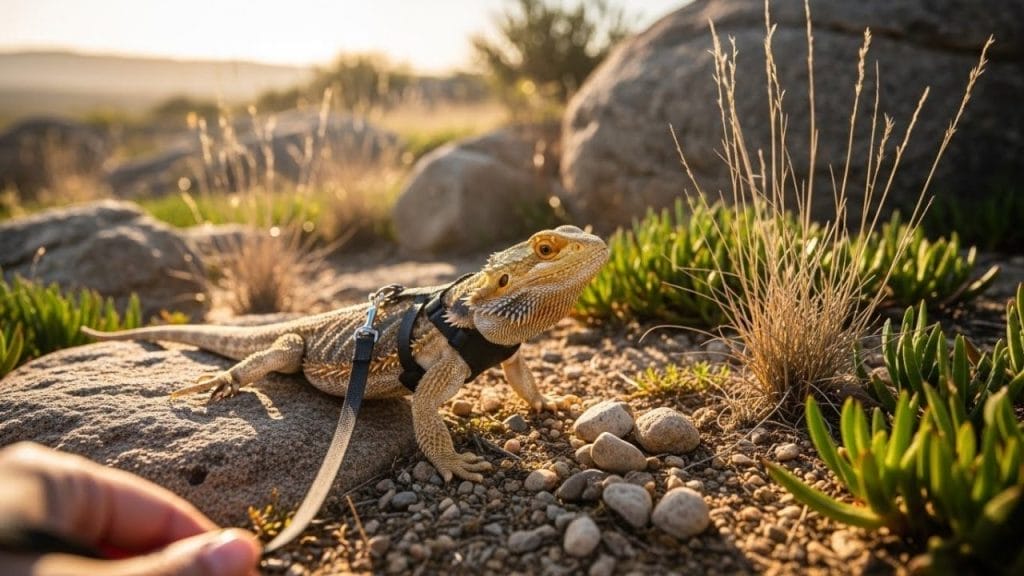
You need a proper reptile harness that goes around their chest and under their arms.
Never put a leash directly around their neck – that can block their airway. The harness distributes pressure safely across their body.
The Adjustment Process
Let them wear the harness inside their tank first.
Just five minutes a day, gradually increasing. They need to get used to the feeling without the stress of being outside.
Then take them outside (still in the harness) without the leash attached. Let them experience the sights and sounds. If they show stress, bring them back inside immediately.
The Walking Part
Once they’re comfortable in the harness outdoors, attach the leash.
Place them on grass and let them wander at their own pace. Never force them to walk – use treats to coax them in the direction you want.
Some beardies love outdoor adventures. Others hate it. There’s no forcing this one.
Fun Tricks You Can Teach
These aren’t as practical as coming when called, but they’re entertaining and provide great mental stimulation.
Trick #1: High Five/Wave
This one works because beardies naturally wave their arms as a submissive gesture.
The trick is capturing that natural behavior and rewarding it. When you see your beardie wave, immediately treat them and say “wave.”
Eventually, you can start making a hand gesture that prompts the wave. It takes patience, but some owners report success.
Trick #2: Standing on Hind Legs
Beardies will naturally stand up to reach food or get a better view.
Hold a treat just above their head height. When they stand up to reach it, treat and praise. Over time, you can add a verbal cue like “up.”
Trick #3: Turning in a Circle
Use target training for this one.
Guide them in a circle with the target stick, rewarding when they complete the rotation. Eventually, they’ll spin on command.
One owner joked they taught their beardie to “hop like a bunny” but admitted that never actually happened. Some tricks are more wishful thinking than reality.
The Realistic Trick List
Based on owner reports, here’s what beardies can actually learn:
- Coming when called (most common success)
- Following a target stick
- Potty training (with consistency)
- Climbing specific things on cue
- Recognizing visual cues (like a towel meaning cuddle time)
- Understanding words like “no,” “stop,” or “go potty”
What they probably can’t learn:
- Handshakes
- Fetching
- Complex multi-step tricks
- Anything requiring fine motor control
Ways to Play With Your Bearded Dragon
Training is great, but sometimes you just want to hang out and have fun.
Here are activities that’ll keep your beardie entertained and enriched.
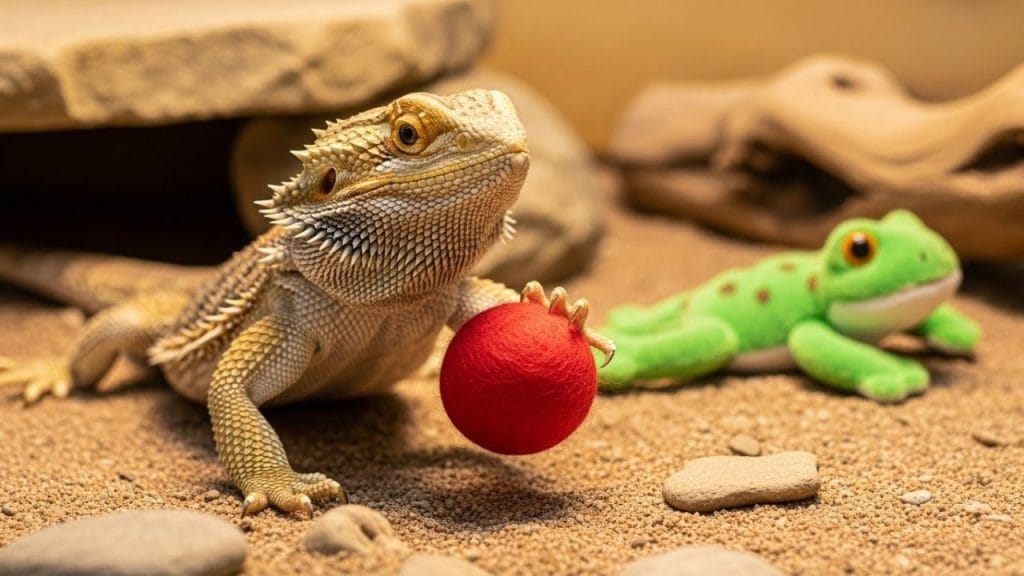
Activity #1: Ball Time
Get a small, lightweight ball – like a cat ball with holes or a hamster ball.
Some beardies love lunging at balls and pushing them around. You can even put feeder insects inside a ball with holes, so they have to roll it to get the bugs out.
Keep ball sessions to 5-10 minutes max so you’re not torturing them trying to get food.
Not all beardies like balls though. Some couldn’t care less. Try it and see what your dragon thinks.
Activity #2: Obstacle Courses and Mazes
Build a simple maze out of cardboard boxes or plastic LEGO bricks.
Put a treat in the center and watch them navigate through. Research shows beardies can successfully solve T-mazes and remember the correct path.
This taps into their natural problem-solving abilities and gives them a mental workout.
Activity #3: Supervised Outside Time
Natural sunlight is way better than any UVB bulb.
Take your beardie outside when it’s above 70°F and humidity is below 60%. Either use a harness or set up a secure playpen.
Watch them constantly – they can dart away faster than you think, and birds see them as snacks.
Let them explore grass, dig a bit, and just experience new textures and smells. Many beardies love munching on clovers and dandelions (just make sure the area isn’t treated with pesticides).
Activity #4: Treasure Hunt
Instead of bowl feeding, hide insects around a safe play area.
This encourages natural foraging behavior. You can use a black light and glow powder to make crickets fluorescent, which makes the hunt more exciting.
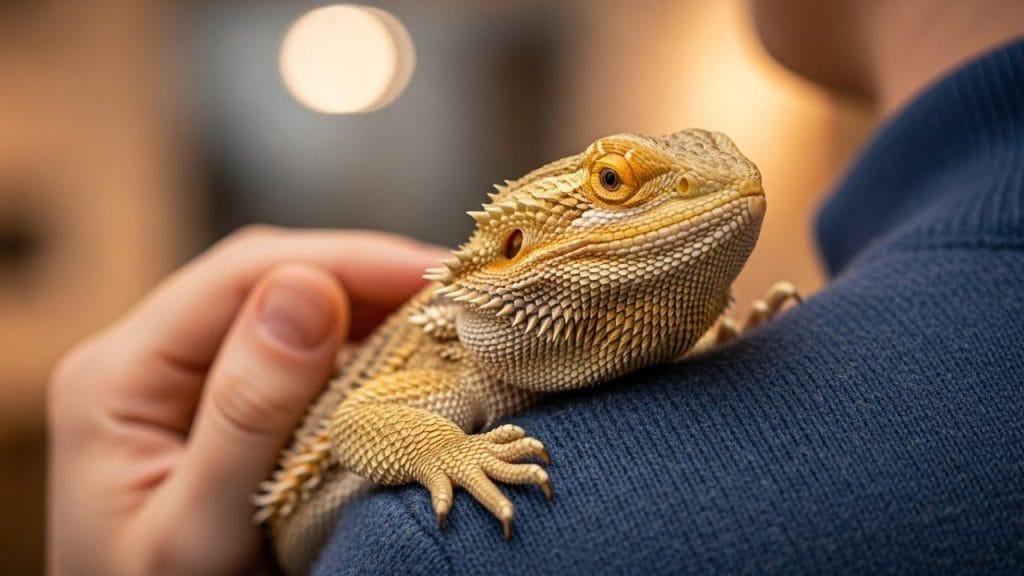
Activity #5: Cuddle Time
Yeah, bearded dragons actually enjoy this.
Let them hang out on your shoulder or chest while you watch TV. Some beardies will snuggle under a soft blanket and just chill.
This isn’t high-energy play, but it’s quality bonding time and they genuinely seem to enjoy the warmth and company.
Activity #6: Window Watching
Set your beardie by a window and let them watch the world.
Some beardies are fascinated by watching birds, people, and cars go by. Others get stressed out. Know your dragon.
If they seem interested rather than anxious, this is easy enrichment that requires zero effort from you.
Activity #7: New Toys
Beardies can enjoy:
- Stuffed animals (some cuddle them)
- Crinkly paper (the texture is interesting)
- Rubber ducks (in bath or on land)
- Mirrors (if they don’t get stressed by their reflection)
- Small toy cars or skateboards they can ride on
Again, every beardie has different preferences. Some will love a stuffed animal. Others will completely ignore it.
Activity #8: Laser Pointer
This one’s controversial, but some beardies love chasing laser dots.
It taps into their hunting instinct. Keep sessions short (under 5 minutes) and always end with a real treat so they get the satisfaction of “catching” something.
Never shine it in their eyes, obviously.
Activity #9: Swimming/Bath Time
Not all beardies like water, but some genuinely enjoy swimming.
Use lukewarm water that comes up to their shoulders. Some owners even got foot massage machines with jets to make bath time more interesting.
Watch their body language. If they’re relaxed, great. If they’re trying to escape, bath time is stressful for them.
Activity #10: Digging Opportunities
Use excavator clay or a dig box with reptile-safe substrate.
Beardies have a natural instinct to dig, and giving them that outlet is enriching. You can even hide treats in the digging area.
Enriching Their Environment
You don’t always need to actively play with them.
Sometimes the best enrichment is making their enclosure more interesting.
Rotate Decor
Every few months, rearrange their tank.
Move branches to new spots, swap out hides, add new climbing opportunities. This forces them to relearn their environment, which is mental stimulation.
Don’t do this too often though – they need time to feel secure in their space.
Add Climbing Structures
Beardies love climbing to high points to survey their territory.
Add branches, hammocks, ramps, and platforms at different heights. Make sure everything is stable and can support their weight.
Create Tunnels and Hides
Use excavator clay to build caves, tunnels, and bridges.
You can change the layout occasionally to keep it interesting. Just make sure there’s always at least one secure hiding spot where they can retreat when stressed.
Use Different Textures
Add variety to their substrate and decor.
Different textures to walk on, different materials to explore. This sensory variety keeps their environment from getting boring.
Important Training Tips
Let me hit you with the practical stuff that’ll make or break your success.
Keep Sessions Short
5-10 minutes max per training session.
Beardies have short attention spans, and pushing longer just frustrates both of you. It’s better to do three 5-minute sessions throughout the day than one 30-minute marathon.
Temperature Matters
Never try to train a cold beardie.
They need to be properly warmed up (basking spot around 35°C / 95°F) to be alert and responsive. Cold beardies are sluggish and can’t focus.
Use High-Value Treats
Figure out what your beardie goes absolutely nuts for.
Waxworms? Superworms? Hornworms? Whatever they love most, that’s your training treat. Save it exclusively for training so it stays special.
Consistency is Everything
Use the same words, same sounds, same gestures every time.
Your beardie isn’t learning English. They’re learning to associate specific sounds and movements with specific outcomes. Change things up and you confuse them.
Be Patient
This isn’t like training a dog.
Progress is slow. Some tricks take weeks or months. Some beardies never learn certain things no matter how hard you try.
Celebrate small wins. If your beardie takes even one step toward you when called, that’s progress worth rewarding.
Know When to Stop
If your beardie is showing stress signals (black beard, trying to escape, aggressive behavior), stop immediately.
Never force training. It should be fun for both of you, not a source of anxiety.
Age Matters
Younger beardies tend to learn faster.
But adult beardies can absolutely still learn – it just takes more patience. Don’t write off your older dragon.
Realistic Expectations
Let’s get real for a second.
Your bearded dragon is never going to fetch a ball like a Labrador. They’re not going to shake hands on command like a trained parrot.
But they can recognize you, respond to their name, learn routines, understand cause and effect, and even solve simple problems.
Some beardies are naturally smarter or more trainable than others. It’s like people – not everyone has the same aptitude for learning.
One owner spent four years calling their beardie’s name with zero response. Another owner’s beardie learned to come when called in two weeks. Your results will be somewhere in that spectrum.
The Bottom Line
Training your bearded dragon isn’t about turning them into a circus act.
It’s about enriching their life, strengthening your bond, and giving them the mental and physical stimulation they need to thrive.
Start with the basics – name recognition and coming when called. Those have practical benefits beyond just being cool.
Add in play activities that match your beardie’s personality. Some will love balls and mazes. Others just want to cuddle on the couch.
Watch your dragon and learn what they enjoy. Every beardie is different, and the best enrichment is whatever makes your specific lizard happy.
Can bearded dragons learn tricks? Absolutely. Are they the smartest pets in the world? No. But they’re way smarter than most people think, and they deserve the chance to show it.
So grab some treats, set aside ten minutes, and start training. Your beardie’s brain will thank you.
And who knows? Maybe yours will be the one that finally masters the high five.

About Author
Hello, I’m Muntaseer Rahman, the owner of AcuarioPets.com. I’m passionate about aquarium pets like shrimps, snails, crabs, and crayfish. I’ve created this website to share my expertise and help you provide better care for these amazing pets.
Disclaimer
This site is owned and operated by Muntaseer Rahman. AcuarioPets.com is a participant in the Amazon Services LLC Associates Program, an affiliate advertising program designed to provide a means for sites to earn advertising fees by advertising and linking to Amazon.com. This site also participates in other affiliate programs and is compensated for referring traffic and business to these companies.