This post was created with help from AI tools and carefully reviewed by a human (Muntaseer Rahman) . For more on how we use AI on this site, check out our Editorial Policy.
Check Out These FREE Tools We Made JUST For You!
Male vs Female Cherry Shrimp: How to Tell the Difference

So you’re staring at your tank, watching these tiny red (or sometimes clear-ish) shrimp zoom around, and you’re thinking: “Wait, which ones are which?”
Don’t worry, you’re not alone. When I first got cherry shrimp, I genuinely thought maybe the store had accidentally sold me all females because everyone was so red. Turns out I was just really bad at shrimp sexing. (And yes, “shrimp sexing” is a real term that actual aquarists use with a straight face.)
Here’s the thing though – knowing which shrimp are male and which are female actually matters. Not just for breeding (though yeah, that’s kind of important if you want baby shrimp), but also for making sure you’ve got a balanced colony that’s going to thrive.
Let me walk you through how to spot the difference without needing a magnifying glass and a marine biology degree.
The Dead Giveaways (100% Female Signs)
Let’s start with the obvious ones – the signs that scream “I’M A LADY SHRIMP” with zero room for confusion.

The Saddle (AKA The Yellow Backpack)
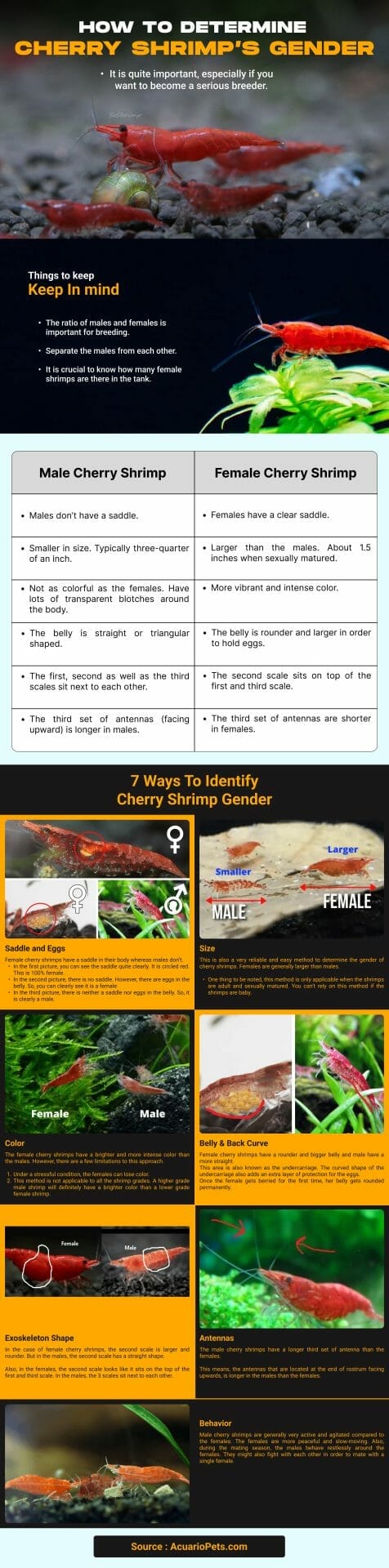
Female cherry shrimp develop a yellow or greenish spot on their back, right behind their head, which contains unfertilized eggs called a “saddle.”
If you see this saddle, congratulations, you’ve found a female. Males don’t have saddles because they don’t carry eggs.
The saddle looks kind of like someone dabbed yellow or green marker on their upper back. Sometimes it’s super obvious, sometimes you have to squint a bit, but once you see it, you can’t unsee it.
Berried Shrimp (When She’s Already Won Mom of the Year)
This one’s foolproof. If a shrimp is carrying eggs under their abdomen – held between their back legs in what looks like tiny grape clusters or jellybeans – it’s 100% a female.
The female carries about 20-30 eggs for roughly 2-3 weeks until they hatch. You’ll see her fanning them occasionally to keep them clean and oxygenated, which is honestly pretty adorable to watch.
Quick Reference: Male vs Female Cherry Shrimp
| Feature | Female | Male |
|---|---|---|
| Size | Up to 1.5 inches | Less than 1 inch |
| Color | Usually more vibrant and opaque (but not always!) | More transparent or speckled |
| Underside | Curved, D-shaped abdomen | Straight, triangular abdomen |
| Saddle | Yellow/green spot visible | No saddle present |
| Eggs | Carries 20-30 eggs when berried | Never carries eggs |
| Behavior | Calm, often hides | Active, especially after female molts |
| Antennae | Shorter | Longer |
| Swimmerets | Broader with extended flaps | Narrower, more pointed |
Body Shape: The Curves Tell a Story
This is where things get interesting. Even when females aren’t carrying eggs or showing a saddle, their body shape gives them away.
The Underside Curve
Female cherry shrimp have a smooth, curved underside to their abdomen that looks like the letter “D” rotated 90 degrees when you view them from the side.
Why? Because nature designed them with built-in baby carriers. That curve creates a safe space for eggs.
Males have an almost straight abdomen on the underside, making them look more symmetrical and triangular.
If you watch them from the side while they’re grazing on plants, you can usually spot this pretty easily. Females look rounder and fuller, males look sleeker and more streamlined.
Size Matters (But Not As Much As You’d Think)
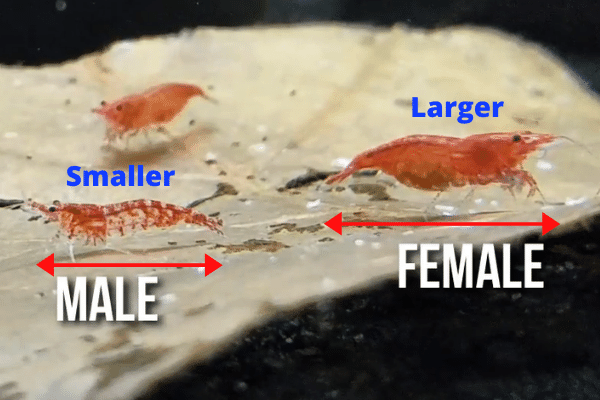
Females are generally larger, often reaching up to 1.5 inches in length, while males are smaller, typically less than 1 inch long.
But here’s the catch – using size alone to sex your shrimp is like trying to guess someone’s age by their height. It works sometimes, but you’re going to be wrong a lot.
It’s very easy to confuse a young female with a full-grown male. So yeah, use this as a clue, but don’t bet your life on it.
The Color Confusion (Why This Gets Tricky)
Okay, this is where most people mess up, including past me.
Here’s what I thought: “Bright red = female, clear = male.” Simple, right?
Wrong. Sort of.
The Actual Truth About Color
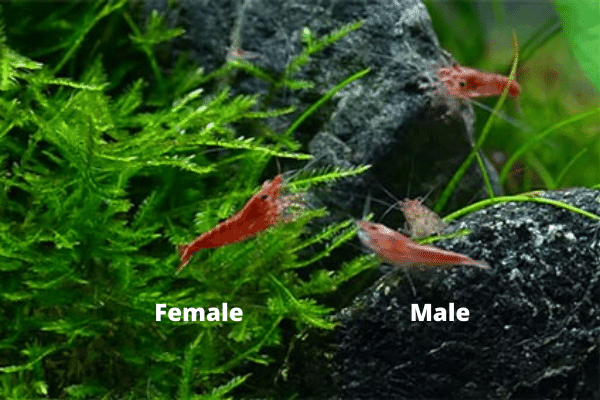
Females tend to have deeper, more vibrant, and opaque coloration, while males are usually less colorful, more translucent, or have speckled red patches rather than solid color.
But there’s a huge caveat here. The grade of the shrimp plays an important role in color, not just sex.
If you’ve got high-grade cherry shrimp (like Fire Reds or Painted Fire Reds), both males and females can be intensely red. In lower grades, the color difference is way more obvious – females look like someone cranked up the saturation slider while males look like they’re still buffering.
This is why you shouldn’t rely on color alone. It’s too variable depending on the grade of your shrimp.
The Antenna Situation (Minor Detail Alert)
Females have shorter antennae while males have longer antennae.
Honestly though? Good luck actually measuring shrimp antennae when they’re zooming around your tank. This is more of a fun fact than a practical identification method.

Behavior: When Males Go Full Speed Dating Mode
This is my favorite part because it’s hilarious to watch.
Males actively pursue females, especially after a female molts. And by “pursue,” I mean they lose their minds.
When males are looking for a female to mate with, they zip around the tank like they dropped a $20 bill. I’m not making this up – that’s an actual analogy used by experienced shrimp keepers.
After a female molts, males will often pile on top of her in what looks like aggressive behavior but is actually just very enthusiastic mating attempts.
Females tend to be calmer and more docile, often hiding unless food appears.
The Swimmerets (For the Detail-Oriented Among Us)
Shrimp have paddle-shaped appendages on the underside of their abdomen called swimmerets or pleopods, and females have more pronounced flaps on the sides to hold and fan their eggs.
Males have narrower, more pointed swimmerets because they don’t need the egg-holding capacity.
If you can get close enough to see these tiny details, more power to you. I usually just squint and hope for the best.
The Reality Check: When They’re Hard to Sex
Sexual dimorphism becomes most obvious once shrimp reach sexual maturity at roughly 75 days after birth.
Stores often sell juvenile shrimp before they hit sexual maturity, making it almost impossible to tell males from females when they’re really young.
This explains why you might buy “assorted” cherry shrimp and end up with what looks like all females. Give them time. The males will reveal themselves eventually when they stop filling out with color and start acting like tiny aquatic speed demons.
Why This All Matters
Look, you might be thinking: “This seems like a lot of work just to figure out shrimp genders.”
And you’re not wrong. But here’s why it actually matters:
For breeding: It’s recommended to have at least 2-3 females for every male in your breeding colony. Too many males and they’ll stress out the females with constant harassment. Too few males and your colony growth slows down.
For buying: Knowing what to look for prevents you from accidentally buying all females (because they’re the pretty bright red ones everyone gravitates toward) and then wondering why you have zero babies after months of waiting.
For population balance: Understanding your colony’s gender ratio helps you manage population growth and overall tank health.
The Bottom Line
Here’s my advice: Don’t stress about identifying every single shrimp perfectly.
Focus on the obvious signs first – saddles and eggs are your best friends. Then look at body shape, particularly that curved vs straight abdomen. Color can help, but it’ll lie to you sometimes.
And honestly? If you just want a thriving colony of cherry shrimp, get 10-15 of them, make sure you see a mix of very red ones and some clearer ones, and let nature do its thing. Cherry shrimp are basically impossible to keep without them breeding if conditions are right.
They’ll figure it out. Trust me, those males will find the females even if you can’t tell them apart.
Now go forth and identify some shrimp. And when someone asks if you can sex cherry shrimp, you can confidently say yes while trying not to laugh at how weird that sounds out loud.

About Author
Hello, I’m Muntaseer Rahman, the owner of AcuarioPets.com. I’m passionate about aquarium pets like shrimps, snails, crabs, and crayfish. I’ve created this website to share my expertise and help you provide better care for these amazing pets.
Disclaimer
This site is owned and operated by Muntaseer Rahman. AcuarioPets.com is a participant in the Amazon Services LLC Associates Program, an affiliate advertising program designed to provide a means for sites to earn advertising fees by advertising and linking to Amazon.com. This site also participates in other affiliate programs and is compensated for referring traffic and business to these companies.