
This post was created with help from AI tools and carefully reviewed by a human (Muntaseer Rahman) . For more on how we use AI on this site, check out our Editorial Policy.
Check Out These FREE Tools We Made JUST For You!
Tree Frog Not Eating: 7 Reasons + How to Fix It Fast

Your tree frog refusing food is usually caused by stress, wrong temperature or humidity, or illness. Most healthy tree frogs can go 1-2 weeks without eating, but if your frog hasn’t eaten in over two weeks and shows other symptoms like lethargy or weight loss, you need to take action now.
This matters because tree frogs hide illness really well until they’re seriously sick. By the time you notice something’s wrong, they might need immediate help.
In this guide, you’ll learn exactly why tree frogs stop eating, how to fix the problem at home, and when you absolutely need to see a vet.
Quick Answer: Why Your Tree Frog Isn’t Eating
Most Common Causes:
- Temperature too cold (below 70°F) or too hot (above 85°F)
- Humidity below 50% or wrong for your species
- Stress from recent changes or handling
- Inadequate vitamin supplements causing deficiency
Red Flags – See a Vet If:
- Not eating for 2+ weeks with weight loss
- Lethargy, bloating, or skin discoloration
- Trouble moving or climbing
- Open sores or excessive skin shedding
First Things to Try:
- Check temperature is 75-85°F during day
- Ensure humidity is 50-80% (varies by species)
- Stop handling for at least a week
- Try different feeder insects
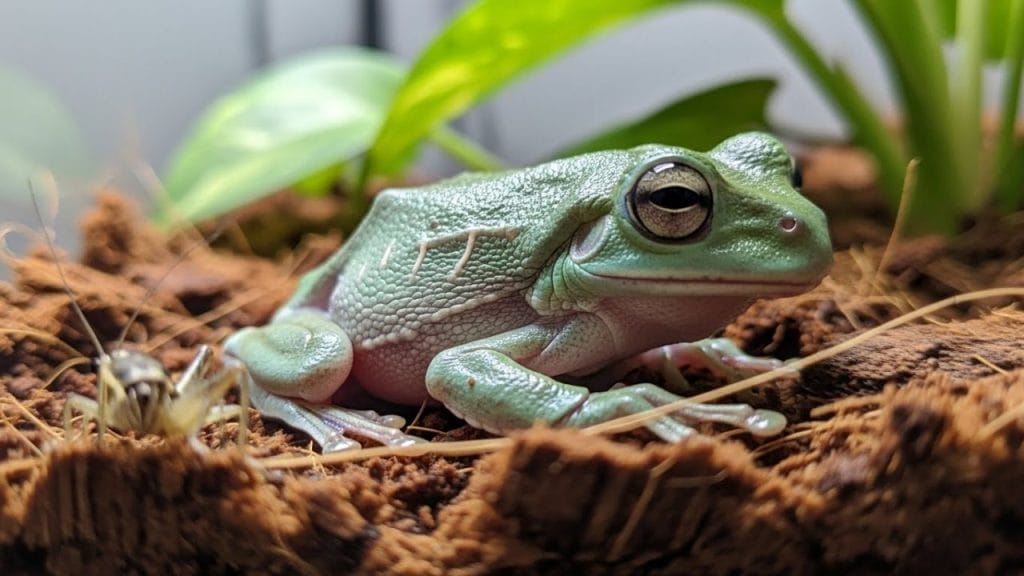
Understanding Normal vs. Problem Eating
Here’s the thing: tree frogs don’t eat on a strict schedule like we do.
Adult tree frogs naturally eat every 2-3 days. Young frogs need food daily. But even healthy frogs might skip a meal or two if they just ate a big cricket or if the weather changed.
The problem isn’t that your frog missed one meal. It’s when they stop eating for more than a week combined with other weird behavior.
Why Is My Tree Frog Not Eating?
Temperature Problems (Most Common Cause)
Temperature is the biggest reason tree frogs stop eating, and most people don’t even realize their tank is wrong.
Tree frogs are cold-blooded. When they’re too cold, their metabolism slows down and they literally can’t digest food properly.
What Your Frog Needs:
- Daytime: 75-85°F
- Nighttime: 65-75°F
- Basking spot: 82-84°F
Too hot is just as bad. Above 85°F and your frog gets heat stress, which kills their appetite fast.
How to Fix It: Get a digital thermometer with a probe (those circular dial ones are useless). Check temps in multiple spots. If it’s too cold, add a low-wattage heat bulb. Too hot? Move the lamp farther away or use a lower wattage bulb.
Humidity Issues
Dry air makes tree frogs feel awful. Their skin needs to stay moist to breathe properly.
If humidity drops below 50%, your frog will stress out and stop eating. They might also sit in their water dish constantly trying to stay hydrated.
Species-Specific Needs:
- White’s Tree Frog: 50-70% humidity
- Green Tree Frog: 60-80% humidity
- Red-Eyed Tree Frog: 70-90% humidity
Quick Fix: Mist the tank once in the morning and once at night with dechlorinated water. Add live plants. Cover part of the mesh lid with plastic wrap to hold moisture better. Get a digital hygrometer to actually know what your humidity is.
Stress from Changes
Tree frogs are weirdly sensitive to changes. Even small stuff stresses them out.
New tank setup? Stressed. New decorations? Stressed. You moved their tank to a different room? Yep, stressed.
Common Stress Triggers:
- Recent move to your home (settling in takes 1-2 weeks)
- Changed tank decor
- Too much handling
- Loud noises or vibrations near tank
- Other pets staring at them
- Lights on at wrong times
Give your frog time to adjust. Cover three sides of the tank with dark paper for a week. This helps them feel secure.
Stop handling completely for at least 7-10 days.

Vitamin and Mineral Deficiencies
This is a silent killer that takes months to show symptoms.
Most feeder insects are low in calcium and way too high in phosphorus. Without supplements, your frog slowly develops metabolic bone disease (MBD).
Early MBD Symptoms:
- Loss of appetite
- Lethargy and weakness
- Trouble climbing or gripping branches
- Sitting at bottom of tank instead of perching
- Slight tremors or twitching
What You Need: Use a calcium + vitamin D3 powder on feeder insects 2-3 times per week. Brands like Repashy Calcium Plus or Rep-Cal work well.
Also make sure you have UVB lighting. Even nocturnal frogs need some UVB to process calcium. Replace UVB bulbs every 6-9 months even if they still glow.
Wrong Food or Food Too Big
Some frogs are picky. Others just can’t handle what you’re offering.
If you’ve only tried one type of feeder, your frog might just be bored. Crickets work for most frogs, but some prefer other insects.
Try These Instead:
- Small roaches (dubia or discoid)
- Phoenix worms or black soldier fly larvae
- Small silkworms
- Houseflies or fruit flies (for smaller frogs)
Never feed mealworms as a staple. Their hard shell can cause impaction and many frogs instinctively know they’re dangerous.
Food size matters too. The insect should be no bigger than the space between your frog’s eyes. Too big and they won’t even try to eat it.
Illness or Parasites
If you’ve fixed temperature, humidity, and supplements but your frog still won’t eat after 2 weeks, illness is likely.
Symptoms of Sick Frogs:
- Skinny with visible hip bones
- Bloated belly
- Discolored skin (brown, gray, or reddish)
- Sitting in water constantly
- Cloudy or swollen eyes
- Not reacting when you approach
- Excessive skin shedding
Common Health Problems:
- Bacterial infections (red leg disease)
- Fungal infections
- Internal parasites
- Impaction from substrate or oversized food
- Organ failure
You can’t fix these at home. These need a vet who specializes in exotic animals.
How to Get Your Tree Frog Eating Again
Step 1: Fix Environment First (Do This Today)
Before anything else, make sure your setup is correct.
Check temperature with a digital thermometer. It should be 75-85°F during the day and 65-75°F at night.
Check humidity with a digital hygrometer. Aim for 50-80% depending on species.
Add more hiding spots if your tank feels exposed. Use cork bark, live plants, or foam backgrounds.
Step 2: Leave Your Frog Alone
Stop handling. Stop staring. Stop taking photos.
Give your frog a full week of peace and quiet. This alone fixes about 30% of appetite problems.
Cover three sides of the tank with cardboard or dark paper so your frog feels secure.
Step 3: Offer Live Food at Night
Tree frogs are nocturnal hunters. They want to hunt at night when it’s dark.
Turn off the lights and wait 30 minutes after sunset. Then add 2-3 appropriately sized live crickets or roaches.
Don’t force-feed. Don’t use tweezers unless your frog is severely weak. Let them hunt naturally.
Leave the food in overnight. Remove any uneaten insects in the morning so they don’t stress your frog.
Step 4: Try Different Feeders
If crickets aren’t working, switch it up.
Try small dubia roaches. Try phoenix worms. Try a hornworm as a treat.
Variety matters. Wild tree frogs eat dozens of different insects.
Step 5: Ensure Proper Supplementation
Dust all feeder insects with calcium + D3 powder.
Put a few insects in a bag with powder, shake gently, then immediately feed to your frog. The powder wears off fast.
Do this 2-3 times per week for adults, every feeding for juveniles.
Step 6: Create a Feeding Routine
Feed at the same time each night. Tree frogs learn schedules.
Most keepers feed after 8pm when it’s fully dark. Pick a time and stick to it.
Adults eat every 2-3 days. Juveniles eat daily. Don’t overfeed or they’ll get obese.
What NOT to Do
Don’t Force-Feed Unless Vet Recommends It
Shoving food in your frog’s mouth usually makes things worse. You can injure them or make them more stressed.
Only force-feed if a vet specifically tells you to and shows you how.
Don’t Use Substrate That Can Be Eaten
Loose substrates like gravel, sand, or small bark chips can cause impaction when accidentally swallowed.
Stick with paper towels, foam, large orchid bark, or a bioactive setup with springtails and isopods.
Don’t Guess on Supplements
“Calcium dust” without vitamin D3 is useless for most frogs. You need the D3 to absorb calcium.
But too much can be harmful too. Follow product instructions and don’t overdo it.
Don’t Panic After One Missed Meal
Healthy adult tree frogs can easily go 2-3 weeks without food. One or two missed meals isn’t an emergency.
Start worrying if it’s been more than 2 weeks AND your frog looks thin or acts lethargic.
Don’t Change Everything at Once
If you change temperature, humidity, food, supplements, and tank setup all at once, you won’t know what helped.
Fix one thing at a time. Give it 3-5 days to see if it works before changing something else.
When to See a Vet Immediately
Some situations can’t wait. Get professional help if you see any of these:
Emergency Signs:
- Not eaten in 3+ weeks and losing weight rapidly
- Bloated like a balloon (could be organ failure)
- Open sores or wounds on skin
- Red or purple discoloration on belly or legs
- Tremors, seizures, or inability to move normally
- Sitting with mouth open gasping
- Completely unresponsive when touched
Don’t wait on these. Tree frogs hide illness until they’re critically sick.
Finding a Vet: Not all vets treat amphibians. Call ahead and ask if they have experience with tree frogs specifically.
Look for an exotic animal specialist or a reptile/amphibian veterinarian. The Association of Reptilian and Amphibian Veterinarians (ARAV) has a directory on their website.
How Long Can a Tree Frog Go Without Eating?
Healthy adult tree frogs can survive 2-4 weeks without food.
Juveniles and young frogs have faster metabolisms and need food more often. They might only last 1-2 weeks.
But just because they can survive doesn’t mean it’s okay. Extended fasting causes stress, weakens their immune system, and makes them more likely to get sick.
If your frog hasn’t eaten in 2 weeks, actively work on fixing the problem. Don’t just wait and hope.
Preventing Future Feeding Problems
Once you get your frog eating again, keep it that way.
Monthly Checklist:
- Replace UVB bulbs every 6-9 months
- Check all temperatures with thermometer
- Verify humidity stays in proper range
- Rotate feeder insect types for variety
- Keep supplements fresh (replace every 6 months after opening)
Keep Records:
Write down when your frog eats and how many insects. This helps you notice patterns or problems early.
Note any weird behavior, color changes, or weight changes. This info is gold if you need to see a vet later.
Don’t Overfeed:
More food isn’t better. Obesity is a real problem in pet tree frogs, especially White’s tree frogs.
Stick to appropriate portions. You should see your frog active and healthy, not shaped like a golf ball.
Frequently Asked Questions
How long is too long for a tree frog not to eat?
If your adult tree frog hasn’t eaten for more than 2 weeks, it’s time to investigate and fix the problem. For juveniles, 1 week without food is concerning. However, if your frog looks healthy, is active, and has good body condition, waiting another few days while you improve their environment is reasonable.
Can I force-feed my tree frog?
You shouldn’t force-feed unless a vet recommends it and shows you the proper technique. Force-feeding can injure your frog’s delicate mouth and throat. It also doesn’t address the underlying reason they stopped eating. Focus on fixing environmental issues first.
Do tree frogs need live food or can they eat dead insects?
Tree frogs are motion-triggered hunters. They need live, moving prey to trigger their feeding response. Dead insects won’t work unless you’re dealing with a very weak frog that a vet is guiding you to assist-feed. Always offer live crickets, roaches, or worms.
My tree frog ate one cricket but won’t eat more. Is this normal?
Yes, completely normal. Adult tree frogs don’t need to eat daily. If they ate one cricket today, they might not be hungry again for 2-3 days. Don’t leave multiple crickets in the tank because uneaten insects can bite your frog while it’s sleeping.
What temperature should the tank be for a tree frog to eat?
Daytime temperatures should be 75-85°F for most tree frog species. At night, temps can drop to 65-75°F. If temperatures fall below 70°F, your frog’s metabolism slows and they won’t feel like eating. Too hot (above 85°F) also suppresses appetite.
Conclusion
Most tree frog appetite problems come down to basic care issues that you can fix at home.
Start with temperature and humidity. Get these right and you’ll solve the problem about 60% of the time. Add proper supplements and reduce stress, and you’ll fix most of the rest.
But don’t ignore warning signs of serious illness. If your frog won’t eat for 2+ weeks and shows other symptoms, see an exotic vet. Catching problems early makes a huge difference.
Your tree frog depends on you to notice when something’s wrong and act on it. Now you know exactly what to do.
About Author
Hello, I’m Muntaseer Rahman, the owner of AcuarioPets.com. I’m passionate about aquarium pets like shrimps, snails, crabs, and crayfish. I’ve created this website to share my expertise and help you provide better care for these amazing pets.
Disclaimer
This site is owned and operated by Muntaseer Rahman. AcuarioPets.com is a participant in the Amazon Services LLC Associates Program, an affiliate advertising program designed to provide a means for sites to earn advertising fees by advertising and linking to Amazon.com. This site also participates in other affiliate programs and is compensated for referring traffic and business to these companies.