
This post was created with help from AI tools and carefully reviewed by a human (Muntaseer Rahman) . For more on how we use AI on this site, check out our Editorial Policy.
Check Out These FREE Tools We Made JUST For You!
Sexing African Dwarf Frogs: Identify Male Vs Female

So you’ve got some African dwarf frogs, and now you’re staring at them wondering… which one is which?
Don’t worry. You’re not alone.
These tiny aquatic frogs look almost identical at first glance, and even experienced keepers sometimes squint at their tanks trying to figure things out.
The good news? There are actually some pretty reliable ways to tell males from females once you know what to look for.
Let’s break it down.
Quick Reference: Male vs Female Summary
| Characteristic | Male | Female |
|---|---|---|
| Armpit glands | White/pink/red bumps behind front legs | None |
| Size | Smaller (about 1-1.25 inches) | Larger (up to 1.5-2 inches, 40% bigger) |
| Body shape | Slim, streamlined | Pear-shaped, rounder |
| Cloaca | Flat, barely visible | Larger, bumpy protrusion |
| Tail | Short nub | Slightly longer |
| Singing | Yes, buzzes and hums (especially at night) | Rarely, very quiet |
| During mating | On top, doing the hugging | Being hugged, goes motionless |
| Sexual maturity | Around 6-9 months | Around 9 months |
Why Sexing African Dwarf Frogs Is Tricky
Here’s the thing about African dwarf frogs: they show what scientists call “sexual dimorphism,” which is a fancy way of saying males and females look different.
But the differences? They’re subtle.
Like, really subtle.
We’re talking about frogs that only grow to about 1.5 inches long on average, so any physical differences are going to be tiny.
The other catch is that you can’t reliably sex these frogs until they reach sexual maturity, which happens around 9 months of age.
Pet stores usually sell them way younger than that.
So if you just brought home some baby frogs, you might have to wait a few months before the telling signs show up.

The Armpit Gland: Your Most Reliable Clue
Let’s start with the single most reliable way to identify a male African dwarf frog.
Look at their armpits.
Yes, really.
Male African dwarf frogs develop small glands called “post-axillary subdermal glands” right behind their front legs where the leg meets the body.
These glands look like tiny pimples or bumps.
They can be white, pinkish, reddish, or even grayish.
Scientists don’t fully understand what these glands do, but they’re believed to play some role in mating, possibly releasing pheromones to attract females.
Females don’t have these glands.
So if you flip your frog over (gently!) and see little bumps behind both front legs, congratulations—you’ve got yourself a boy.
Size and Body Shape Differences
Once African dwarf frogs mature, the size difference becomes pretty obvious.
Females are about 40% larger than males when fully grown.
That’s not a typo.
Females are significantly bigger and chunkier.
But it goes beyond just size.
| Feature | Male | Female |
|---|---|---|
| Body size | Smaller, about 1-1.25 inches | Larger, up to 1.5-2 inches |
| Body shape | Slim and streamlined | Pear-shaped, especially when carrying eggs |
| Overall build | Lean and wiry | Rounder and fuller |
Females develop that distinctive pear shape because their abdomens fill with eggs as they mature.
When a female is gravid (carrying eggs), she’ll look noticeably plump and round in the belly area.
Males stay slim their whole lives.
Think of it like this: if your frog looks like it skipped leg day but never misses a meal, it’s probably female.
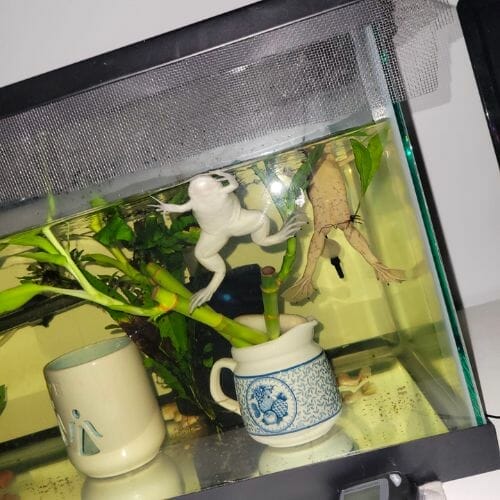
The Tail Situation
Both male and female African dwarf frogs have a small tail, but there’s a difference.
Females typically have a slightly longer tail than males.
Males have what’s basically a tiny nub.
This isn’t the easiest thing to spot, but combined with other clues, it can help confirm what you’re seeing.
The Cloaca: Looking at the Back End
Here’s where things get a little personal.
The cloaca is the single opening that frogs use for both waste elimination and reproduction.
Both sexes have one, but they look different.
Female African dwarf frogs have a larger, more pronounced cloaca that appears as a bump between their back legs.
This is called the ovipositor, and it’s where eggs come out during spawning.
Males have a relatively flat cloaca that’s much less noticeable.
If you see a small protrusion at the back end between the hind legs, you’re likely looking at a female.
The Singing Dead Giveaway
Okay, this is the fun one.
Male African dwarf frogs sing.
And by sing, I mean they make a buzzing or humming sound that’s surprisingly loud for such tiny creatures.
Some keepers describe it as sounding like an underwater cricket.
This typically happens at night because these frogs are nocturnal.
Males sing to attract females for mating, but they’ll also hum when they’re just happy or excited.
If you’re lying in bed at night and hear a weird buzzing coming from your aquarium, you’ve definitely got at least one male.
Females occasionally make soft sounds in response, but they don’t produce the same loud, persistent humming that males do.
Want a silent tank? Get females.
Want a frog that serenades you at 2 AM? Males are your guys.
The Hugging Test
This one requires patience and a bit of luck.
When African dwarf frogs mate, the male grabs onto the female in a position called amplexus.
It looks like a bear hug, with the smaller male clinging to the larger female’s back just above her hind legs.
If you see two frogs “hugging” and staying locked together for hours (sometimes up to a day and a half), you know the one on top is male and the one being hugged is female.
Important note: Males will sometimes grab other males when they’re in the mood.
So if you see hugging behavior but no eggs appear, you might have two over-enthusiastic boys.
The singing is still your best behavioral indicator since only males do it consistently.

When Can You Actually Tell?
Here’s the frustrating reality.
Most African dwarf frogs sold in pet stores are juveniles, usually only a few months old.
At that age, the differences haven’t developed yet.
Sexual maturity typically occurs between 6 to 12 months, with most frogs becoming clearly identifiable around 9 months.
So if you just bought your frogs and can’t figure out what they are, give it time.
The armpit glands on males usually become visible first, followed by the size and shape differences as the frogs continue to grow.
Does Gender Matter for Care?
Not really.
Males and females have the same care requirements: same water temperature (72-80°F), same diet, same tank setup.
They behave similarly too, spending most of their time at the bottom of the tank in that classic “zen” relaxation pose before darting up to the surface for air.
The main differences come down to noise (males sing) and potential breeding.
If you have mixed sexes and conditions are right, you might wake up to eggs floating at the water’s surface.
These frogs can lay up to 750 eggs per spawning and may breed multiple times per year.
Just know that the parents will happily eat their own eggs and tadpoles if given the chance.
Nature is weird like that.
Final Thoughts
Sexing African dwarf frogs isn’t rocket science, but it does require patience.
Look for those armpit glands first—they’re your most reliable indicator for spotting males.
Then factor in size, body shape, and whether anyone’s been humming at night.
If you’ve got young frogs, just wait a few months and the answers will become clear.
And if you end up with all males or all females? No big deal.
These social little frogs get along regardless of the ratio.
They’re just happy to have company in the tank.
Now go squint at your frogs with confidence.

About Author
Hello, I’m Muntaseer Rahman, the owner of AcuarioPets.com. I’m passionate about aquarium pets like shrimps, snails, crabs, and crayfish. I’ve created this website to share my expertise and help you provide better care for these amazing pets.
Disclaimer
This site is owned and operated by Muntaseer Rahman. AcuarioPets.com is a participant in the Amazon Services LLC Associates Program, an affiliate advertising program designed to provide a means for sites to earn advertising fees by advertising and linking to Amazon.com. This site also participates in other affiliate programs and is compensated for referring traffic and business to these companies.