
This post was created with help from AI tools and carefully reviewed by a human (Muntaseer Rahman) . For more on how we use AI on this site, check out our Editorial Policy.
Check Out These FREE Tools We Made JUST For You!
Female Betta Fish: Complete Care Guide and Behavioral Differences

Let’s be real—when you walk into a pet store, everyone’s gawking at the male bettas with their flowing fins like they’re underwater supermodels.
Meanwhile, the female bettas are sitting there like the cool kids who don’t need all that fuss, and honestly? They’re the ones you should be paying attention to.
Female bettas are basically the practical, zippy, spunky alternatives to their drama-king brothers, and they come with way less attitude (most of the time).
What Makes Female Bettas Different? (Spoiler: A Lot)
The Physical Stuff You Can Actually See
First things first—how do you even tell if you’re looking at a female betta?
Females have shorter, more compact fins compared to males whose fins look like they’re wearing ball gowns everywhere they go.
The body shape is different too—females are rounder and a bit shorter, kind of like they’re built for speed rather than show.
Size-wise, females are slightly smaller and definitely less “look at me!” than males.
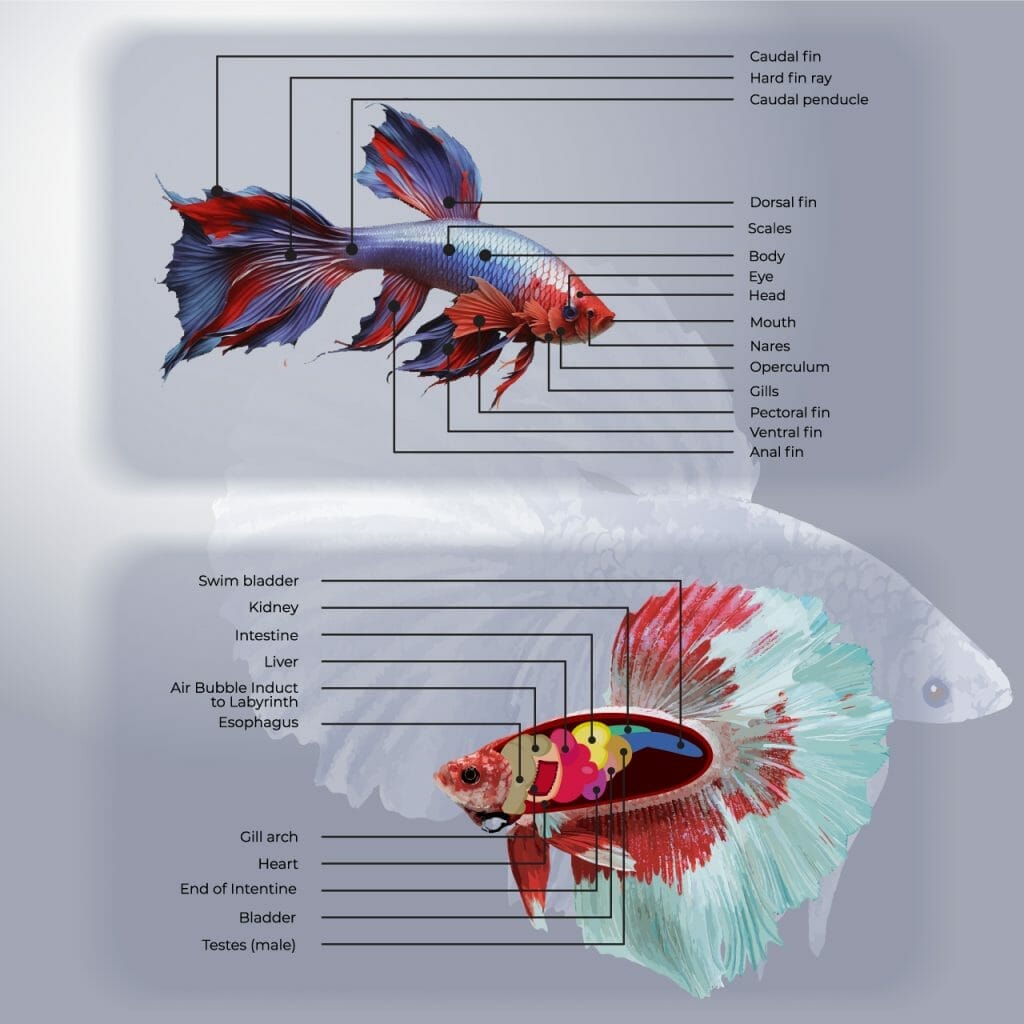
Here’s the dead giveaway: the egg spot (called an ovipositor if you want to get fancy, which we don’t).
It’s a small white dot between her anal and ventral fins, and when she’s carrying eggs, it’ll stick out like a tiny white tube.
Males almost never have this—it’s basically the female betta’s ID card.
Color Me… Less Impressed?
Now, don’t get me wrong—female bettas can be gorgeous.
But they’re generally less vibrant than males, with more subdued colors that won’t blind you from across the room.
Think of it this way: males are wearing neon signs, females are rocking a classy palette.
When they’re ready to breed, females show vertical stripes on their bodies (breeding bars), which males don’t have.
They can also display horizontal stripes when they’re scared—these “fear stripes” can appear and disappear so fast you’ll wonder if you imagined them.
The Beard Situation
Both male and female bettas have what looks like a “beard”—the opercular membrane under their gills.
Males have way bigger beards that you can see even when they’re chilling, while females have smaller ones that only show up when they flare.
It’s like males are constantly ready for a showdown and females only bring out the attitude when absolutely necessary.
Personality Check: Are Female Bettas Actually Nicer?
The Aggression Question
Here’s the thing—yes, female bettas are generally less aggressive than males, but that doesn’t mean they’re pushovers.
Males will literally fight to the death if you put them together (hence the whole “Siamese Fighting Fish” nickname).
Females are more like “I’ll chase you around and maybe nip your fins, but I probably won’t kill you.”
That said, individual personalities vary like crazy.
Some females are absolute angels, others act like they woke up and chose violence every single day.
The Zippy Factor
One thing everyone who keeps female bettas mentions: they’re faster and more active than males.
Males have all those fancy fins weighing them down like they’re swimming in a prom dress, so they tire out easily.
Females are built like little underwater race cars—they dart around, zoom from hiding spot to hiding spot, and generally have way more energy.
They’re also more exploratory and curious, which makes them fun to watch.
Bubble Nests? Not Really Their Thing
Male bettas build bubble nests even when there’s no female around, like they’re practicing for a family they’ll never have.
Females don’t typically build nests—though in rare cases, an aggressive female might make a small one just to prove she can.
If your female is building bubble nests, she’s probably more territorial and might not play well with others.
Setting Up the Perfect Home for Your Girl
Tank Size: Bigger Is Better
Here’s where people mess up constantly—bettas don’t live in bowls.
I don’t care what your local pet store told you; bowls are for cereal, not fish.
A single female betta needs at least 5 gallons, ideally 10 gallons.
If you’re keeping multiple females in a sorority (more on that nightmare/dream scenario later), you need at least 20 gallons.
Water Parameters: Don’t Wing It
Female bettas come from tropical Southeast Asia—Thailand, Myanmar, places where it’s warm and muggy.
Your tank needs to match that vibe: temperature between 75-82°F (23.8-27.2°C).
A heater isn’t optional—it’s mandatory unless you live somewhere that’s perpetually tropical (and even then, get a heater).
Water pH should hover around 7.0, and you want low general hardness.
Test your water weekly because bad water quality is the number one way to stress out your betta and invite every disease in the book.
Filtration and Flow
Bettas aren’t strong swimmers, so don’t blast them around with a powerful filter like they’re in a water park.
Sponge filters are perfect—they provide biological filtration without creating a hurricane in your tank.
If your filter has strong flow, add some filter floss to the output to calm things down.
Decorations: Give Her Places to Hide
Female bettas are hiders—they love darting between plants and decorations like they’re playing hide and seek.
You need lots of plants (live plants are better but silk plants work too—just avoid sharp plastic that can tear fins).
Add caves, driftwood, and other hiding spots so she can claim territories and escape if needed.
The more visual barriers and hiding places, the less stressed your betta will be.
Feeding Your Female Betta (Without Overfeeding)
What’s on the Menu?
Bettas are carnivores, so they want protein-rich food—not plant flakes.
High-quality betta pellets (the pellets I feed my betta daily) should be your go-to, supplemented with live or frozen foods like bloodworms, brine shrimp, and daphnia.
How Much and How Often?
Here’s the thing about bettas—their stomach is the size of their eyeball.
That means you need to feed them small amounts 1-2 times per day, only what they can eat in 2-3 minutes.
Overfeeding leads to bloating, constipation, and polluted water (because everything they can’t digest becomes waste).
Remove any uneaten food immediately—don’t let it rot in there.
Community Tanks: Can Female Bettas Make Friends?
Solo Living vs. Tank Mates
Female bettas can actually live with other fish, unlike their male counterparts who treat everyone like mortal enemies.
Good tank mates include peaceful fish like neon tetras, Corydoras catfish, snails, and shrimp.
Avoid fin-nippers like tiger barbs or anything that looks flashy enough to be mistaken for another betta (sorry, guppies).
If you’re adding a female betta to an existing community tank, watch her closely—some girls are total sweethearts, others become the alpha fish who runs the show.
Tank Mate Red Flags
Never put two male bettas together—they’ll fight to the death, period.
Don’t keep just one male and one female together either unless you’re actively breeding them with proper setup and supervision.
Males can harass females to death if they’re stuck together, which is about as grim as it sounds.
The Sorority Setup: Multiple Females Living Together
What Is a Betta Sorority?
A sorority is basically a group of female bettas living together in one tank.
It sounds awesome in theory—multiple beautiful bettas in one aquarium!
In reality, it’s either going to be a stunning success or a complete disaster, and the difference comes down to how well you plan.
The Bare Minimum Requirements
If you want to try a sorority, here’s what you need:
| Requirement | Details |
|---|---|
| Tank Size | Minimum 20 gallons (bigger is better) |
| Number of Females | At least 5 (never less than 4) |
| Age and Size | Similar age and size—no mixing babies with adults |
| Introduction | Add all females at the same time |
| Decorations | Heavily planted with lots of hiding spots |
Why the Odd Numbers?
Keeping at least 5 females spreads out aggression so no single fish becomes a constant target.
If you only have 3 females and one’s a bully, the other 2 are going to have a bad time.
With 5+ females, the aggression gets distributed and everyone has a better chance at peace.
The Introduction Process
This is where people mess up—you CANNOT add females one at a time to an established tank.
You need to add all of them together, ideally within 5 minutes of each other.
Why? Because if one fish has already claimed the territory, she’s going to fight anyone new who shows up.
Acclimate them all in separate containers where they can see each other for a bit, then release everyone at once.
The First 36 Hours: Don’t Panic
Your females are going to chase each other, flare, and generally act dramatic while they establish a pecking order.
This is completely normal and doesn’t mean your sorority is failing.
Body slamming, chasing, orbiting—all part of the process.
Only intervene if you see actual fin tearing or one fish getting relentlessly bullied to the point she can’t eat or hide.
Choosing the Right Females
Here’s the pro tip everyone should know: buy females that were born and raised together if possible.
Sisters or fish from the same spawn are already familiar with each other and will be way less aggressive.
Local breeders are your best bet for this—big chain stores mix fish from everywhere.
Also, younger females are calmer than older ones, so get them young and let them grow up together.
When Sororities Go Wrong
Sometimes, despite doing everything right, a sorority just doesn’t work.
If one female is constantly attacking others or if someone’s getting seriously injured, you need a backup plan.
That means having a separate tank ready to remove the aggressor or the victim.
Removing the alpha female (not the one being bullied) can sometimes help reset the hierarchy.
You can try reintroducing her after a couple days, but some fish just aren’t sorority material.
Health and Maintenance: Keeping Your Girls Happy
Weekly Water Changes Are Non-Negotiable
Change out 25-50% of the water weekly and vacuum the substrate to remove waste.
Don’t do 100% water changes—you’ll nuke all the beneficial bacteria that keep your tank ecosystem healthy.
Test your water parameters (ammonia, nitrites, nitrates, pH) regularly to catch problems before they become disasters.
Signs of a Happy Betta
A healthy, happy female betta is active, curious, and eats well every day.
She’ll have bright colors (for a female), intact fins, and swim around comfortably.
If she’s constantly hiding, refusing food, or showing clamped fins, something’s wrong.
Common Health Issues
Stress is the number one killer of bettas—it weakens their immune system and makes them vulnerable to diseases.
In sorority tanks, stress and injuries from fighting can quickly spread illness to the whole group.
Watch for lethargy, unusual swimming patterns, fin rot, or white spots (ich).
Quarantine new plants and decorations before adding them to prevent introducing parasites.
Breeding Female Bettas (If You’re Feeling Adventurous)
The Basics of Breeding
Breeding bettas at home is possible but requires serious preparation.
The male builds a bubble nest, the female lays eggs in it, then the male fertilizes them and guards the nest.
After spawning, remove the female immediately—males can get aggressive and harass her to death.
Signs She’s Ready to Breed
When a female betta is full of eggs, she’ll look bloated with a protruding egg spot.
She’ll display vertical breeding stripes on her body, signaling she’s ready.
The eggs will either be spawned or absorbed back into her body naturally—she doesn’t need a male to “release” them.
Don’t Breed Unless You’re Prepared
You’ll need separate conditioning tanks, a breeding tank, and a plan for dozens (sometimes hundreds) of babies.
Baby bettas need special tiny food and tons of maintenance.
Don’t breed bettas on a whim—it’s a huge commitment.
Female Betta Lifespan and Long-Term Care
With proper care, female bettas typically live 2-4 years, though some can reach 8-9 years with excellent conditions.
Factors affecting lifespan include water quality, diet, tank size, and stress levels.
Sorority fish often have shorter lifespans than solo females due to constant social stress.
Keep up with regular maintenance, provide enrichment, and monitor their health to give them the longest, happiest life possible.
Fun Personality Quirks of Female Bettas
Female bettas are often described as “spunky” and “playful” by their owners.
They’re more interactive than you’d expect—many will follow your finger around the tank or come to the front when they see the person who feeds them.
You can even train them to do tricks like jumping through hoops (seriously).
Each female has her own personality—some are bold and curious, others are shy and nervous.
The “zippy” swimming style combined with their curiosity makes them entertaining to watch all day.
Bottom Line: Should You Get a Female Betta?
If you want a colorful, active, personality-packed fish that doesn’t need to live alone forever, female bettas are way more impressive than they look.
They’re less high-maintenance than males (no massive fins to worry about), faster swimmers, and actually capable of living with others—whether that’s other fish or a sorority of their sisters.
Yes, they can be feisty.
Yes, sororities can be risky.
But with the right setup—proper tank size, great water quality, plenty of hiding spots, and carefully chosen tank mates—female bettas thrive.
They’re the practical, zippy, underrated queens of the betta world, and honestly? They deserve way more attention than they get.
So next time you’re at the pet store and all the males are putting on their dramatic fin displays, take a second look at the females.
You might just find your new favorite fish.
Male vs Female Betta: Quick Comparison
When it comes to Betta fish, distinguishing between males and females can be both fascinating and essential for any aquarist.
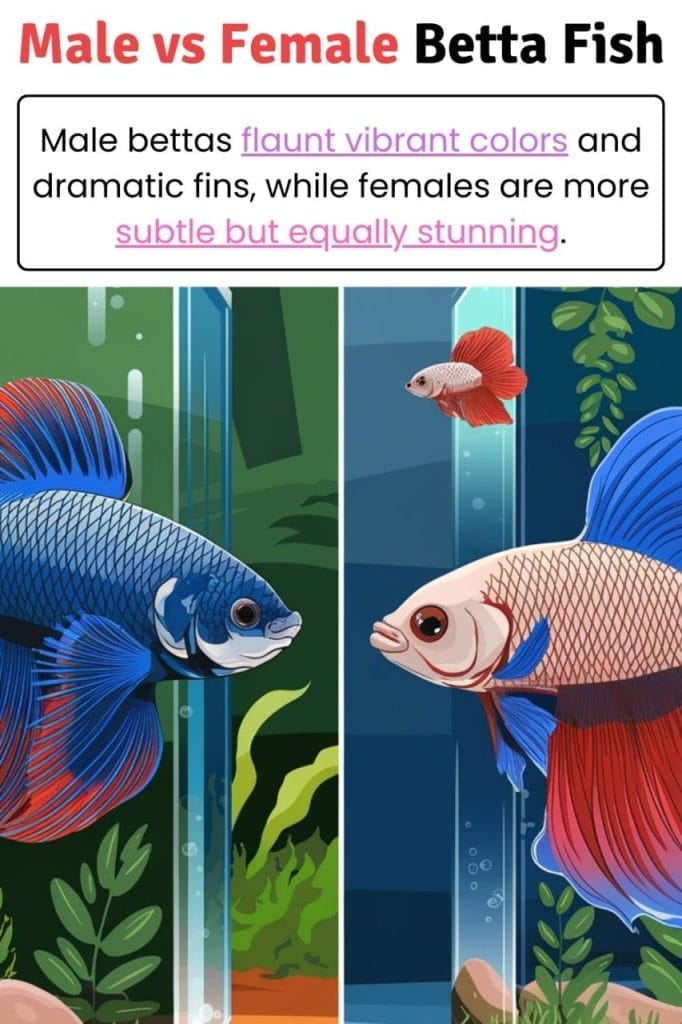
Male Betta fish are often recognized for their vibrant colors and long, flowing fins, while females typically have shorter fins and a subtler appearance.
Understanding these differences is key not only for choosing the right tank mates but also for ensuring proper care and breeding.
This post will guide you through the distinctive traits that set male and female Betta fish apart, helping you to confidently identify and appreciate each.

Physical Differences
When distinguishing between male and female betta fish, physical characteristics are the most noticeable differences.
Size and Body Shape
| Feature | Male Betta Fish | Female Betta Fish |
|---|---|---|
| Size | Larger, typically 2.5 to 3 inches | Smaller, usually 2 to 2.5 inches |
| Body Shape | Sleeker, elongated body | Rounder, more robust body |
Male bettas are generally larger and have a more streamlined, elongated body compared to the rounder, more robust shape of females.
Fins and Coloration
One of the most striking differences is in the fins and coloration:
- Male Betta Fish: Males have longer, more elaborate fins that can span out in a dramatic display. Their colors are usually more vibrant, with a wider range of hues and patterns.
- Female Betta Fish: Females have shorter fins and are less colorful, with more subdued shades. However, they still have beautiful patterns and can display bright colors, especially when in a well-maintained environment.
Ovipositor (Egg Spot)
Female bettas have a small white spot on their abdomen between their ventral fins, known as the ovipositor. This spot is an indication of their ability to lay eggs. Males do not have this feature, making it a clear distinguishing mark.
Bubble Nesting Behavior
Male bettas are known for building bubble nests on the surface of the water as part of their breeding behavior. They create these nests in preparation for the female to lay eggs, which the male then fertilizes and cares for. Females do not build bubble nests, although they may occasionally contribute bubbles if in a breeding condition.

Behavioral Differences
Understanding the behavioral differences between male and female betta fish is essential, especially if you’re considering keeping them with other fish or in a community tank.
| Aspect | Male Betta Fish | Female Betta Fish |
|---|---|---|
| Aggression | Highly territorial and aggressive, especially toward other males | Generally less aggressive, can coexist with other females and certain tank mates |
| Social Interaction | Solitary; prefers its own space; not very interactive with other fish | More social; can be kept in groups (sororities); interacts well with other fish |
| Breeding Behavior | Builds bubble nests; engages in elaborate courtship; takes care of eggs | Responds to male’s courtship but does not build nests or care for eggs |
Aggression and Territory
- Male Betta Fish: Males are highly territorial and can be aggressive, especially towards other males. They will often flare their gills and spread their fins to appear larger when they feel threatened. This behavior makes it challenging to keep multiple males in the same tank.
- Female Betta Fish: Females are generally less aggressive and can coexist with other females in a group known as a sorority. However, they can still display territorial behavior, especially in a confined space.
Social Interaction
- Male Betta Fish: Males are more solitary and prefer to have their own space. They do not typically interact well with other fish and are best kept alone or with carefully selected tank mates.
- Female Betta Fish: Females are more social and can be kept in groups. They tend to be more interactive with other fish and can create a dynamic community in the tank.
Breeding Behavior
During the breeding process, males display elaborate courtship behaviors, including building bubble nests and engaging in a dance with the female. The female will release eggs, which the male fertilizes and then gathers into the nest. The male takes on the role of caring for the eggs and guarding them until they hatch.
Tank Mates Consideration
Choosing the right tank mates for your betta fish is crucial for maintaining a peaceful and stress-free environment.
tank mates for Male Betta Fish
Males are known for their territorial nature, making it challenging to find suitable tank mates. They are prone to attacking other fish, especially those with long fins or bright colors that they may mistake for rivals. When selecting tank mates for a male betta, consider the following:
- Peaceful, non-aggressive species such as snails, shrimp, or small, fast-moving fish like neon tetras.
- Avoid tank mates with long fins or similar coloring to prevent aggression.
tank mates for Female Betta Fish
Females are generally more tolerant of other fish, making them easier to pair with tank mates. They can be kept in sorority tanks with other females, provided there is enough space and hiding spots to reduce stress. Suitable tank mates for female bettas include:
- Other small, peaceful fish like guppies, corydoras, or rasboras.
- Snails and shrimp are also good options for a community tank.
Best Practices
- Introduce tank mates slowly: Gradual introduction allows your betta to adjust without feeling threatened.
- Provide ample space and hiding spots: This helps reduce stress and gives fish a place to retreat if needed.
- Monitor interactions closely: Be prepared to separate fish if aggressive behavior arises.

Choosing Between a Male and Female Betta Fish
When deciding whether to get a male or female betta fish, consider the following factors:
Factors to Consider
- Tank Setup: Males require more space and fewer tank mates due to their aggressive nature. Females can be kept in groups and with a wider range of other fish.
- Experience Level: If you’re new to keeping bettas, a female may be easier to manage due to their less aggressive behavior.
- Personal Preferences: Consider whether you prefer the dramatic appearance of a male or the more subdued, social nature of a female.
Pros and Cons of Each
| Aspect | Male Betta Fish | Female Betta Fish |
|---|---|---|
| Appearance | More vibrant colors, longer fins | Shorter fins, less vibrant but still beautiful |
| Aggression | Highly territorial, often aggressive | Less aggressive, can be kept in groups |
| Tank Setup | Best kept alone or with careful selection of tank mates | Can be kept with a wider variety of tank mates, including other females |
Common Misconceptions
There are several myths and misconceptions about male and female betta fish:
- “Females are boring and dull.” While females may be less colorful than males, they can still be quite vibrant and have their own unique charm.
- “Male bettas can’t be kept with any other fish.” While it’s true that males are more aggressive, they can coexist with certain peaceful species if carefully managed.
- “Female bettas don’t need as much space.” Both male and female bettas benefit from ample space and a well-maintained tank environment.

About Author
Hello, I’m Muntaseer Rahman, the owner of AcuarioPets.com. I’m passionate about aquarium pets like shrimps, snails, crabs, and crayfish. I’ve created this website to share my expertise and help you provide better care for these amazing pets.
Disclaimer
This site is owned and operated by Muntaseer Rahman. AcuarioPets.com is a participant in the Amazon Services LLC Associates Program, an affiliate advertising program designed to provide a means for sites to earn advertising fees by advertising and linking to Amazon.com. This site also participates in other affiliate programs and is compensated for referring traffic and business to these companies.