This post was created with help from AI tools and carefully reviewed by a human (Muntaseer Rahman) . For more on how we use AI on this site, check out our Editorial Policy.
Check Out These FREE Tools We Made JUST For You!
Can My Chameleon Recognize Me? Do They Show Affection?

So you’ve been staring at your chameleon for the last twenty minutes, and you swear he just looked at you. Like, really looked at you. One eye swiveled, locked on, and held your gaze for a solid three seconds.
Now you’re sitting there wondering if your tiny color-changing dinosaur actually knows who you are. Or if he just thinks you’re a weirdly shaped tree with food in its hands.
Honestly? It’s a bit of both. And the answer is way more interesting than you’d think.
The Short Answer (And Why It’s Complicated)
Yes, your chameleon can recognize you. Studies and keeper experience both back this up. Chameleons learn to tell handlers apart within just a few days of regular interaction.
But before you start picturing your chameleon waiting by the door wagging his tail, pump the brakes.
Chameleons don’t bond the way a dog or cat does. They don’t miss you. They don’t get jealous when you talk to your other pets. What they do is learn to associate your specific shape, smell, and routine with safety and food.
That’s still recognition. It’s just not love.
What “Recognition” Actually Means to a Chameleon

Your chameleon’s brain isn’t wired for emotional bonding the way a mammal’s is. Reptiles lack the fancy limbic system structures mammals use for things like attachment, social play, and pack loyalty.
What they DO have is a really solid memory for patterns. Specifically:
- Visual patterns: your shape, your face, your movement style
- Scent patterns: they have a surprisingly strong sense of smell
- Routine patterns: feeding times, misting schedules, when you walk into the room
After a few weeks of consistent contact, your chameleon learns: this big slow-moving thing brings crickets and doesn’t try to eat me. That’s a positive association.
Walk in the room and his behavior changes. Have a stranger walk in and he might puff up, darken, or hide. That’s recognition in action.
What Their Two Independent Eyes Are Doing
Here’s a fun detail. Chameleons can move each eye independently, which means they can scan two things at once. When your chameleon points one eye at you and keeps the other on his branch, he’s essentially keeping tabs on you while staying alert.
When both eyes lock on you at the same time? That’s full-attention mode. He’s processing you specifically.
It’s not affection. But it IS interest, and it’s a sign he’s identifying you as a known entity, not a threat.
Can They Recognize Your Voice?
Sort of. But probably not the way you’re imagining.
Chameleons are basically deaf to airborne sounds. They have no external ears and their hearing range is super narrow, somewhere between 200 and 600 Hz. That covers some human speech but not nearly as much as we’d hope.
What they’re much better at picking up is vibration. Footsteps, doors closing, the hum of appliances. So when your chameleon “responds to your voice,” he’s almost always reacting to:
- The vibration of you walking up to the cage
- The shift in light when you approach
- The visual movement of your body
- The smell that comes with you opening the cage
Not the actual words. Sorry. Your chameleon doesn’t care that you’ve named him Sir Reginald the Third.
The Big Question: Do Chameleons Feel Affection?
Here’s where I have to be the buzzkill at the party.
Most herpetologists agree: chameleons do not feel affection in the human or even mammalian sense. They don’t experience love, attachment, or longing. Their brain literally doesn’t have the hardware for it.
But here’s the thing. They absolutely can develop trust. And in the reptile world, trust is the closest thing to affection you’re gonna get.
A chameleon that trusts you will:
- Not run away when you approach
- Take food directly from your hand
- Climb onto your hand willingly
- Stay calm during handling instead of going dark and stressed
- Keep both eyes open and relaxed in your presence
That’s not love. That’s earned tolerance. And honestly, when you understand how anti-social chameleons are by nature, earned tolerance is a huge deal.
Real Signs Your Chameleon Knows You
Forget the cat and dog signals. Here’s what actually means something in chameleon body language.
| Sign | What It Means |
|---|---|
| Stays its normal color when you’re near | Relaxed, not stressed by your presence |
| Approaches the front of the enclosure when you arrive | Has positively associated you with food or interaction |
| Takes food from your hand without hesitation | High level of trust, big deal |
| Eyes stay open and alert | Comfortable enough to keep them open around you |
| Doesn’t gape, hiss, or puff up | No threat response = recognition of safety |
| Lets you hand-feed without lunging defensively | Knows your hand isn’t a predator |
Compare that to a stranger walking up. Chameleon goes dark, puffs out, opens his mouth, maybe rocks side to side trying to look bigger. That contrast is the recognition.
Signs People MISREAD as Affection
Be careful with these. A lot of new keepers think these mean their chameleon loves them. Spoiler: they don’t.
- Closed eyes: almost always a sign of illness or extreme stress, NOT contentment. A healthy chameleon never sleeps with you in the room.
- Climbing onto you “willingly”: sometimes they’re just trying to get to a higher branch, and you happen to be the tallest thing in the room.
- Sitting still while you pet them: could be tolerance, but more often it’s the freeze response. They’re hoping you’ll go away.
- Bright vibrant colors: often means territorial display, not happiness. Calm chameleons are usually muted greens or browns.
If you want to know what your chameleon’s color is actually telling you, our chameleon color changes guide breaks down the full mood-ring vocabulary.
How to Build Trust With Your Chameleon

You can’t speed-run this. Trust takes weeks or months of consistent, low-pressure interaction. Here’s the playbook that actually works.
Week 1-2: Don’t Touch, Just Exist
For the first two weeks after bringing your chameleon home, leave him alone. No handling. No reaching in. Just let him acclimate to the new enclosure.
Walk past slowly. Talk softly nearby (not because he hears you, but because it gets you in the habit of moving calmly). Mist the cage. Keep the lights consistent.
You’re basically becoming background noise. That’s the goal.
Week 3-4: Hand-Feed From the Outside
Start offering crickets or worms with feeding tongs through the cage door. Don’t reach in with bare hands yet.
Move slowly. Don’t make eye contact directly. Chameleons interpret head-on staring as predator behavior. Approach from below or the side.
When he takes food without flinching, you’ve made progress. Be patient. This step alone can take weeks.
Week 5+: Hand Feeding and Optional Handling
Once he reliably takes food from tongs, switch to your fingers. Hold the cricket between two fingers and let him shoot his tongue at it.
If he does this without freaking out, congratulations. You’re now a known food source. That’s a big trust milestone.
Want to try handling? Read our guide on holding a chameleon and what actually happens before you reach in. There’s a right way and a stressful way to do this.
Why Some Chameleons Will Never Bond With You
Here’s a hard truth: not every chameleon is going to tolerate you no matter how much work you put in.
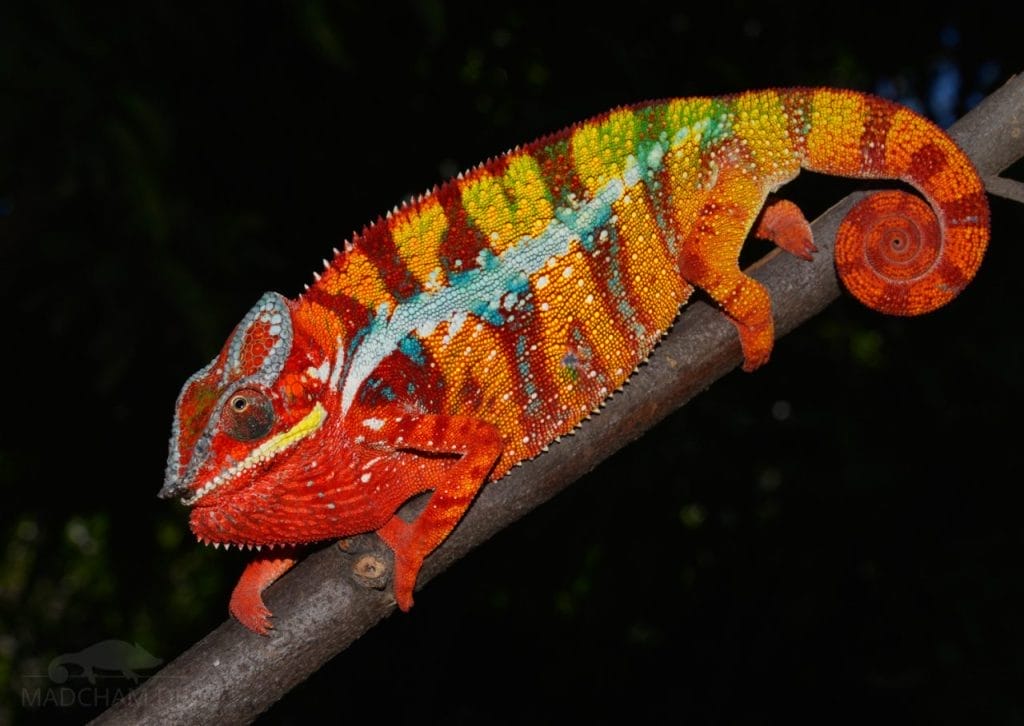
Some species and individuals are just more anti-social than others. Veiled chameleons are notorious for being grumpy. Panthers tend to be a bit calmer. Jackson’s chameleons are usually somewhere in between.
| Species | Temperament | Tolerance for Handling |
|---|---|---|
| Veiled Chameleon | Bold, defensive, often aggressive | Low |
| Panther Chameleon | Calmer, more curious | Medium |
| Jackson’s Chameleon | Shy, prefers to be left alone | Low to medium |
| Pygmy Chameleons | Tiny, very stress-prone | Very low |
Females of most species tend to be more skittish than males, especially during egg-laying cycles. If you want to dig into the personality split, our male vs female chameleons breakdown goes deep on the differences.
Wild-caught chameleons rarely tame down. Captive-bred ones from a young age have a much better shot at tolerating people.
What About Other Reptiles? Do They Bond More?
For comparison, here’s roughly where chameleons sit on the reptile sociability scale.
| Reptile | Bonding Capacity |
|---|---|
| Bearded Dragon | High. Recognizes owners and enjoys handling |
| Leopard Gecko | Medium-high. Tolerates handling, learns routines |
| Ball Python | Medium. Calm with handling, neutral to people |
| Tegus | High. Surprisingly dog-like with consistent handling |
| Chameleon | Low. Recognizes but rarely seeks interaction |
So if you specifically want a reptile that will hang out with you on the couch, a chameleon is one of the worst picks in the lizard world. They’re more like aquarium fish you can interact with occasionally. Beautiful to watch, fascinating to learn from, but not exactly cuddly.
If you weren’t sure whether one was right for you, our guide on whether chameleons make good pets gives the unvarnished version.
Final Thoughts: Recognition Without Romance
Your chameleon knows you. He recognizes your shape, your smell, your routine, and the vibration of your footsteps. He knows you’re the food guy and not a threat.
That’s recognition. It’s real. And for a creature with a brain the size of a peanut, it’s actually pretty impressive.
But he doesn’t love you. He doesn’t miss you when you’re at work. He won’t be excited to see you. And that’s okay.
The reward of keeping a chameleon isn’t snuggles or playtime. It’s the privilege of getting close to one of the strangest, most evolutionarily weird creatures on the planet, and earning enough of his trust that he stops treating you like a predator.
That’s a smaller win than what you’d get from a dog. But honestly? It might mean more.
Now go mist your cage. Your chameleon is thirsty, and that’s the kind of “showing affection” he actually understands.

About Author
Hello, I’m Muntaseer Rahman, the owner of AcuarioPets.com. I’m passionate about aquarium pets like shrimps, snails, crabs, and crayfish. I’ve created this website to share my expertise and help you provide better care for these amazing pets.
Disclaimer
This site is owned and operated by Muntaseer Rahman. AcuarioPets.com is a participant in the Amazon Services LLC Associates Program, an affiliate advertising program designed to provide a means for sites to earn advertising fees by advertising and linking to Amazon.com. This site also participates in other affiliate programs and is compensated for referring traffic and business to these companies.