This post was created with help from AI tools and carefully reviewed by a human (Muntaseer Rahman) . For more on how we use AI on this site, check out our Editorial Policy.
Check Out These FREE Tools We Made JUST For You!
Albino Pacman Frog Care For Beginners [Complete Care Sheet]
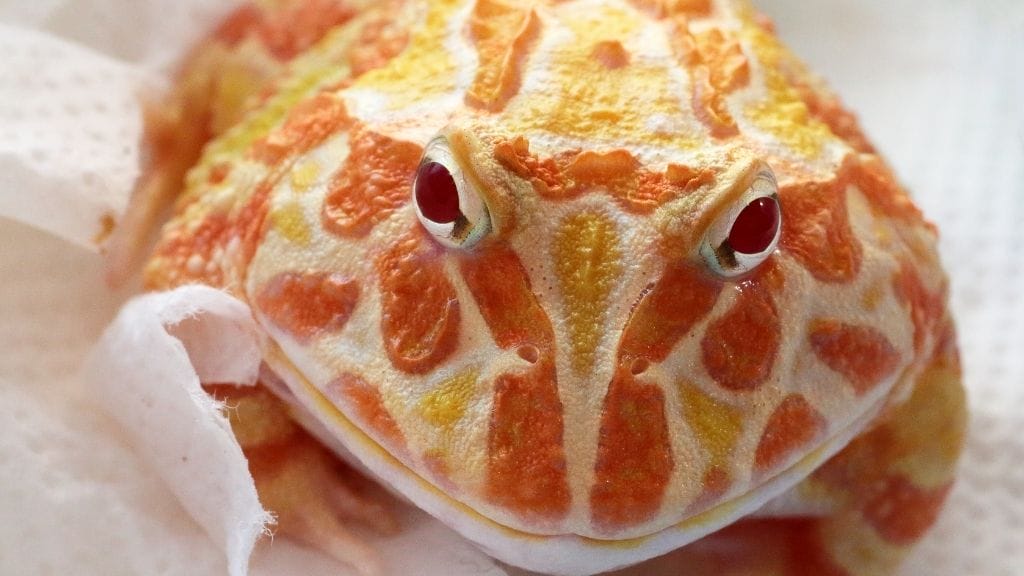
So you went to the pet store for “just a quick look” and came home with a bright yellow frog that looks like it swallowed a tennis ball.
Welcome to the club.
Albino Pacman frogs are easily the most popular morph in the Pacman frog world. And honestly, it’s not hard to see why. Those red eyes, that golden skin — they look like a tiny, grumpy ball of sunshine.
But here’s the thing. That gorgeous pale skin comes with a catch.
Albino Pacman frogs need a bit more attention than their green cousins. Get the care right, and this little blob of attitude will hang around for 10 to 15 years. Get it wrong, and you’re looking at a sick, stressed frog that won’t eat.
This care sheet covers everything you need. Tank setup, lighting (this one’s a big deal for albinos), feeding, supplements, common diseases, and the stuff nobody tells beginners until it’s too late.
Let’s get into it.
Quick Care Cheat Sheet
| Parameter | Requirement |
|---|---|
| Tank size | 10 to 20 gallons |
| Substrate | Coconut fiber or sphagnum moss (keeps the humidity right), 3 to 4 inches deep |
| Temperature | 75°F to 80°F day, never above 85°F |
| Humidity | 60% to 80% |
| Lighting | Ambient room light only — no UVB, no bright bulbs |
| Water | Shallow dish, dechlorinated, changed daily |
| Diet | Gut-loaded crickets, roaches, nightcrawlers + variety |
| Supplements | Calcium w/ D3 every feeding (babies) or every other (adults), multivitamin (I suggest this one) weekly |
| Handling | Minimal — gloves only when necessary |
| Lifespan | 10 to 15 years with proper care |
What Makes Albino Pacman Frogs Different?
Albino Pacman frogs lack pigmentation. That’s the whole story behind their look.
The missing pigment is what gives them that yellow-to-orange skin and those signature red eyes (the blood vessels are visible through the eye tissue). You’ll find them in a few flavors too — standard albino, apricot albino, and the strawberry pineapple albino with a pink tone.
But this isn’t just a cosmetic thing. The lack of pigmentation means their skin and eyes are way more sensitive than a regular Pacman frog’s.
Their skin has basically zero protection against UV light. Their eyes can’t handle bright lighting. And they’re more prone to infections across the board.
Think of it like this — a regular Pacman frog is wearing sunscreen. An albino Pacman frog forgot the sunscreen, the hat, and the sunglasses.
That’s why they need special care. Not dramatically different care, but a few key adjustments that make all the difference.

Tank Setup
Size
Pacman frogs are basically living speed bumps. They don’t move. They sit in one spot, buried up to their eyeballs, waiting for food to walk by.
So you don’t need a mansion. A 10-gallon glass tank (the glass terrarium I set up for them) is perfect for an adult albino Pacman frog. If you want to go bigger, a 20-gallon works great too, but it’s not necessary.
Go with glass over plastic. Glass holds heat and humidity better, and it’s easier to clean.
Lid
This part matters more than people think.
You need a tight-fitting screened lid. At least half of it should be mesh or screen. This does two things — keeps the frog from staging a jailbreak (yes, they try) and prevents the air inside from getting stagnant.
Stagnant, humid air is basically a bacteria factory. And since albino Pacman frogs are already prone to infections, good ventilation is non-negotiable.
Substrate
Your frog is going to spend 90% of its life buried in whatever you put at the bottom of the tank. So this choice matters a lot.
The best options are coconut fiber (my go-to substrate base) (coco coir) or sphagnum moss. Both hold moisture well, are safe if accidentally ingested in small amounts, and are easy to replace.
Here’s what you need to know:
- Substrate should be 3 to 4 inches deep — deep enough for your frog to fully burrow
- Keep it damp but not soaking wet — think wrung-out sponge, not puddle
- Change it every 2 to 4 weeks to prevent bacterial buildup
- Never use gravel, bark chips, or rocks — these cause impaction if swallowed, and Pacman frogs will swallow them
Impaction is when your frog eats something it can’t digest. It blocks their gut, they stop eating, and it can kill them. This is one of the most common causes of death in captive Pacman frogs.
So keep it simple. Coconut fiber. Done.

Lighting (This Is Where Albinos Are Totally Different)
Here’s where albino Pacman frog care takes a hard turn from regular Pacman frog care.
No Bright Lights. Period.
The pale skin and red eyes of albino Pacman frogs are extremely light-sensitive. The room’s ambient lighting is usually all they need.
If you watch an albino Pacman frog under bright light, you’ll actually see their pupils shrink down to tiny dots. That’s them being uncomfortable. Prolonged exposure to bright or direct light can cause blindness and serious skin damage.
No UVB
Regular Pacman frogs can tolerate low levels of UVB. Albinos can’t.
Do not put a UVB bulb in an albino Pacman frog’s tank. UVB exposure above 4% to 5% can cause fatal damage to their eyes and skin. Even the frog community online is pretty unanimous on this one — take the UV bulb out if you have an albino.
In the wild, these frogs hide under the earth on rainforest floors. They’re built for darkness, not sunlight.
What About a Day/Night Cycle?
Pacman frogs are nocturnal, so they do benefit from knowing when it’s “day” and when it’s “night.” But for albinos, the room’s natural light cycle handles this just fine.
If your tank is in a dark room and you want to add a light, use a low-wattage red or blue bulb (25 to 30 watts). Never a white daylight bulb. Some keepers also use very low-voltage LED strips for bioactive setups, which works as long as it’s not aimed directly at the frog.
Bottom line: when in doubt, less light is better for albinos.
Temperature
Albino Pacman frogs like it a bit cooler than regular Pacman frogs.
| Parameter | Ideal Range |
|---|---|
| Daytime temperature | 75°F to 80°F (24°C to 27°C) |
| Nighttime temperature | 65°F to 75°F (18°C to 24°C) |
| Maximum safe temperature | 85°F (29°C) — never exceed this |
Their pale skin can’t handle high heat well. Anything above 85°F is dangerous.
For heating, an under-tank heat mat (side-mount this, never under the tank) connected to a thermostat is the safest option. Place it on the side of the tank (not underneath), because a heat mat under the substrate can overheat the burrowing zone — exactly where your frog spends all its time.
A ceramic heat emitter mounted above the tank is another solid choice. It gives off heat without light, which is perfect for albinos.
Keep a digital thermometer in the tank at all times. Don’t guess. Temperature swings are one of the fastest ways to stress a Pacman frog into not eating.
Humidity And Water
Humidity
Albino Pacman frogs need 60% to 80% humidity in the tank. Try not to let it drop below 65%.
A few ways to maintain this:
- Mist the tank once or twice a day with dechlorinated water (5 to 10 seconds per mist)
- Keep the substrate consistently damp
- Add live plants like pothos if you want — they help regulate humidity naturally
- Use a digital hygrometer (the combo gauge I keep on the screen) to monitor levels (analog ones are notoriously inaccurate)
But don’t go overboard. Overly wet, swampy substrate is a fast track to bacterial and fungal infections. Damp is good. Dripping wet is bad.
Water
Keep a shallow water dish in the tank with clean, dechlorinated water. Your frog will soak in it, drink from it, and — let’s be honest — poop in it.
Change the water daily. This is not optional. Pacman frogs absorb everything through their skin. Dirty water means your frog is literally soaking in its own waste. That leads to a condition called Toxic Out Syndrome, which is exactly as bad as it sounds.
A few water rules:
- Use dechlorinated tap water (treat it with a water conditioner like ReptiSafe) or spring water
- Never use distilled water — it lacks the minerals frogs need
- The dish should be shallow enough that your frog can sit in it without the water going above its chin
- Disinfect the dish weekly
Feeding
What To Feed
Albino Pacman frogs eat the same stuff as regular Pacman frogs. They’re carnivores with zero table manners. If it moves and fits in their mouth, they’re going to try to eat it.
| Food Type | Role | Notes |
|---|---|---|
| Crickets | Staple | Gut-load before feeding |
| Dubia roaches | Staple | Great nutritional profile |
| Nightcrawlers | Staple | Many experienced keepers call these the #1 food for Pacman frogs |
| Earthworms | Staple | Avoid red wigglers — they taste terrible to frogs |
| Hornworms | Occasional treat | High moisture, good variety |
| Silkworms | Occasional treat | Soft-bodied, nutritious |
| Waxworms | Rare treat | Very high in fat — like feeding your frog a donut |
| Pinky mice | Once a month max | High fat, low calcium — don’t overdo it |
The golden rule: variety is everything. Feeding only crickets week after week is like eating nothing but broccoli. You’d survive, but you’d be missing a lot of nutrients.
Gut-Loading (Don’t Skip This)
This is where a lot of beginners drop the ball.
Gut-loading means feeding your feeder insects a nutritious diet 24 to 48 hours before you offer them to your frog. Whatever the cricket eats, your frog gets the benefit of.
Feed your crickets or roaches things like dark leafy greens, carrots, sweet potatoes, oranges, or a commercial gut-load diet. This alone makes a massive difference in your frog’s overall nutrition.
How Often To Feed
| Frog Age/Size | Feeding Frequency | Portion Size |
|---|---|---|
| Baby (under 2 inches) | Every day | 3 to 4 small crickets per feeding |
| Juvenile (2 to 4 inches) | Every other day | Appropriately sized insects |
| Adult (4+ inches) | Every 2 to 3 days | About 5 crickets or equivalent |
If your frog doesn’t eat within 15 to 20 minutes, remove the food. Leftover crickets running around the tank can actually stress and even bite a burrowed frog.
Also, keep an eye on body shape. A healthy Pacman frog should look plump but not bloated. If your frog is starting to look like it swallowed a baseball, cut back on the portions.
Supplements (Yes, They’re Mandatory)
Live insects alone don’t provide everything your frog needs. Supplements fill the gaps, and for albino Pacman frogs — which are already more prone to health problems — skipping supplements is asking for trouble.
- Calcium with D3 — Dust feeder insects at every feeding for babies and juveniles, every other feeding for adults. Use a phosphorus-free calcium powder (my daily dusting pick). Without calcium, your frog will develop metabolic bone disease — brittle bones, a drooping jaw, and eventual death.
- Multivitamin — Once a week, dust one meal with a multivitamin powder. Look for one that includes vitamin A, vitamin K, and minerals. Repashy Calcium Plus is popular because it’s an all-in-one formula that simplifies the routine.
The easiest way to dust? Toss a few crickets in a plastic bag with a pinch of supplement powder. Shake it like a tiny maraca. Feed immediately after.
Handling (Or Rather, Don’t)
Here’s the part that disappoints a lot of new owners.
Pacman frogs are not pets you hold. They’re pets you watch.
Albino Pacman frogs especially should be handled as little as possible. Their sensitive skin absorbs oils, chemicals, lotions, and bacteria from your hands. Even brief contact can make them sick.
On top of that, they don’t enjoy being touched. Startle them and you’ll get a bite — and Pacman frogs have a surprisingly strong bite for something that looks like a squeaky toy.
If you absolutely need to handle your frog (like during a tank cleaning), wear powder-free, moistened latex gloves. Keep it brief. Put them right back.
The best way to interact with your Pacman frog? Sit back and watch it do its thing. Tong-feeding is about as hands-on as you should get, and honestly, watching a Pacman frog lunge at a cricket from its burrow is way more entertaining than holding it.
Common Health Issues
Albino Pacman frogs are tougher than they look, but their lack of pigmentation does make them more vulnerable to certain problems.
Here’s a quick reference:
| Signs | Likely Issue | What To Do |
|---|---|---|
| Weight loss, redness, sores, bleeding from mouth | Bacterial/fungal infection | See an exotic vet immediately. Check substrate isn’t soaking wet. Clean tank. |
| Hard lump in belly, no pooping, not eating | Impaction | Soak frog in lukewarm shallow water. Gently massage sides of belly. See vet if no improvement. |
| Drooping jaw, weak bones, trouble catching food | Metabolic bone disease | Start calcium + D3 supplementation immediately. Consult a vet. |
| Drooling, lethargy, wheezing | Respiratory infection | Check humidity levels. Ensure proper ventilation. Vet visit needed. |
| Stretching out hind legs, erratic behavior | Toxic Out Syndrome | Move frog to fresh, clean dechlorinated water immediately. Deep clean entire tank. |
| Skin abnormalities, weakness, appetite loss | Skin issues | Review lighting — make sure there’s no UV exposure. See vet. |
| Eyes closed for extended periods | Ammonia buildup | Tank needs a thorough cleaning. Change substrate and water. |
The number one rule with frog health: if something looks wrong, don’t wait. Find an exotic vet (a regular dog-and-cat vet usually can’t help here) and get your frog checked out.
Most of these problems are preventable with proper husbandry — clean tank, correct humidity, correct temperature, and proper diet with supplements.
Why Is My Albino Pacman Frog Turning Green?
Don’t panic. This is totally normal.
After eating, you might notice a greenish color appearing on your albino Pacman frog’s sides or the top of its head. It freaks out every new owner the first time it happens.
It’s just digestion. The green shows through their translucent skin as food is being processed. Once digestion is complete, their normal yellow or orange color comes right back.
Think of it as a built-in “currently eating” indicator light. Pretty cool, actually.
Final Thoughts
Albino Pacman frogs aren’t hard to keep. They’re just a little pickier than the standard green Pacman frog about a few key things — mainly lighting, cleanliness, and temperature.
Get those three things right, keep the tank clean, feed a varied diet with proper supplements, and your golden little grump will be with you for over a decade.
They don’t ask for walks. They don’t need toys. They don’t want cuddles. They just want a warm, dark, damp hole to sit in and something crunchy to eat every few days.
Honestly? They might be the most low-maintenance pet that still manages to have a ton of personality.
If you’re thinking about getting one, do it. Just respect the care requirements, and you’ll have a weird, wonderful pet that’s way more interesting than it has any right to be.
About Author
Hello, I’m Muntaseer Rahman, the owner of AcuarioPets.com. I’m passionate about aquarium pets like shrimps, snails, crabs, and crayfish. I’ve created this website to share my expertise and help you provide better care for these amazing pets.
Disclaimer
This site is owned and operated by Muntaseer Rahman. AcuarioPets.com is a participant in the Amazon Services LLC Associates Program, an affiliate advertising program designed to provide a means for sites to earn advertising fees by advertising and linking to Amazon.com. This site also participates in other affiliate programs and is compensated for referring traffic and business to these companies.