This post was created with help from AI tools and carefully reviewed by a human (Muntaseer Rahman) . For more on how we use AI on this site, check out our Editorial Policy.
Check Out These FREE Tools We Made JUST For You!
Whisker Shrimp Care: Feeding, Behavior & Aggression Explained

So you want to keep whisker shrimp?
Bold move.
These guys have a reputation in the aquarium hobby. And it’s not exactly the “friendly neighborhood cleanup crew” kind of reputation.
Whisker shrimp (Macrobrachium lanchesteri) are the troublemakers of the shrimp world. They’re feisty, territorial, and will absolutely try to eat their tankmates if given the chance.
But here’s the thing — they’re also fascinating to watch, surprisingly easy to care for, and add some serious personality to any tank.
Let me walk you through everything you need to know about keeping these little terrors alive and (mostly) well-behaved.
What Exactly Is A Whisker Shrimp?
Whisker shrimp belong to the Macrobrachium genus, which literally translates to “long arm.”
And yep, that’s exactly what makes them stand out.
These shrimp sport impressively long front arms with small claws at the end. Those arms aren’t just for show — they use them to grab food, defend territory, and occasionally snatch slow-moving fish right out of the water column.
Native to Southeast Asia (Malaysia, Singapore, Thailand, Brunei, and Laos), whisker shrimp are also called Asian glass shrimp or riceland prawns. In Thailand, they’re actually caught and sold at fish markets as food.
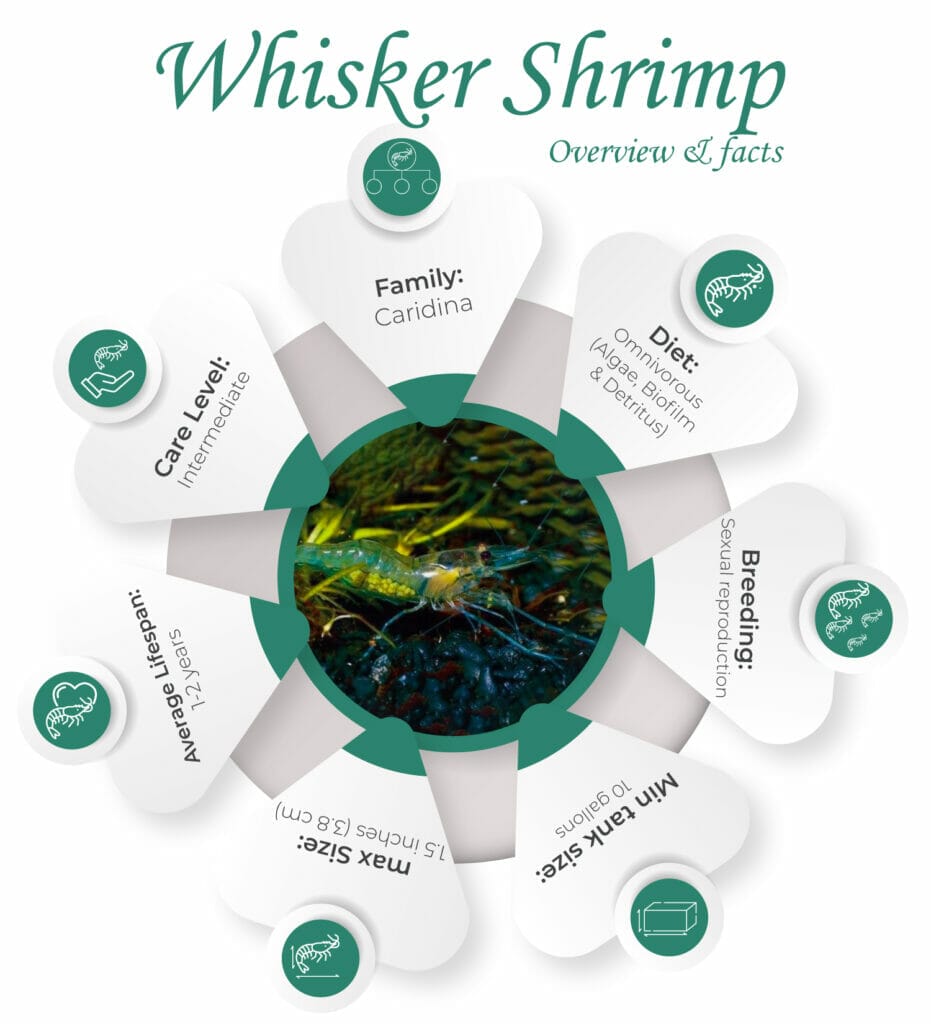
Quick Stats:
| Attribute | Details |
|---|---|
| Scientific Name | Macrobrachium lanchesteri |
| Size | 1.5 – 2.5 inches |
| Lifespan | 1-2 years (up to 5 with great care) |
| Temperament | Semi-aggressive to aggressive |
| Care Level | Easy |
| Diet | Omnivore |
Whisker Shrimp vs Ghost Shrimp: Don’t Get Fooled
Here’s where things get tricky.
Pet stores frequently mislabel whisker shrimp as ghost shrimp. You think you’re bringing home a peaceful little cleaner, and instead you’ve adopted a tiny assassin.
The mix-up happens because both species are semi-transparent and have similar body shapes.
But there are key differences:
| Feature | Whisker Shrimp | Ghost Shrimp |
|---|---|---|
| Size | Up to 2.5 inches | Up to 1.5 inches |
| Arms/Claws | Long arms with visible claws | Short arms, tiny claws |
| Markings | Brown/black stripes on front body, no orange bands | Orange bands on legs and antennae, dotted pattern |
| Temperament | Aggressive | Peaceful |
| Back Hump | Small hump | More pronounced hump |
The easiest tell? Check for those orange bands at the base of the antennae and legs.
Orange bands = ghost shrimp (safe for community tanks).
No orange bands + long arms = whisker shrimp (proceed with caution).
Tank Setup: Give Them Space Or Pay The Price
Whisker shrimp aren’t picky about their environment.
But they ARE picky about personal space.
Crowd them, and you’ll wake up to shrimp pieces scattered around your tank. These guys are territorial and will absolutely fight to the death over a good hiding spot.
Tank Size
Minimum 10 gallons for a single shrimp or a pair.
If you want to keep multiple whisker shrimp, add about 5 gallons per additional shrimp. And even then, stick to one male with multiple females. Males are more territorial and will guaranteed fight each other.
Water Parameters
| Parameter | Ideal Range |
|---|---|
| Temperature | 72-86°F (24-30°C) |
| pH | 6.5 – 8.5 |
| GH | 2 – 14 |
| KH | 1 – 8 |
| Ammonia | 0 ppm |
| Nitrite | 0 ppm |
| Nitrate | Below 20 ppm |
Good news: whisker shrimp are pretty hardy compared to more sensitive species like Crystal Red shrimp.
They can tolerate a wider range of parameters, but that doesn’t mean you should slack on water quality. They’re still shrimp, and shrimp hate ammonia spikes.
Substrate and Decor
Whisker shrimp don’t care what substrate you use.
Sand, gravel, aquarium soil (the planted-tank substrate I rebuy every time) — all fine.
But here’s where you need to think strategically: don’t overcrowd the tank with decorations.
Yes, they need hiding spots for molting. But too many plants and caves create territories to fight over.
Keep it moderate. A few hiding spots, some open swimming space, and you’re good.
Filtration
Sponge filters work great for shrimp tanks.
Just make sure any filter intake is covered with a sponge or mesh. These shrimp are small enough to get sucked in, especially after molting when they’re soft and vulnerable.
The Aggression Problem (And How To Manage It)
Let’s address the elephant in the room.
Whisker shrimp are jerks.
They’re territorial, cannibalistic, and will eat anything they can catch. Other shrimp, small fish, snails, their own young — nothing is off the menu.
And the worst part? They’re nocturnal hunters.
Your fish might be sleeping peacefully at night while your whisker shrimp is plotting its next meal.
Why Are They So Aggressive?
It’s not personal. It’s just biology.
Macrobrachium species evolved as opportunistic predators. Those long arms with claws? Built for grabbing prey.
Their aggression increases when they:
- Feel crowded
- Are hungry
- Are competing for territory
- Get larger (bigger shrimp = more dangerous)
How To Reduce Aggression
You can’t turn a whisker shrimp into a peaceful community member.
But you CAN reduce the carnage:
1. Keep them well-fed. A hungry whisker shrimp is a dangerous whisker shrimp. Make sure they’re eating regularly so they’re less tempted to hunt tankmates.
2. Provide enough space. More room = less territorial aggression.
3. Keep only one male. Multiple males will fight. Period.
4. Consider a species-only tank. Honestly? This is the safest option. Many aquarists end up going this route after losing a few fish.
Feeding: The Easiest Part Of Whisker Shrimp Care
If there’s one thing whisker shrimp are good at, it’s eating.
They’ll eat anything. And I mean anything.
These shrimp are omnivorous scavengers. In the wild, they feed on biofilm, detritus, algae, insects, mollusks, and dead organic matter.
In your tank? They’ll happily devour:
- Shrimp pellets
- Fish flakes
- Algae wafers
- Blanched vegetables (zucchini, spinach, cucumber)
- Frozen bloodworms
- Frozen brine shrimp
- Sinking pellets
- Dead plant matter
- Literally anything that sinks to the bottom
Feeding Schedule
Feed once or twice daily.
Only give them what they can finish in 1-2 hours. These shrimp are greedy — they’ll grab as much food as they can carry, even if it’s way more than they need.
Remove uneaten food after a couple hours to prevent water quality issues.
Calcium Is Important
Like all shrimp, whisker shrimp molt regularly as they grow.
A failed molt can kill them.
Make sure they’re getting enough calcium for healthy shell development. You can:
- Add cuttlebone to the tank
- Use mineral supplements
- Feed calcium-rich foods
Some keepers also add Indian almond leaves, which provide tannins and extra grazing surfaces.
Tank Mates: The Tricky Part
Finding tank mates for whisker shrimp is like finding a needle in a haystack.
Too small, and they become food.
Too big, and the fish eats the shrimp.
It’s a frustrating Catch-22.
What To Avoid
Small fish: Neon tetras, guppies, endlers — any fish that can fit in those claws is at risk. Whisker shrimp are especially dangerous at night when fish are resting near the substrate.
Slow fish: Bettas might seem like they could hold their own, but they sleep near the bottom. A whisker shrimp will absolutely nip fins or worse.
Bottom dwellers: Small corydoras, plecos, and loaches compete for the same space. Not a good combo.
Other shrimp: Cherry shrimp, Amano shrimp, ghost shrimp — all will eventually become snacks.
Small snails: Easy meals.
Potentially Safe Tank Mates
Notice I said “potentially.”
No fish is 100% safe with whisker shrimp.
Your best bets are:
- Larger, quick-swimming tetras (like black skirt tetras)
- Larger barbs (not too aggressive though)
- Larger corydoras species
- Mystery snails (their size offers some protection)
Or just keep them alone. Seriously.
A species-only whisker shrimp tank eliminates the stress of wondering who’s going to get eaten next.
Breeding: Possible But Difficult
Can you breed whisker shrimp at home?
Technically, yes.
Will you succeed on your first try?
Probably not.
Whisker shrimp are “lower-order” shrimp, meaning their babies hatch as tiny larvae (called zoea) instead of miniature adults.
These larvae are microscopic, extremely fragile, and notoriously difficult to keep alive.
The Breeding Process
- A female develops a green “saddle” behind her head, indicating she’s carrying eggs.
- She moves the eggs to her pleopods (swimmerets under her tail).
- Eggs hatch in about a month if fertilized.
- Tiny free-swimming larvae emerge.
- And then things get hard.
Why Larvae Die
The zoea face several threats:
- Getting sucked into filters
- Being eaten by parents and tankmates
- Starvation (they need specific microscopic food)
- Poor water quality
To give them a fighting chance, move the berried female to a separate rearing tank before the eggs hatch. Remove her immediately after hatching — she will eat her own young.
The rearing tank needs to be well-established with lots of infusoria and biofilm. You can also try powdered fry food or freshly hatched baby brine shrimp.
It takes about 2-3 weeks for larvae to develop into juvenile shrimp.
Most hobbyists don’t bother with breeding. It’s a lot of work for uncertain results.
Common Health Issues
Whisker shrimp are hardy, but they’re not invincible.
Failed Molts
The most common killer.
Signs include a shrimp stuck halfway out of its old shell, or a white/cloudy appearance before death.
Causes:
- Calcium deficiency
- Poor water quality
- Sudden parameter swings
Prevention: Maintain stable water parameters, provide calcium, and avoid large water changes that shock the system.
Muscular Necrosis
White, opaque patches appear in the muscle tissue.
There’s no cure. Remove infected shrimp immediately to prevent spreading.
Keep water quality pristine to reduce risk.
Scutariella Japonica
A parasitic worm that attaches to shrimp.
It looks like tiny white threads on the head or rostrum.
Treatment: Salt bath (1 teaspoon per cup of tank water for 30-60 seconds).
White Ring Of Death
A white ring appears around the body, usually at the junction between the head and abdomen.
This indicates a molt is about to go wrong. The shrimp often dies stuck in its shell.
Caused by mineral deficiency or parameter instability.
Tips For Success
After all that, here’s the condensed wisdom for keeping whisker shrimp happy:
1. Don’t buy them by accident. Know what you’re getting. Check for those long arms and lack of orange bands before purchasing.
2. Give them space. Cramped shrimp are aggressive shrimp.
3. Feed them well. A full whisker shrimp is less likely to hunt tankmates.
4. Keep water stable. They’re hardy, but sudden swings cause problems.
5. Accept their nature. You’re not going to turn them into peaceful community pets. Work with their personality, not against it.
6. Consider species-only. Sometimes the best tank mate is no tank mate.
Final Thoughts
Whisker shrimp aren’t for everyone.
They’re not the colorful, peaceful shrimp you see in most aquascapes.
But if you want something different — something with attitude — these transparent little predators deliver.
They’re hardy, entertaining, and genuinely fascinating to observe. Watching a whisker shrimp stalk around the tank, arms outstretched, looking for its next meal is like having a tiny action movie playing 24/7.
Just don’t put your favorite fish in with them.
You’ve been warned.
About Author
Hello, I’m Muntaseer Rahman, the owner of AcuarioPets.com. I’m passionate about aquarium pets like shrimps, snails, crabs, and crayfish. I’ve created this website to share my expertise and help you provide better care for these amazing pets.
Disclaimer
This site is owned and operated by Muntaseer Rahman. AcuarioPets.com is a participant in the Amazon Services LLC Associates Program, an affiliate advertising program designed to provide a means for sites to earn advertising fees by advertising and linking to Amazon.com. This site also participates in other affiliate programs and is compensated for referring traffic and business to these companies.