
This post was created with help from AI tools and carefully reviewed by a human (Muntaseer Rahman) . For more on how we use AI on this site, check out our Editorial Policy.
Check Out These FREE Tools We Made JUST For You!
Screen vs Glass vs Hybrid Cages: Which Is Best for Chameleons?

So you’re setting up a chameleon habitat and the internet just exploded your brain with conflicting advice about cages.
One forum says screen or your chameleon dies, another swears by glass, and some mysterious third option called “hybrid” keeps popping up.
Let me break this down for you like I’m explaining it over coffee, because this debate has been driving chameleon keepers nuts for decades.
The Great Cage War (And Why Everyone’s Kind of Right)
Here’s the thing that’ll blow your mind: all three cage types can work perfectly fine.
The drama started back when people kept chameleons in fish tanks with zero ventilation and wondered why their pets got sick.
Then screen cages became the gold standard and suddenly people thought glass would instantly kill chameleons.
That’s like saying cars are dangerous because Model Ts didn’t have seatbelts.
Screen Cages: The “Easy Mode” Option
Think of screen cages as nature’s air conditioner for your chameleon.
They’re basically wire mesh boxes that let air flow through like crazy.
When Screen Cages Actually Make Sense
If you live somewhere humid and warm, screen cages are your best friend.
They’re perfect when your home’s natural temperature and humidity already match what chameleons need (mid-70s°F with decent humidity).
Screen cages basically mirror whatever’s happening in your room.
Heat lamp on? That warmth disappears into your whole house instead of building up.
Misting system running? That moisture evaporates faster than your motivation on a Monday morning.
The Reality Check
Here’s what nobody tells you: maintaining proper humidity in a screen cage is like trying to fill a bucket with holes in it.
You’re fighting against physics.
People in Colorado and other dry areas basically run their misters constantly and still struggle to hit 60-70% humidity that chameleons need at night.
Some keepers literally wrap their screen cages in shower curtains during winter just to keep moisture in.
If that sounds annoying, that’s because it is.
The Price Tag
Screen cages are usually the cheapest option, which is why they’re so popular.
A basic 24x24x48 inch ReptiBreeze runs around $100-150.
But here’s the catch: you’ll probably spend another $50-100 on automatic misters and humidifiers trying to compensate for the ventilation.
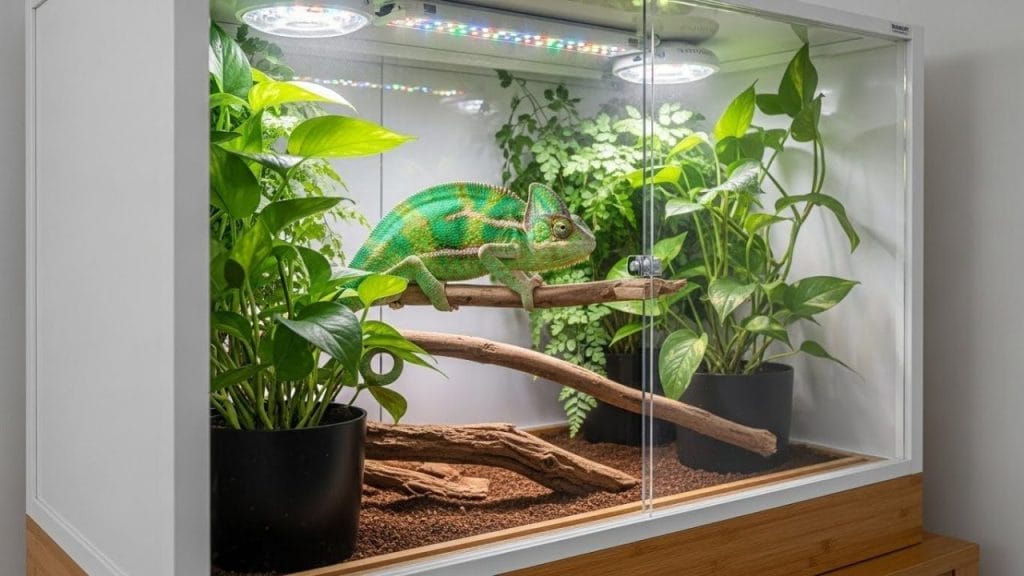
Glass Cages: The “Expert Mode” Option
Glass cages are like keeping your chameleon in a greenhouse.
They’re fantastic at trapping heat and humidity, which sounds great until you realize that can kill your pet if you mess up.
The Respiratory Infection Myth
Let’s kill this zombie myth right now: glass doesn’t cause respiratory infections.
Bad husbandry causes respiratory infections.
The confusion came from old-school keepers using aquariums (designed for fish, not airflow) and wondering why their chameleons got sick.
Modern glass terrariums have ventilation strips at the bottom and screen tops that create a “chimney effect” – warm air rises, pulls cool air from below, keeps everything fresh.
It’s actually pretty clever.
When Glass Makes Perfect Sense
Live somewhere cold and dry? Glass might be your salvation.
If you’re running the AC all summer or heating all winter, glass cages let you create a tropical bubble inside your freezing house.
The solid walls hold in humidity like a boss and you’re not fighting a losing battle with your mister.
The “But” That’s Bigger Than Your Chameleon
Here’s where glass gets tricky: everything happens faster and more intensely.
Heat builds up? It builds up FAST.
Humidity spikes? It spikes HARD.
In a screen cage, you can leave the basking light on all day and your chameleon will be fine.
In a glass cage, that same routine could literally cook your pet like it’s stuck in a parked car in summer.
You need to watch your heat lamp timing and actually monitor temperature and humidity with digital thermometers and hygrometers (those stick-on analog ones are garbage, don’t even bother).
Other Glass Headaches
Glass cages are heavy as hell and can shatter.
They’re expensive – a proper sized glass terrarium runs $200-400 easily.
Finding one big enough for an adult chameleon is tough because the larger they get, the more they weigh and the more they cost.
Drainage is also a pain since most have solid bottoms.
Hybrid Cages: The Goldilocks Solution
Hybrid cages are exactly what they sound like: solid sides with screen parts.
Think three PVC or acrylic walls with a screen front and top.
Why Hybrids Are Actually Genius
Most experts now consider hybrids the best general-purpose option for chameleons.
They give you the humidity control of glass without the “oh crap I just overheated my lizard” panic.
The solid sides hold moisture in, but the screen front and top provide enough airflow through the chimney effect to prevent stuffiness.
You get to control the environment instead of constantly fighting against it.
The Humidity Sweet Spot
Here’s why hybrids win: chameleons need totally different humidity at different times.
During the day, they want it drier (maybe 50-60%).
At night, they want it cranked up to 80-100% like they’re chilling in rainforest fog.
Screen cages can barely hold humidity for five minutes.
Glass cages hold it TOO well and you risk respiratory issues if things stay too damp during the day.
Hybrids let you create those humidity swings naturally by misting at night and letting it dry during the day.
The Setup Flexibility
Another cool thing: you can position your basking bulb strategically.
Put it near the screen side and heat dissipates quickly (screen cage behavior).
Put it near the solid side and heat lingers longer (glass cage behavior).
It’s like having a temperature dial you can adjust with furniture placement.
The Price Reality
Hybrids cost more than basic screen cages but less than glass.
Expect to pay $150-300 for a decent hybrid setup.
Dragon Strand (made in the USA) runs around $400-500 with all the bells and whistles like drainage trays and mounting brackets.
Yeah, that’s not cheap, but you’re paying for functionality that actually works instead of constantly buying bandaid solutions.
The Reflection Controversy
Quick side note: some people freak out about chameleons seeing their reflection in glass or acrylic and getting stressed.
Honestly? It’s rarely a problem.
Most chameleons figure out pretty quick that ghost chameleon isn’t real or just ignore it.
If your cham does seem bothered, stick a plant in front of the reflective area and call it a day.
Don’t let this minor issue scare you away from hybrids or glass if they otherwise make sense for your situation.
So Which One Should You Actually Get?
Here’s my honest breakdown:
| Your Situation | Best Cage Type | Why |
|---|---|---|
| You live somewhere warm and humid | Screen | Your room already has what chameleons need |
| You live somewhere cold and dry | Glass or Hybrid | You need to trap heat and humidity |
| You’re a first-time owner | Hybrid or Screen | More forgiving than glass |
| You’re experienced and detail-oriented | Glass or Hybrid | You can handle the monitoring |
| You’re on a tight budget | Screen | Cheapest upfront cost |
| You want the best overall option | Hybrid | Balances everything nicely |
The honest truth? Hybrid cages are the MVP for most situations.
They’re not the cheapest, but they make proper chameleon care way easier than fighting against a screen cage or constantly monitoring a glass setup.
The Husbandry Changes Nobody Warns You About
Here’s something crucial: you can’t use the same routine for all cage types.
Screen cage owners blast their misters for 5 minutes at a time because moisture disappears instantly.
Do that in a hybrid or glass cage and you’ve just created a swamp that’ll make your chameleon sick.
Similarly, leaving a heat lamp on all day works fine in screen but could kill in glass.
Always adjust your routine to match your cage type.
If you switch cage types, you need to completely rethink your temperature and humidity management.
My Actual Recommendation
If you’re reading this and still not sure, here’s what I’d do:
Go hybrid if you can afford it.
The 24x24x48 inch size is perfect for adult veileds and panthers.
If budget’s tight, get a screen cage and be prepared to work harder on humidity control.
Skip glass unless you’re experienced or live somewhere where humidity control is genuinely impossible with other options.
And here’s the key thing everyone forgets: the cage type matters way less than proper setup.
A screen cage with live plants, good misting, and proper monitoring beats a fancy hybrid cage with fake plants and guesswork any day.
Focus on getting the basics right – UVB lighting, temperature gradients, hydration, proper diet – and the cage type is just one tool among many.
The Bottom Line
The screen vs glass vs hybrid debate has been raging since the dinosaurs (okay, maybe just since the 90s).
But here’s what actually matters: pick the cage that makes it easiest for YOU to provide proper care in YOUR specific environment.
Cold, dry house? Don’t torture yourself with a screen cage.
Perfect ambient conditions? Don’t overpay for a hybrid you don’t need.
And whatever you choose, monitor your temps and humidity instead of just hoping everything’s fine.
Because at the end of the day, your chameleon doesn’t care what the internet argued about.
It just wants to sit on a branch, occasionally eat a cricket, and not develop a respiratory infection because you followed bad advice from 2006.
Choose wisely, set things up properly, and your color-changing buddy will be happy regardless of what its walls are made of.

About Author
Hello, I’m Muntaseer Rahman, the owner of AcuarioPets.com. I’m passionate about aquarium pets like shrimps, snails, crabs, and crayfish. I’ve created this website to share my expertise and help you provide better care for these amazing pets.
Disclaimer
This site is owned and operated by Muntaseer Rahman. AcuarioPets.com is a participant in the Amazon Services LLC Associates Program, an affiliate advertising program designed to provide a means for sites to earn advertising fees by advertising and linking to Amazon.com. This site also participates in other affiliate programs and is compensated for referring traffic and business to these companies.