
This post was created with help from AI tools and carefully reviewed by a human (Muntaseer Rahman) . For more on how we use AI on this site, check out our Editorial Policy.
Check Out These FREE Tools We Made JUST For You!
How to Tell If Your Pacman Frog Is Male or Female [7 Easy Ways]

So you’ve got a Pacman frog sitting in its tank, half-buried in substrate, staring at you like a judgmental potato.
And now you’re wondering… is this a boy potato or a girl potato?
Fair question.
Despite the name “Pacman,” these frogs come in both male and female varieties. No Pac-woman needed.
But figuring out which one you’ve got? That’s where things get tricky.
The short answer: check for nuptial pads (dark bumps on the thumbs), compare the size, and listen for croaking. Males are smaller, have nuptial pads, and croak regularly. Females are bigger, lack those pads, and stay mostly silent.
Now let me break down every method so you can figure this out for yourself.

Why Does It Even Matter?
You might be thinking, “I just want a pet frog. Who cares if it’s male or female?”
Actually, you should care. Here’s why.
Enclosure Size
Female Pacman frogs can grow nearly twice the size of males.
A male can get by in a 10-gallon tank. A female needs around 20 gallons.
Buy the wrong size tank and your frog is basically living in a studio apartment meant for a hamster. That leads to stress, health issues, and one grumpy frog.
Noise Levels
Male Pacman frogs croak. Not constantly, but enough that you’ll notice it at 2 AM if his tank is in your bedroom.
Females? Almost completely silent.
So yeah, knowing your frog’s gender before you set up the tank next to your pillow is a pretty solid move.
Breeding
This one’s obvious. If you’re planning to breed Pacman frogs, you need one male and one female.
Put two males together and they’ll fight. Put two females together and nothing happens. Put a male and female together without proper preparation and one might eat the other.
These frogs are cannibalistic. I’m not exaggerating. They will literally eat each other.
When Can You Actually Tell?
Here’s the frustrating part.
You can’t reliably sex a baby or juvenile Pacman frog. It’s basically a guessing game until they start maturing.
The earliest you can start looking for signs is around 6 to 8 months old. But for more accurate identification, waiting until 12 to 16 months is the smarter play.
That’s when males start developing nuptial pads, croaking, and showing darker coloring. Before that, you’re flipping a coin.
One more catch: figuring out how old your frog actually is can be just as hard. Ask the breeder or the pet store when you buy it. Don’t try to guess.
Male vs Female Pacman Frog: Quick Comparison
| Feature | Male | Female |
|---|---|---|
| Size | 3-4 inches (7.5-10 cm) | 4-7 inches (10-18 cm) |
| Nuptial Pads | Yes, dark bumps on thumbs | None |
| Croaking | Regular, especially at night | Rarely, if ever |
| Vocal Sacs | Present | Absent |
| Chest Color | Darker, especially during mating season | White |
| Throat | Loose skin, color differs from belly | Smooth, color matches belly |
| Skin Texture | Rougher | Smoother |
| Body Color | Dark green, yellow, lime variations | Typically tan or brown |
| Arms | Thicker, more muscular | Thinner |
| Temperament | More active, territorial | More docile, calm |
Now let’s get into the details.
7 Ways To Tell If Your Pacman Frog Is Male Or Female
1. Check For Nuptial Pads (The Most Reliable Method)
This is the gold standard. If you only check one thing, make it this.
Male Pacman frogs develop nuptial pads on their thumbs. These are dark, rough, bump-like patches that look a bit like moles.
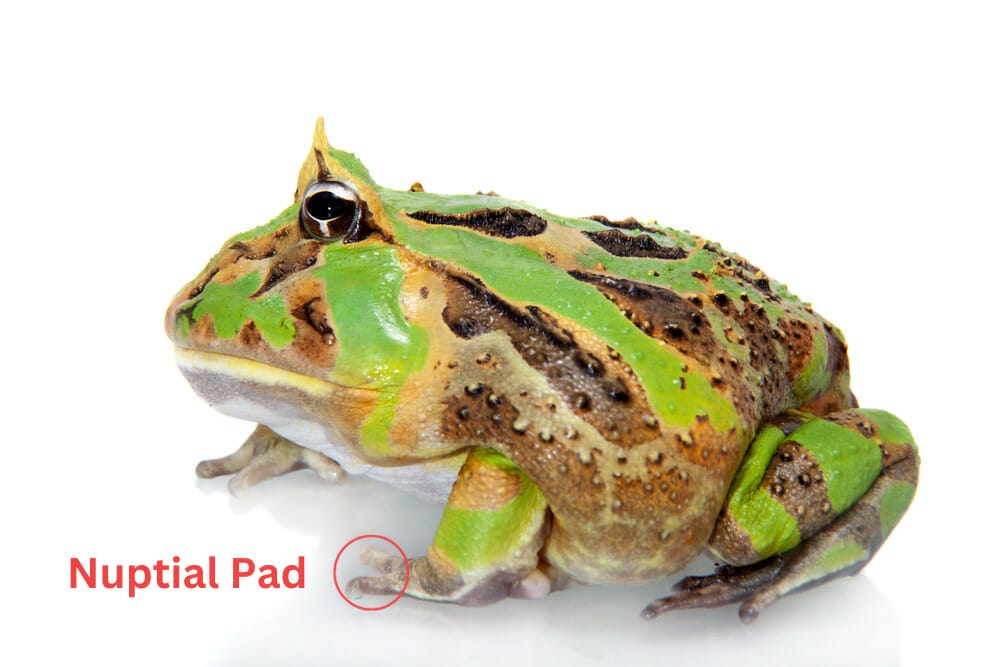
They use these pads to grip onto the female during mating (a process called amplexus). It’s basically nature’s version of grip tape.
Females don’t develop these pads. Ever. No exceptions.
Here’s an important detail that a lot of people miss: in Pacman frogs (Ceratophrys), males have nuptial pads year-round once they mature. Unlike some other frog species where pads only appear during breeding season, Pacman frog males keep theirs permanently.
Sometimes the pads aren’t super dark. They can be lighter in color and harder to spot. But you’ll still feel a rough, raised texture on the thumb area if it’s a male.
If your frog is fully mature and has zero sign of nuptial pads on any thumb, you’ve got a female.
2. Compare The Size
This one is pretty straightforward once your frog is an adult.
Males typically max out at 3 to 4 inches (about 7.5 to 10 cm) from snout to vent.
Females can reach 4 to 7 inches (10 to 18 cm). Some well-fed females hit the upper end and look absolutely massive compared to males.
Picture a tennis ball next to a softball. That’s roughly the difference we’re talking about.
One thing to keep in mind though: diet plays a huge role in growth. A well-fed male can get bigger than an underfed female. So size alone isn’t a 100% guarantee. Use it alongside other methods.
3. Listen For Croaking
If your frog croaks regularly, congratulations, you have a male.
Male Pacman frogs croak to establish territory and attract mates. They’re especially vocal at night, after misting, and during breeding season.
In captivity, a male might croak a few times a day. Maybe 3-4 times at night. Not earth-shattering, but definitely noticeable.
Females are almost entirely silent. Some sources claim females never croak at all. The more accurate take is that females may occasionally make a squeak, chirp, or grunt if they’re stressed or startled. But consistent, regular croaking? That’s a male thing.
Here’s a fun trick: try playing a recording of a male Pacman frog calling on YouTube near your frog’s tank. If your frog croaks back, it’s almost certainly a male.
4. Look At The Skin Texture
This one’s subtle, but it’s there.
Male Pacman frogs tend to have rougher skin compared to females. You might notice slightly textured patches on their hands and forearms.
Females have smoother skin overall.
Honestly, this is one of the harder methods to use on its own. You’d need to handle both a male and a female side by side to really feel the difference. But combined with other signs, it adds up.
5. Check The Color
Pacman frog colors vary a lot depending on the morph, but there are some general patterns.
Males tend to show more vivid and varied coloration. They can be dark green, bright green, yellow, lime, or ornately patterned.
Females typically lean toward tanned, brown, or more muted tones.
This is called sexual dichromatism, and it’s not unique to Pacman frogs. Plenty of animals do this. The flashy male tries to impress the ladies while the female blends in.
But here’s the thing: with all the captive-bred color morphs available today (albinos, strawberries, fantasies), color alone is not a reliable method. Use it as a supporting clue, not the deciding factor.
6. Examine The Chest And Arms
Take a look at your frog’s chest area.
Male Pacman frogs develop a noticeably darker chest, sometimes called a “beard.” This gets even more pronounced during mating season.
Female Pacman frogs keep a white or pale chest throughout their lives.
Also check the arms. Males have thicker, more muscular forearms. Makes sense since they need the strength to hold onto females during mating.
Females have thinner, less defined arms.
7. Look At The Throat
This one is actually pretty easy to spot once you know what to look for.
Male Pacman frogs have loose, saggy skin on their throat (that’s where the vocal sac is). The throat color usually looks different from the belly.
Female Pacman frogs have smooth throat skin that matches the color of their belly. No puffiness, no color mismatch.
What About Nose Shape?
You might have read online that males have flatter noses while females have more triangular or pointed noses.
This method is unreliable. Experienced breeders have pointed out that nose shape varies more with genetics and individual development than actual gender. Some males have pointy noses. Some females have flat ones.
One experienced Ceratophrys breeder put it pretty bluntly: the nose shape theory was likely made up by a dealer trying to sell sexed froglets, and forums turned it into gospel.
Don’t rely on nose shape to sex your Pacman frog. Stick with the proven methods above.
Can You Keep A Male And Female Together?
Short answer: no.
Long answer: absolutely not.
Pacman frogs are solitary, aggressive, and cannibalistic. They will try to eat anything that fits in their mouth. And their mouth is enormous relative to their body. That includes other Pacman frogs.
It doesn’t matter if it’s male-male, female-female, or male-female. Keeping them together outside of a carefully controlled breeding setup is asking for trouble.
If you want to breed them, here’s the basic process:
- The frogs need a brumation (cooling) period of 30 to 60 days first
- After brumation, place them in a rain chamber to simulate breeding conditions
- Remove them from each other immediately after breeding
Don’t leave them together hoping they’ll “figure it out.” One of them will end up as dinner.
Still Not Sure? Here’s What To Do
If your frog is under a year old and you can’t tell, just wait. The signs become way more obvious with time.
If your frog is over a year old and you’re still unsure, here’s a quick checklist:
- Mist the tank and listen. Croaking = male.
- Check the thumbs. Dark bumps = male.
- Look at the chest. Dark = male. White = female.
- Measure the size. Over 4 inches and still growing = likely female.
When all else fails, ask an experienced breeder. They’ve seen hundreds of these frogs and can usually tell pretty quickly.
Final Thoughts
Sexing a Pacman frog isn’t rocket science, but it does require patience.
The most reliable indicators are nuptial pads, size, and croaking. Everything else is supporting evidence.
Don’t stress about it when your frog is young. Wait until it matures, and the answer will become pretty clear on its own.
And whatever you do, don’t put two Pacman frogs in the same tank thinking they’ll be friends. They won’t. They’ll be dinner.

About Author
Hello, I’m Muntaseer Rahman, the owner of AcuarioPets.com. I’m passionate about aquarium pets like shrimps, snails, crabs, and crayfish. I’ve created this website to share my expertise and help you provide better care for these amazing pets.
Disclaimer
This site is owned and operated by Muntaseer Rahman. AcuarioPets.com is a participant in the Amazon Services LLC Associates Program, an affiliate advertising program designed to provide a means for sites to earn advertising fees by advertising and linking to Amazon.com. This site also participates in other affiliate programs and is compensated for referring traffic and business to these companies.