
This post was created with help from AI tools and carefully reviewed by a human (Muntaseer Rahman) . For more on how we use AI on this site, check out our Editorial Policy.
Check Out These FREE Tools We Made JUST For You!
Complete Jackson’s Chameleon Care Sheet (Diet, Habitat & Health)
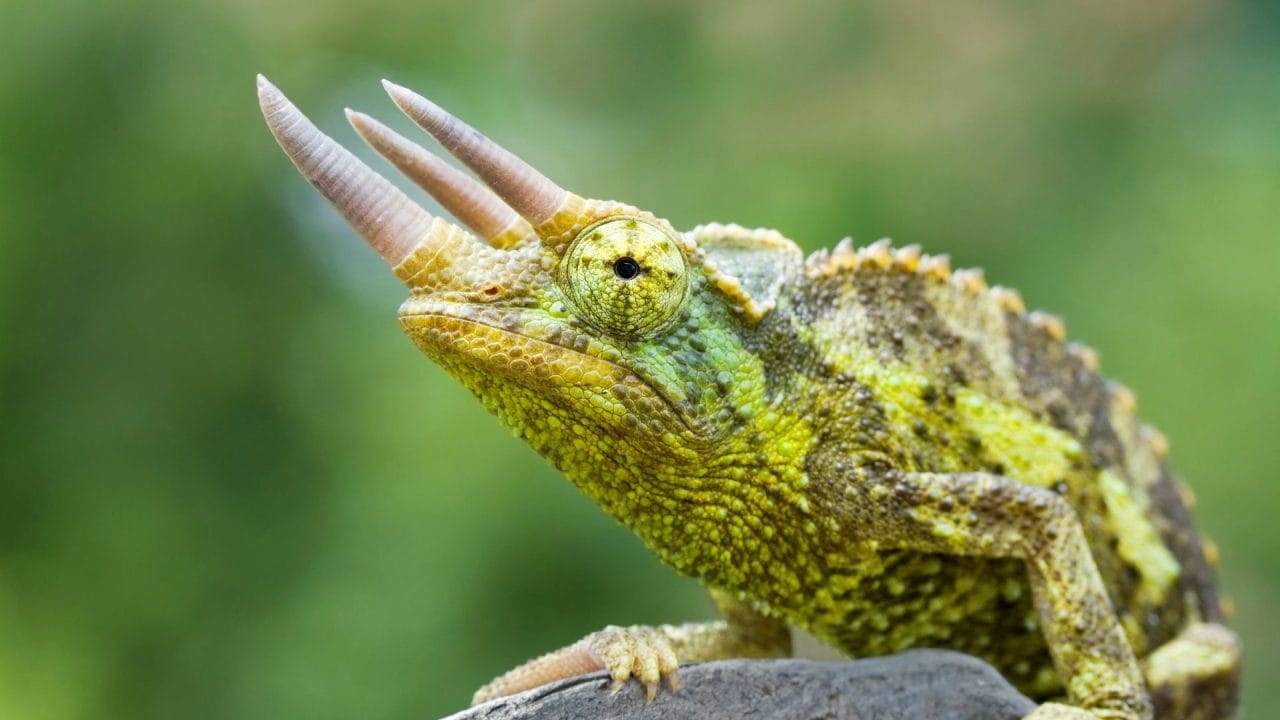
So you want a pet dinosaur that fits in your living room?
Let me introduce you to Jackson’s chameleons – basically tiny triceratops with attitude and the ability to change colors when they’re having a bad day.
These little horned wonders from East Africa are way more interesting than they look (and they already look pretty cool).
What Makes Jackson’s Chameleons Special?
The Three-Horned Wonder
Male Jackson’s chameleons rock three brown horns on their heads – one on the nose and two above their eyes, like they’re perpetually cosplaying as a dinosaur.
Females? They got none, or maybe a tiny nub if they’re feeling fancy.
This makes telling boys from girls easier than trying to figure out if your goldfish is male or female (which is basically impossible).
They Give Birth to Live Babies
Here’s where things get wild.
Most chameleons lay eggs like normal reptiles, but Jackson’s chameleons decided to be different and give birth to 8-30 live babies after carrying them for 5-6 months.
The babies literally pop out in little gelatinous sacs, wiggle free, and immediately start hunting bugs like tiny, newborn action heroes.
Mom doesn’t even stick around to teach them anything – these babies are on their own from day one.
Color-Changing Champions
Everyone thinks chameleons change color to blend in with their surroundings like some kind of living invisibility cloak.
Wrong!
They change colors based on their mood, temperature, and stress levels – kind of like how your face turns red when you’re embarrassed, except way cooler.
A happy Jackson’s is bright green with yellow accents, but a stressed one can turn so dark it’s almost black.
Eyes That Move Independently
Imagine being able to look at your phone with one eye while watching TV with the other.
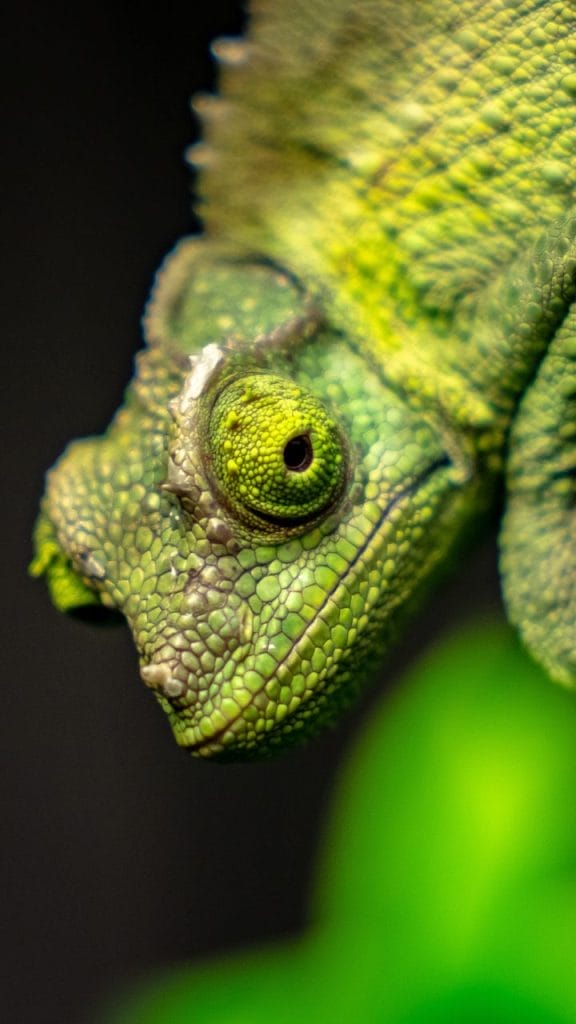
Jackson’s chameleons can rotate their eyes 180 degrees and move them completely independently – one watching for predators while the other scopes out lunch.
They might even be able to magnify what they’re looking at by changing the shape of their eyes, which is basically built-in zoom lenses.
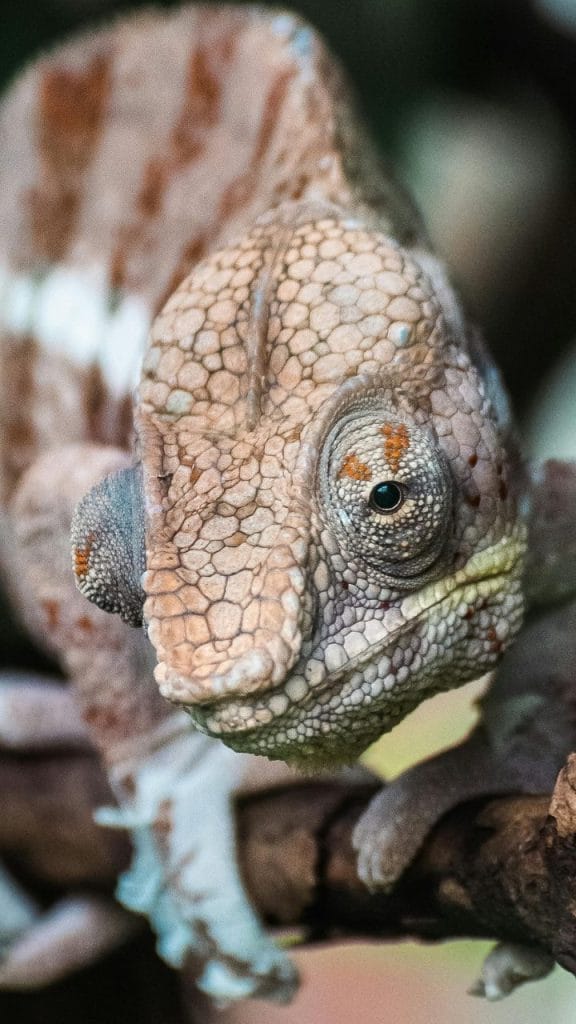
Before You Get a Jackson’s Chameleon
They’re Not Beginner Pets
Let’s be real here – these aren’t hamsters.
Jackson’s chameleons need specific temperatures, humidity levels that would make a tropical rainforest jealous, and daily misting routines that’ll make you feel like you’re running a tiny spa.
If you’re looking for a pet you can cuddle and play with, get a dog.
The Price Tag
A Jackson’s chameleon will run you about $75 to $175, which honestly isn’t terrible.
But the enclosure, lighting, misting systems, and bugs you’ll need to buy? That’s where your wallet starts crying.
Lifespan Expectations
Males can live 8-10 years with proper care, which is a decent commitment.
Females? Only 3-6 years, and that’s partly because giving birth to live babies takes a serious toll on their bodies.
Setting Up the Perfect Jackson’s Chameleon Home
Enclosure Size Matters
Your adult Jackson’s needs at least a 24″L x 24″W x 48″H cage, though bigger is always better.
These guys are arboreal (tree-dwellers), so height is more important than floor space – they spend basically zero time on the ground unless absolutely necessary.
Mesh, Not Glass
Use a mesh or screen cage, not a glass aquarium.
Glass tanks can create two big problems: poor ventilation and reflections that make males think there’s another dude trying to fight them (which stresses them out big time).
The only exception is if you have a sick or very young chameleon that needs extra humidity control.
Temperature Requirements
Here’s where Jackson’s chameleons are different from their tropical cousins.
Daytime temperatures: 70-80°F ambient, with a basking spot of 82-85°F
Nighttime temperatures: 50-70°F (yes, they NEED it to drop)
That nighttime temperature drop is critical – without it, they basically get sleep-deprived and their health tanks over time.
Think of it like trying to sleep in a hot, stuffy room every night – you’d eventually lose your mind too.
Humidity: Welcome to the Rainforest
Keep humidity between 60-80%, which is basically “walked through a cloud” levels of moisture.
You’ll need to mist the enclosure 2-3 times daily, and a lot of keepers use automatic misting systems because doing it manually gets old fast.
Live plants help maintain humidity and give your chameleon places to drink from (they lick water droplets off leaves).
Lighting Setup
You need two types of lighting, and this is non-negotiable.
UVB lighting: Use a 5.0-6.0 UVB bulb for 10-12 hours daily – this helps them produce vitamin D3 and absorb calcium.
Replace UVB bulbs every 6 months even if they still light up, because the UVB output dies long before the visible light does.
Basking bulb: A regular incandescent bulb (start with 60 watts and adjust) to create that warm basking spot.
Keep your chameleon 6-12 inches from heat and light sources to prevent burns.
Décor and Climbing Stuff
Fill the cage with branches, vines, and live plants (ficus trees work great).
Offer branches of varying thicknesses so your chameleon can exercise different grip strengths – think of it as their personal gym equipment.
Make sure there are plenty of hiding spots because Jackson’s chameleons like their privacy.
Substrate: Keep It Simple
Most experienced keepers skip substrate entirely or use paper towels.
Sand, gravel, or mulch can be accidentally eaten with prey, which leads to impaction (basically reptile constipation on steroids).
Plus, a bare bottom makes it easier to spot poop and monitor your chameleon’s health.
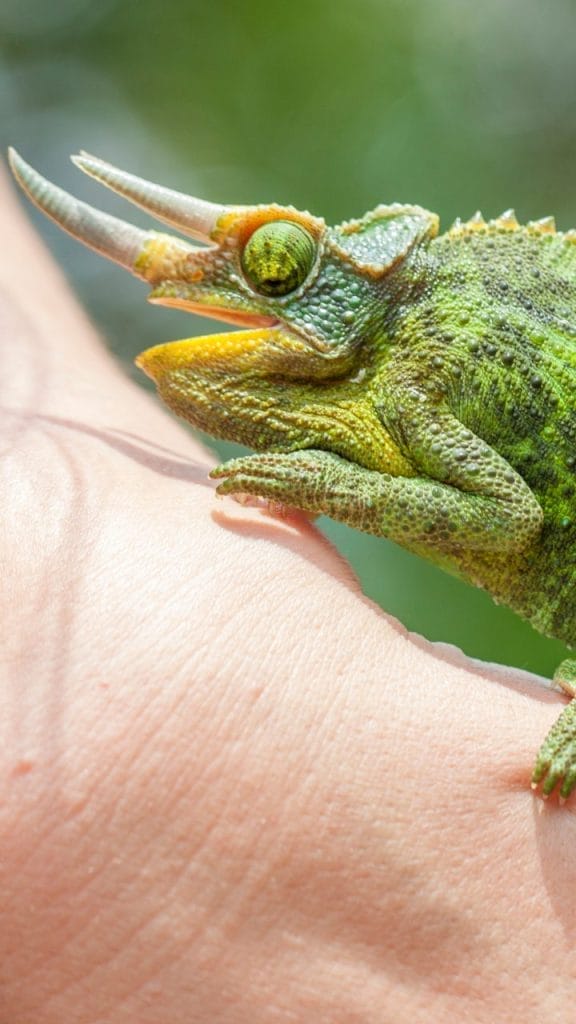
Feeding Your Tiny Dinosaur
What Do They Eat?
Jackson’s chameleons are hardcore insectivores – they eat bugs, and only bugs.
In the wild, they hunt flying insects like bees, flies, and butterflies (basically anything that moves and fits in their mouth).
The Bug Menu
Here’s what should be on the regular rotation:
Primary feeders:
- Crickets
- Dubia roaches
- Black soldier fly larvae
- Hornworms
- Silkworms
- Locusts
Occasional treats (high in fat):
- Superworms
- Waxworms
- Butterworms
Never feed bugs that are longer than the space between your chameleon’s eyes – that’s the golden rule.
Feeding Schedule by Age
Jackson’s chameleons have slower metabolisms than other popular chameleon species, so they don’t eat as much.
| Age | Feeding Schedule |
|---|---|
| Babies (1-3 months) | As much as they want, twice daily (tiny insects only) |
| Juveniles (3-6 months) | 10-12 small crickets daily |
| Juveniles (6-12 months) | 8-10 medium crickets every other day |
| Adults (12+ months) | 6-8 large crickets every other day, or 1-3 feeders per feeding |
Adult males eat every other day, and that’s perfectly normal.
If your chameleon starts being picky and only wants their favorite food, they’re probably just full – skip a feeding or two and they’ll be less demanding.
The Supplement Game
This is where things get slightly complicated, but stick with me.
Calcium without D3: Dust feeders twice a week
Calcium with D3: Once a month
Multivitamin: Once a month
Jackson’s chameleons evolved in nutrient-poor environments, so they’re actually prone to vitamin overdoses – less is more here.
To dust insects, throw them in a plastic bag with a pinch of supplement powder and shake them around like you’re making the world’s tiniest protein shake.
Bee Pollen: The Secret Weapon
Wild Jackson’s eat tons of flying insects that are covered in pollen from flowers.
Adding bee pollen to your gutload and dusting routine acts like a natural multivitamin and immune booster.
You can buy it as granules (for gutloading) or powder (for dusting).
Gutloading: Making Bugs More Nutritious
Gutloading is feeding your feeder insects nutritious food so when your chameleon eats them, they get all those good nutrients too.
Feed your crickets, roaches, and other bugs a mix of:
- Collard greens
- Turnip greens
- Dandelion greens
- Carrots
- Butternut squash
- Commercial gutload products
Do this for 24-48 hours before feeding them to your chameleon.
Hydration: It’s More Complicated Than You’d Think
They Don’t Drink from Bowls
Jackson’s chameleons won’t drink from a water dish sitting at the bottom of their cage.
They drink rain droplets and dew off leaves in the wild, so you need to replicate that.
Misting is Life
Mist the entire enclosure 2-3 times daily, making sure to hit all the plants and branches.
Your chameleon will lick the droplets off leaves, and you’ll probably see them “cleaning” their eyes by pushing them in and out – that’s normal.
Humidity Tools
Hand misting works, but let’s be honest – it’s annoying to do multiple times a day.
Consider getting:
- Automatic misting system: Best option, sets it and forgets it
- Fogger: Creates a cool mist for extra humidity
- Drip system: Slowly drips water onto plants throughout the day
Clean these systems weekly to prevent bacteria and mold buildup.
The Weekly Shower
Some keepers give their chameleons a weekly “rainstorm” by putting them on a plant in the shower under a gentle, lukewarm mist for 30 minutes.
It’s like a spa day for reptiles.
Handling and Temperament
Look, Don’t Touch
Jackson’s chameleons are observation pets, not cuddling pets.
They tolerate handling better than some species, but daily handling stresses them out.
Limit handling to once or twice a week max, and only when necessary (like cage cleaning or vet visits).
How to Handle Properly
Never grab your chameleon or pull them off a branch – that can break their delicate toes and tail.
Instead, put your hand under their front feet and let them walk onto you at their own pace.
Move slowly and deliberately – sudden movements make them think you’re a predator.
Signs of Stress
A stressed Jackson’s chameleon will:
- Turn dark or black
- Hiss or open their mouth wide (gaping)
- Rock back and forth
- Try to escape or hide
- Stop eating
If you see these signs, back off and leave them alone.

Common Health Problems
Metabolic Bone Disease (MBD)
This is the big one – caused by insufficient calcium, vitamin D3, or UVB lighting.
Symptoms include soft or deformed bones, jaw weakness, trembling, and lethargy.
Prevention is simple: proper UVB lighting, calcium supplementation, and gut-loaded feeders.
Respiratory Infections
Signs include lethargy, loss of appetite, gaping mouth, and difficulty breathing.
Usually caused by temperatures that are too low or humidity that’s too high/low.
If you suspect a respiratory infection, get to a reptile vet ASAP.
Vitamin A Deficiency
Super common in Jackson’s chameleons specifically.
Symptoms: swollen eyes, discharge from eyes, retained shed, and respiratory issues.
Make sure your multivitamin includes preformed vitamin A (not just beta-carotene, which chameleons can’t convert).
Eye Problems
Chameleons sometimes circulate fluid in their eyes to clean debris – if you see occasional squinting or bulging, that’s normal.
But if it lasts more than 24 hours, something’s wrong and you need a vet.
Dehydration
Sunken eyes, wrinkled skin, lethargy, and weight loss are all red flags.
Usually happens when humidity is too low or misting isn’t frequent enough.
Parasites
Wild-caught chameleons often come with internal parasites.
Even captive-bred ones can get parasites from feeder insects.
A yearly fecal exam at your reptile vet is smart.
Things That’ll Stress Out Your Chameleon
Housing Multiple Chameleons Together
Don’t do it. Seriously, don’t.
Jackson’s chameleons are solitary and territorial – putting two together (especially two males) will result in fighting, chronic stress, and potentially death.
Even keeping two cages within sight of each other can stress out males.
Too Much Handling
We already covered this, but it bears repeating: these are not puppies.
Every time you handle them, it’s stressful – save it for when absolutely necessary.
Wrong Temperatures
Too hot during the day (above 85°F basking) can cause heat stress.
No temperature drop at night means they can’t sleep properly and will gradually decline in health.
It’s like if you had to sleep in a sauna every night – eventually, you’d be a wreck.
Inadequate Hiding Spots
Jackson’s chameleons like to feel secure and hidden.
If they can’t find a good hiding spot, they’ll be chronically stressed.
Cool Facts That’ll Make You Appreciate These Lizards
Chemical Luring
Jackson’s chameleons have been observed wiping a whitish-yellow substance from their temporal gland onto branches, then waiting for flies to land nearby.
It’s basically setting a trap for prey, which is way smarter than we give them credit for.
That same gland can emit a scent that smells like toxic decay to deter predators.
Zygodactylous Feet
Their feet are split so two toes point inward and three point outward – perfect for gripping branches.
It’s like having built-in tree-climbing gloves.
Prehensile Tail
That long tail isn’t just for looks – it’s a fifth limb for gripping branches.
Unlike some lizards, chameleons cannot drop their tails to escape predators, so if the tail gets injured, it won’t grow back.
Tongue Length
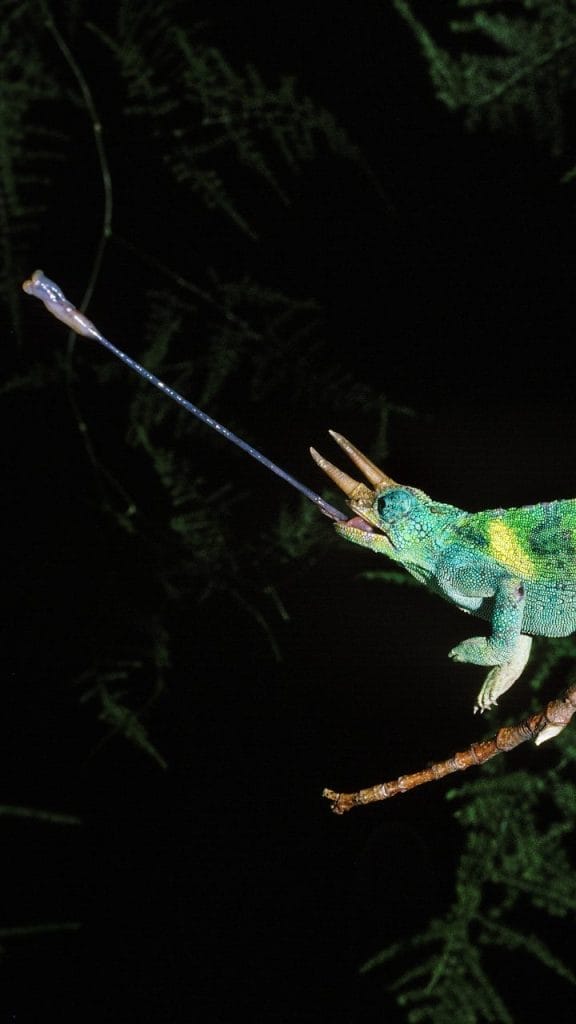
A Jackson’s chameleon’s tongue can be 1.5 times their body length, covered in sticky saliva to catch prey.
They can shoot it out and retract it in less than a second.
The Hawaiian Invasion
Jackson’s chameleons were introduced to Hawaii in 1972 when 36 individuals were released (probably escaped pets).
Now there’s a massive population on all the main Hawaiian islands, and they’re considered invasive because they eat native insects and snails.
Finding a Healthy Jackson’s Chameleon
Captive-Bred vs Wild-Caught
Always, always buy captive-bred from a reputable breeder.
Wild-caught chameleons are usually stressed, dehydrated, loaded with parasites, and have a much shorter lifespan.
Most Jackson’s in the US pet trade today are from Hawaiian populations (which are technically wild, but established for decades).
Health Checklist
When examining a potential new chameleon:
- Eyes should be open, alert, and not sunken
- No discharge from eyes or nose
- Active grip when climbing
- Bright coloration (for their mood)
- No visible mites or parasites
- Healthy weight (not too thin)
- No mouth rot (check inside the mouth if possible)
If ANY animal in the breeder’s collection has mites, walk away – they spread like wildfire.
Never Pull Them Off a Branch
When examining or picking up a chameleon, let them walk onto your hand.
Pulling them off can damage their delicate toes.
Setting Up Costs
Let’s talk money, because this isn’t a cheap hobby.
| Item | Estimated Cost |
|---|---|
| Chameleon | $75-$175 |
| Screen cage (24x24x48) | $100-$200 |
| UVB lighting setup | $50-$100 |
| Basking bulb & fixture | $20-$40 |
| Live plants & branches | $50-$100 |
| Misting system (automatic) | $100-$300 |
| Thermometer/hygrometer | $15-$30 |
| Supplements | $30-$50 |
| Feeder insects (monthly) | $20-$40 |
Total initial setup: Around $460-$1,035
Monthly costs: $20-$60 for bugs and occasional replacement bulbs
The Bottom Line
Jackson’s chameleons are absolutely fascinating pets if you’re willing to put in the work.
They need precise temperature gradients, high humidity, daily misting, proper UVB lighting, and a varied diet of gut-loaded insects – basically, they’re high-maintenance.
But watching a little three-horned dinosaur slowly stalk a cricket, shoot out a tongue longer than its body, and change colors based on mood?
That’s pretty incredible.
If you want a reptile you can handle regularly and interact with, get a bearded dragon.
If you want a living piece of prehistoric art that requires dedication but rewards you with bizarre behavior and stunning looks, a Jackson’s chameleon might be your guy.
Just remember: these are observation pets, their care requirements are non-negotiable, and cutting corners on temperature, lighting, or humidity will result in a sick chameleon.
Do your research, set up the habitat correctly before bringing one home, find a reptile vet in your area, and commit to daily misting sessions.
Your tiny triceratops will thank you by living a long, healthy life and giving you endless entertainment.
Now go set up that enclosure – your future chameleon is waiting.

About Author
Hello, I’m Muntaseer Rahman, the owner of AcuarioPets.com. I’m passionate about aquarium pets like shrimps, snails, crabs, and crayfish. I’ve created this website to share my expertise and help you provide better care for these amazing pets.
Disclaimer
This site is owned and operated by Muntaseer Rahman. AcuarioPets.com is a participant in the Amazon Services LLC Associates Program, an affiliate advertising program designed to provide a means for sites to earn advertising fees by advertising and linking to Amazon.com. This site also participates in other affiliate programs and is compensated for referring traffic and business to these companies.