This post was created with help from AI tools and carefully reviewed by a human (Muntaseer Rahman) . For more on how we use AI on this site, check out our Editorial Policy.
Check Out These FREE Tools We Made JUST For You!
Signs of Stress in Shrimp: 8 Warning Signs (and How to Fix Each One)
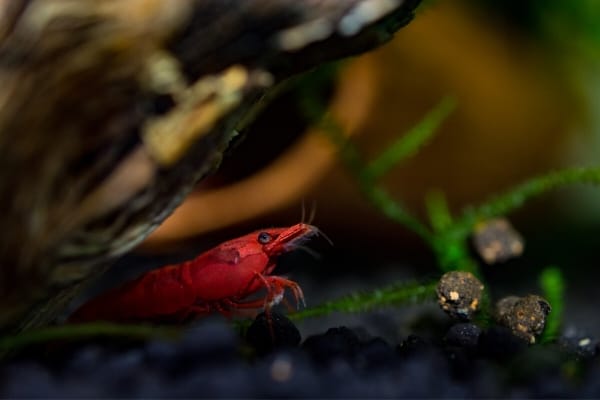
Here’s the scary part about shrimp.
By the time something looks “off,” they’ve usually been stressed for a while.
Shrimp are tiny, they can’t make a sound, and they hide their problems until things get bad. So learning to read the early signs is the difference between catching an issue and waking up to a tank full of dead shrimp.
The good news? Stressed shrimp give you clues if you know what to watch for.
The most common signs of stress in shrimp are fading color, hiding, loss of appetite, frantic swimming, hanging at the water surface, failed molts, curling up, and stopping breeding. Almost every one of these traces back to water quality.
Let’s go through all 8, what each one means, and exactly how to fix it.
The 8 Signs of Stress in Shrimp at a Glance
| Sign | What it usually means | First thing to check |
|---|---|---|
| Fading or washed-out color | Stress hormones, poor diet, or disease | Water parameters + tankmates |
| Hiding and lethargy | Parameter swing or chronic stress | Temperature and pH |
| Loss of appetite | Sickness or bad water | Ammonia and nitrite |
| Frantic, erratic swimming | Acute toxin shock | Copper, chlorine, ammonia |
| Hanging at the surface | Low oxygen or ammonia poisoning | Oxygen + ammonia |
| Failed molt (white ring) | Mineral imbalance or sudden change | GH and calcium |
| Curling up or lying on side | Severe stress, often fatal | Everything, fast |
| Stopped breeding | Long-term stress | Stability over weeks |
1. Fading or Washed-Out Color
This is the sign most people notice first.
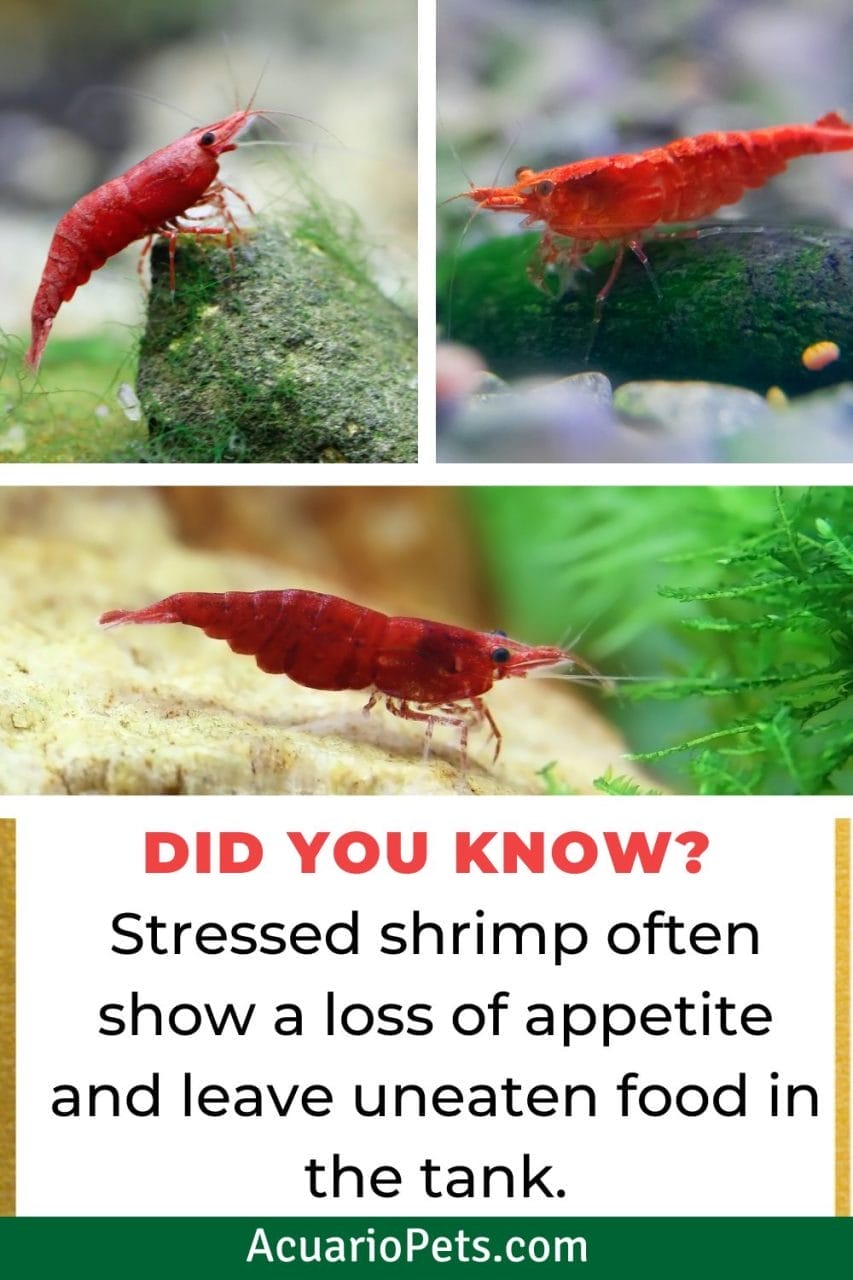
A bright red cherry shrimp slowly turning pale, milky, or see-through is waving a little red flag at you.
Color loss happens because stress affects the pigment cells in a shrimp’s shell. A scared or sick shrimp literally drains its own color.
But here’s where you have to be careful.
A milky, opaque white look running through the muscle (not the shell) can be muscular necrosis, which is a serious and often deadly condition.
Black or brown spots on the body can point to a bacterial infection instead.
The fix: Test your water first. If parameters are fine, look at diet and substrate. A varied diet and stable, calm conditions bring color back, and you can read more in our guide on how to enhance shrimp color.
Need To Talk With A Vet Right Now?

2. Hiding and Lethargy
Healthy shrimp are busy little things.
They graze constantly, climb everything, and never seem to sit still.
So when an active shrimp suddenly parks itself in a corner and barely moves, something changed.
Lethargy is almost always a water issue. A jump in temperature, a pH swing, or a slow buildup of waste makes shrimp sluggish.
The fix: Check temperature and pH right away. Neocaridina shrimp are happiest at a stable 68 to 75°F. If anything looks off, do a small, slow water change with temperature-matched water before it turns into a bigger problem.

3. Loss of Appetite
Shrimp are basically tiny vacuum cleaners with legs.
They are voracious eaters, so leftover food sitting in the tank when you didn’t overfeed is a warning sign.
Now, one caveat: a mature tank grows biofilm and algae that shrimp graze on all day. If they’re ignoring pellets because they’re snacking on natural food, that’s totally fine.
But a real appetite drop usually means stress or disease, like vorticella.
The fix: Remove uneaten food so it doesn’t foul the water. Then test parameters. If the water is clean and stable, encourage grazing with a biofilm booster and a varied diet.
4. Frantic, Erratic Swimming
This one freaks people out, and for good reason.
When shrimp suddenly start zooming around the tank like the water is on fire, that is acute stress.
It almost always means something toxic just hit the water.
The usual suspects are copper, chlorine, an ammonia or nitrite spike, or a big swing in TDS right after a water change. Shrimp are extremely sensitive to copper, way more than fish, so even small amounts can set off this panic swimming.
The fix: Stop and think about what changed. Did you just do a water change? Add a new plant, fertilizer, or medication? Treat the tap water with a conditioner, and if copper is even a possibility, act fast. This same panic swimming is a classic reason behind shrimp dying after a water change.

5. Hanging at the Water Surface
If your shrimp climb to the very top and stay there, pay attention.
Shrimp don’t hang out at the surface for fun.
They go up there when the water below isn’t giving them enough oxygen, or when ammonia and nitrite are poisoning them.
It’s the shrimp version of someone sticking their head out a window to breathe.
The fix: Test ammonia and nitrite immediately, since both should read zero. Boost surface agitation with an air stone or sponge filter to raise oxygen. If your tank is new, it may not be fully cycled yet.
6. Failed Molts (the White Ring of Death)
This is the most shrimp-specific sign on the list, and it’s a heartbreaker.
Molting is normal. Shrimp shed their old shell to grow, and a clean empty shell in the tank is a good thing.
But when a shrimp gets stuck halfway out, you’ll often see a white ring or gap around the middle of its body. Keepers call it the White Ring of Death, and the shrimp usually doesn’t survive it.
Failed molts are caused by mineral problems, usually low GH, not enough calcium, or a sudden change in water hardness.
The fix: Keep GH stable and in range, especially if you use RO water that needs remineralizing. Avoid big, sudden water changes that swing the hardness. Our full breakdown of cherry shrimp molting problems walks through this in detail.

7. Curling Up or Lying on Their Side
This is a late-stage sign, and it’s serious.
A shrimp curled into a tight C-shape or lying on its side, not moving much, is in real trouble.
At this point the stress has gone on too long, or a toxin has hit hard.
The fix: This is an emergency. Test everything, do a gentle water change with clean conditioned water, and remove any obvious cause. Sometimes you can save them, sometimes you can’t, but acting fast gives them the best shot.
8. Stopped Breeding or Dropped Eggs
Happy shrimp breed. It’s almost annoying how fast they multiply when conditions are good.
So when breeding suddenly stops, or a berried female drops or abandons her eggs, that’s chronic stress talking.
Females won’t carry eggs in conditions that feel unsafe, and they’ll release them early if the environment goes downhill.
The fix: Focus on long-term stability, not a quick fix. Steady temperature, clean water, good food, and plenty of cover over a few weeks is what brings breeding back.
What Actually Causes Shrimp Stress
Notice a pattern? Almost every sign above comes back to the same handful of causes.
Get these right and most stress problems disappear on their own.
| Cause | Why it stresses shrimp | How to fix it |
|---|---|---|
| Unstable water parameters | Sudden swings in temp, pH, GH, or TDS shock their system | Make changes slow and small |
| Ammonia or nitrite | Toxic even in tiny amounts; common in new tanks | Cycle the tank fully; keep both at zero |
| Copper | Shrimp are extremely sensitive; often from meds, tap water, or fertilizers | Use shrimp-safe products only |
| Wrong temperature | Too warm lowers oxygen and speeds metabolism | Hold a stable 68 to 75°F for neocaridina |
| Poor acclimation | Dumping new shrimp in too fast shocks them | Drip acclimate over 1 to 2 hours |
| Bad tankmates | Aggressive or hungry fish stress and eat shrimp | Keep peaceful, shrimp-safe species only |
| Overcrowding or low oxygen | Crowded, stuffy water raises waste and lowers oxygen | Don’t overstock; add gentle aeration |
How to Help a Stressed Shrimp Fast
When you spot trouble, work through these in order.
- Test the water. Check ammonia, nitrite, nitrate, pH, GH, and temperature. This tells you 90% of the story.
- Fix the obvious problem. If ammonia is high, do a partial water change. If temperature spiked, cool it down slowly.
- Do a small, slow water change. Use temperature-matched, dechlorinated water. Never dump in a huge change, since that adds shock on top of shock.
- Add cover. Moss, plants, and botanicals give shrimp somewhere to feel safe while they recover.
- Stop adding things. No new food, fertilizers, or medications until they stabilize.
How to Prevent Stress in the First Place
Prevention beats treatment every single time with shrimp.
- Keep water parameters stable, since stability matters more than hitting a perfect number.
- Cycle every new tank fully before adding shrimp.
- Drip acclimate new arrivals slowly.
- Provide hiding places like moss, cholla wood, and leaf litter.
- Feed a varied diet and remove leftovers.
- Avoid copper and only use shrimp-safe products.
- Don’t overstock, and keep tankmates peaceful.
Do these and you’ll rarely see a stressed shrimp at all.
Freshwater Shrimp Diseases, Prevention & Cure
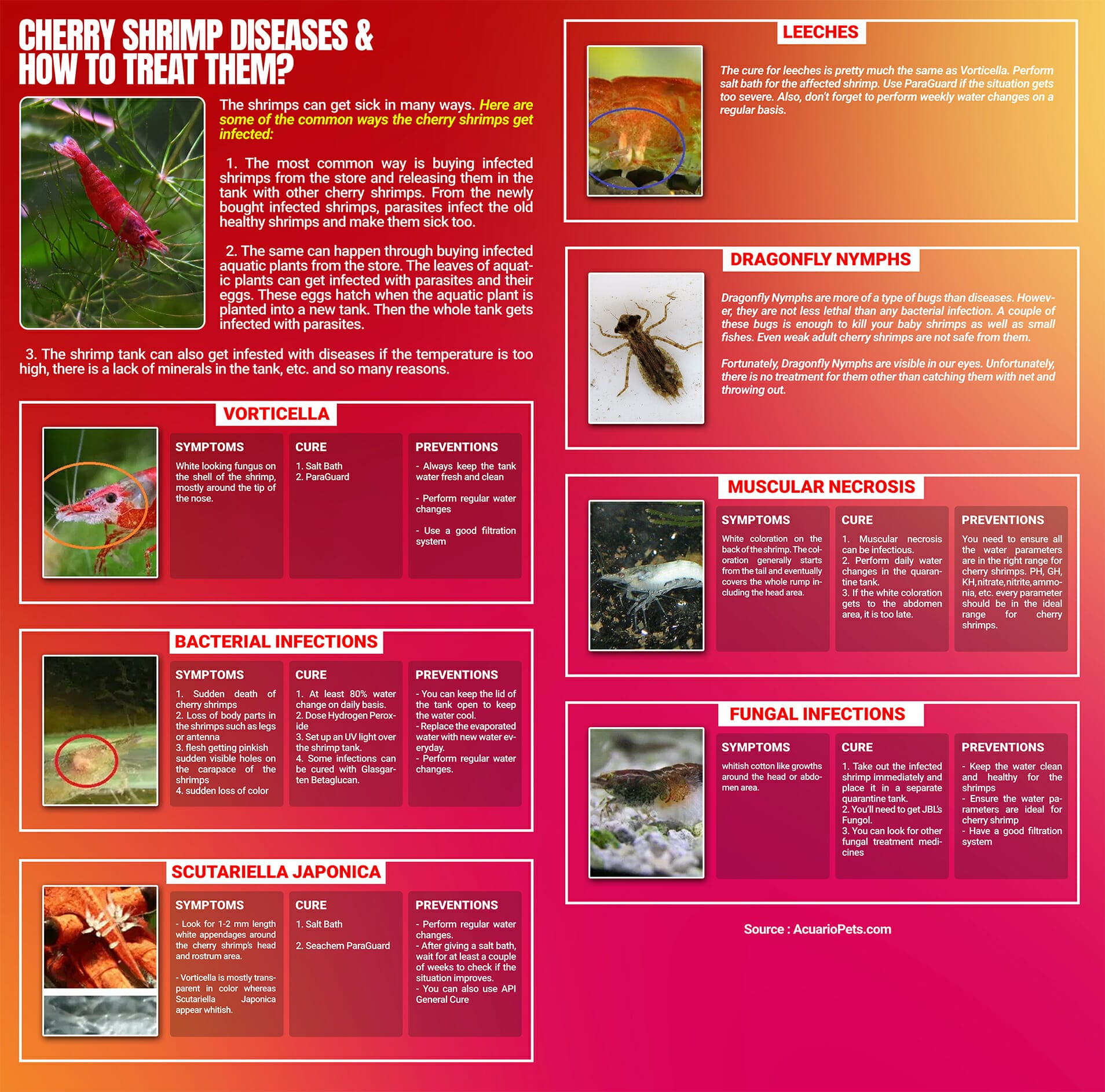
Want to get a printable version of this infographic? Click here! [If you want to use this infographic on your website, please link back to this post as the source!]
Frequently Asked Questions
Do shrimp molt when stressed?
Molting itself is normal and healthy, but stress can mess with the timing and cause failed molts.
Signs of trouble include the white ring around the body, lethargy, and lost color around molting time. If molts keep failing, check your GH and calcium first.
How can I tell if my shrimp are happy?
Happy shrimp are easy to spot.
They graze eagerly all over the tank, move around constantly, show bright color, and breed when they’re mature. Clear eyes, smooth shells, and active antennae are all good signs.
Why are my shrimp huddled in a corner?
Corner-huddling usually points to a water problem.
Common reasons are poor water quality, an ammonia or nitrite spike, a sudden temperature or pH change, or stress from predators and overcrowding. Test your water and add more hiding spots.
Why are my shrimp swimming around like crazy?
Frantic swimming is one of the clearest stress signs.
It’s often triggered by bad water parameters, copper, a temperature swing, or a rough water change. New shrimp exploring or mating behavior can also cause activity, but constant frantic swimming means check your water now.
Do water changes stress shrimp?
They can, if you do them wrong.
Big, sudden changes in temperature, pH, or hardness shock shrimp and can kill them. Done right, with small amounts of temperature-matched, dechlorinated water, regular changes actually keep shrimp healthier by removing waste.
What do stressed shrimp look like?
A stressed shrimp may look pale or washed out, hide more, swim erratically, hang at the surface, stop eating, struggle to molt, or stop breeding.
If you see several of these at once, treat it as a water-quality emergency until proven otherwise.
The Bottom Line
Stress signs are your early warning system.
A shrimp that’s fading, hiding, or swimming in a panic is telling you something is wrong before it becomes fatal.
Nine times out of ten, the answer is in the water. Test it, fix what’s off, and make your changes slow and steady.
Catch the signs early and you’ll keep your shrimp colorful, active, and breeding for a long time.
If random deaths or sickness are part of the picture too, our full guide to cherry shrimp diseases covers what to watch for, and if shrimp keep vanishing entirely, here’s why your cherry shrimp might be disappearing.
About Author
Hello, I’m Muntaseer Rahman, the owner of AcuarioPets.com. I’m passionate about aquarium pets like shrimps, snails, crabs, and crayfish. I’ve created this website to share my expertise and help you provide better care for these amazing pets.
Disclaimer
This site is owned and operated by Muntaseer Rahman. AcuarioPets.com is a participant in the Amazon Services LLC Associates Program, an affiliate advertising program designed to provide a means for sites to earn advertising fees by advertising and linking to Amazon.com. This site also participates in other affiliate programs and is compensated for referring traffic and business to these companies.