
This post was created with help from AI tools and carefully reviewed by a human (Muntaseer Rahman) . For more on how we use AI on this site, check out our Editorial Policy.
Check Out These FREE Tools We Made JUST For You!
Can Chameleons Live Together? The Truth About Cohabitation

So you’ve got one chameleon and you’re staring at that big enclosure thinking, “you know what would be cute? Two of them. They could be friends.”
Stop. Put the second chameleon back.
I’m not trying to be mean here. But this is one of those questions where the internet has flooded everyone with bad advice, cute Instagram videos, and pet store employees who’d rather sell you two animals than tell you the truth.
Here’s the truth: chameleons are solitary animals, and 99% of the time, housing them together is a slow-motion disaster. The kind where everything looks fine on the surface while one or both lizards quietly stress themselves into an early grave.
Let’s break down why, when the rare exceptions apply, and what to actually do if you already messed up.
The Short Answer: No, Chameleons Should Not Live Together
If you skim this post and read nothing else, read this part.
One chameleon per enclosure. Always. That’s the rule.
Every reputable chameleon keeper, breeder, and reptile vet says the same thing. Chameleon Academy, Dragon Strand, Canvas Chameleons, Reptiles Magazine, the actual chameleon forums where breeders hang out, they all agree. Solo housing is the standard.
The exceptions are so narrow and so rare that you should treat them like winning the lottery. Theoretically possible, basically never going to apply to you.
Why Chameleons Are Built to Live Alone
Let’s get into the biology, because this is where it clicks.
Chameleons are territorial, solitary, ambush predators. They evolved to sit very still on a branch, blend in, eat passing bugs, and aggressively chase off anything that looks like competition.
They are not pack animals. They are not social. They do not “get lonely.” That’s a human projection, not a chameleon emotion.
In the wild, chameleons stake out a tree or a section of canopy and defend it. When two males meet, they puff up, gape, flash bright colors, and try to murder each other. When a male meets a female, they breed (sometimes), and then she leaves. That’s it. That’s the whole social life.
Even in places where chameleons live in dense populations, like the Jackson’s chameleons that were introduced to Hawaii, they don’t actually hang out. They just happen to be in the same trees while maintaining strict personal space, like New Yorkers on a packed subway.
The Stress Killer Nobody Sees Coming

Here’s the part that catches people off guard. You put two chameleons in a cage. They don’t fight. There’s no biting, no posturing, no obvious drama.
You think it worked.
It didn’t.
Chronic stress is the silent killer in chameleon cohabitation. One chameleon has decided the enclosure belongs to it. The other one has accepted second-class citizenship and is now slowly losing the will to live.
Symptoms of a stressed-out chameleon include:
- Dark, dull colors that won’t go away (especially during the day under proper basking temps)
- Hiding constantly in the back of the cage
- Skipping meals or eating dramatically less than before
- Glass surfing along the screen of the enclosure
- Sleeping during the day with eyes closed
- Sunken eye turrets or eyes constantly closed
- Weight loss over weeks or months
By the time you notice these signs, the stressed chameleon has often already developed a respiratory infection, parasite bloom, or metabolic issue, because chronic stress tanks their immune system.
This is why “well, mine seem fine together” is the worst possible evidence. Chameleons are champion poker players. They will hide weakness until they collapse. If you want a deeper dive on this, check the 12 warning signs of a sick chameleon post, because half of those signs overlap with stress.
What About Two Females? Or a Male and Female?
Glad you asked, because the answer is still mostly no.
Two Females Together
Female chameleons are less openly aggressive than males, but they are still territorial.
They’ll do all the silent-bullying I described above. One female will dominate basking spots, food, water, and the best perches. The other female gets pushed around until her health crashes.
For veiled and panther chameleons, female-female cohabitation is not recommended. For the rare “social” species like Jackson’s, it’s still risky and not worth attempting unless you’re an experienced breeder running a controlled setup.
A Male and Female Together
This is where pet stores really mislead people. “Oh you can keep a breeding pair together!”
No. You really can’t. Not full-time.
Breeders introduce a male and female briefly, usually for a few hours up to 24 hours, just long enough to mate. Then they separate them immediately.
Why? Because once a female is gravid (carrying eggs), she gets aggressive toward the male. She’ll turn dark, hiss, and threaten him. Some males will keep trying to mount her anyway, which stresses her out, exhausts her, and can injure both animals.
Continuous male-female housing also leads to chronic over-breeding, which kills females. A female chameleon that breeds back-to-back depletes her calcium stores, develops MBD, and dies young. We’re talking lifespans cut in half. If you want the gory details on calcium crashes, the metabolic bone disease post covers what that actually looks like.
So even “breeding pairs” don’t live together. They cohabitate for a few hours during introduction, then go back to separate cages.
The Hatchling Exception (And When It Ends)
There is one window where multiple chameleons can share space: the first 3 to 4 months of life.
Hatchling chameleons can be raised in groups because their territorial instincts haven’t fully developed yet. Breeders raise clutches together for the first couple months, then start separating them as personalities emerge.
By 3 months old, you’ll start seeing dominance behavior. By 4 months, they need to be in separate enclosures. No exceptions.
If you bought “baby chameleons” from a breeder and they’re being kept together, ask how old they are and have a separation plan ready before you bring them home.
Mixing Species: Just Don’t
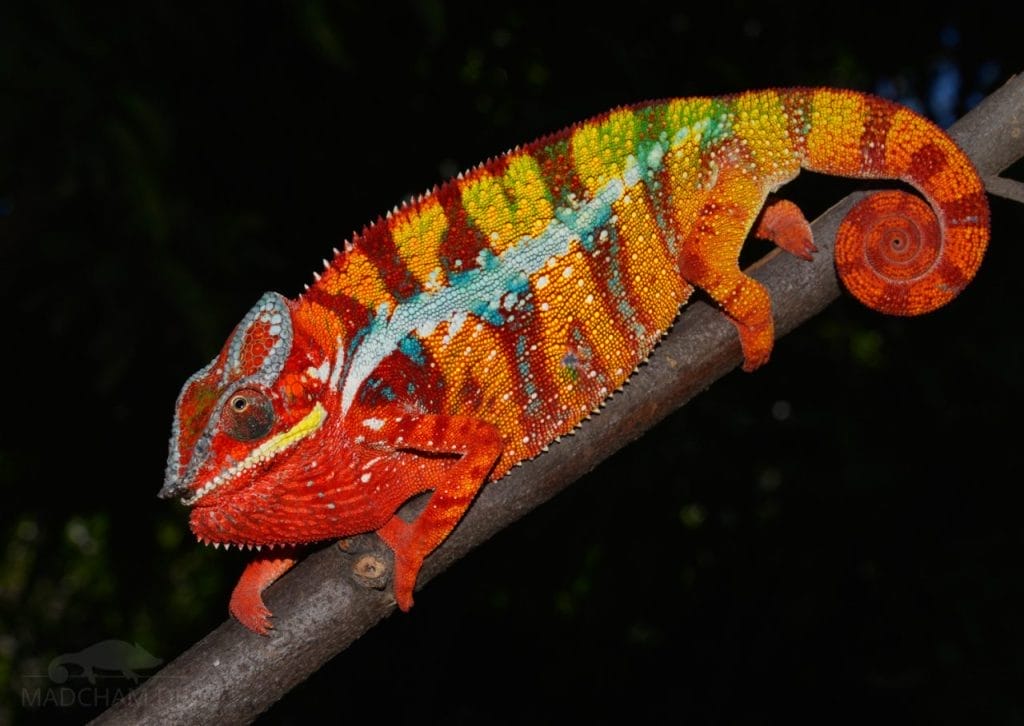
Sometimes people ask: “Can I put a Jackson’s chameleon with a panther chameleon? They’re different species, so they wouldn’t compete, right?”
Wrong. Wronger than wrong.
Mixing chameleon species is a triple disaster:
| Risk | Why It’s a Problem |
|---|---|
| Different husbandry needs | Jackson’s are cool/montane, panthers are warm/lowland. You can’t satisfy both at once. |
| Different humidity levels | Get one species’ humidity wrong and you cause respiratory infections fast. |
| Cross-species parasites | Chameleons from different regions carry different parasites with no shared immunity. |
| Behavior signals don’t match | A panther’s threat display might mean nothing to a Jackson’s, leading to surprise attacks. |
| Stress amplified | They don’t recognize each other as the same species, which adds to the threat perception. |
This applies to any reptile mixing, by the way. No frogs with chameleons. No anoles with chameleons. No “tank buddies.” Chameleons get the cage to themselves.
“But What About a Huge Enclosure?”
Yes, technically, in a giant enclosure with proper visual barriers, you can keep multiple chameleons in the same space. Some experienced keepers run rooms full of free-ranging chameleons with floor-to-ceiling plants and zero clear sightlines.
But here’s the catch.
A high tolerance for cage mates does not equal a need for cage mates. Chameleons get zero benefit from companionship. None. They aren’t happier. They aren’t healthier. They just tolerate it because they have enough escape routes.
For the average keeper with a 24x24x48 inch enclosure, this is not your situation. You’d need something closer to a walk-in greenhouse with multiple basking zones, multiple feeding stations, and visual barriers thick enough that one chameleon never sees the other.
If you have the space and money to build that, great. Just know that two chameleons in two separate enclosures will be just as happy and a lot easier to manage.
What to Do If You Already Have Two Together

Maybe you didn’t know. Maybe a pet store told you it was fine. Maybe you just inherited two chameleons and now they share a cage.
Here’s the action plan.
Step 1: Separate them today. Even a temporary tub setup is better than another night together. Just make sure each has UVB, a basking spot, and water access.
Step 2: Watch for stress signs. Both chameleons need to be evaluated for the symptoms I listed above. The “dominant” one might look fine and still have suppressed immunity.
Step 3: Vet check. If either chameleon shows weight loss, respiratory symptoms, sunken eyes, or off-color skin that doesn’t bounce back, get to a reptile vet. Don’t wait.
Step 4: Build the second proper enclosure. Same size, same lighting, same setup as the first. The chameleon cage setup guide walks through the basics, and the size requirements per species post has the minimums for veileds, panthers, Jackson’s, and more.
Step 5: Don’t beat yourself up. A lot of people make this mistake because the bad advice is everywhere. The win is fixing it now, not pretending it never happened.
Quick Reference: What Goes With What
| Combination | Verdict |
|---|---|
| Two adult males (any species) | Never |
| Two adult females (any species) | Almost never |
| Adult male + adult female | Only briefly for breeding |
| Hatchlings under 3 months | Okay, with a separation deadline |
| Hatchlings 4 months and older | Separate immediately |
| Different species together | Never |
| Chameleon + frog/anole/gecko | Never |
| Chameleon + chameleon in a “giant” enclosure | Technically possible, rarely worth it |
The Bottom Line
Chameleons are not lonely. They are not sad to be alone. They are biologically optimized to want one tree, one basking spot, and zero roommates.
When you give them that, they thrive. When you don’t, they hide it until they crash. That’s not a chameleon being “fine,” that’s a chameleon being a stoic prey animal doing what evolution programmed it to do.
If you want two chameleons, get two enclosures. Yes, it’s more money. Yes, it’s more space. But you’ll have two healthy, brightly colored, long-lived lizards instead of two slowly dying ones.
For new keepers thinking about a first chameleon, take a minute to read the biggest mistakes new owners make. Cohabitating is right near the top of that list.
Now go set up that second cage. Your chameleon will thank you by living a long, dramatic, color-changing life.

About Author
Hello, I’m Muntaseer Rahman, the owner of AcuarioPets.com. I’m passionate about aquarium pets like shrimps, snails, crabs, and crayfish. I’ve created this website to share my expertise and help you provide better care for these amazing pets.
Disclaimer
This site is owned and operated by Muntaseer Rahman. AcuarioPets.com is a participant in the Amazon Services LLC Associates Program, an affiliate advertising program designed to provide a means for sites to earn advertising fees by advertising and linking to Amazon.com. This site also participates in other affiliate programs and is compensated for referring traffic and business to these companies.